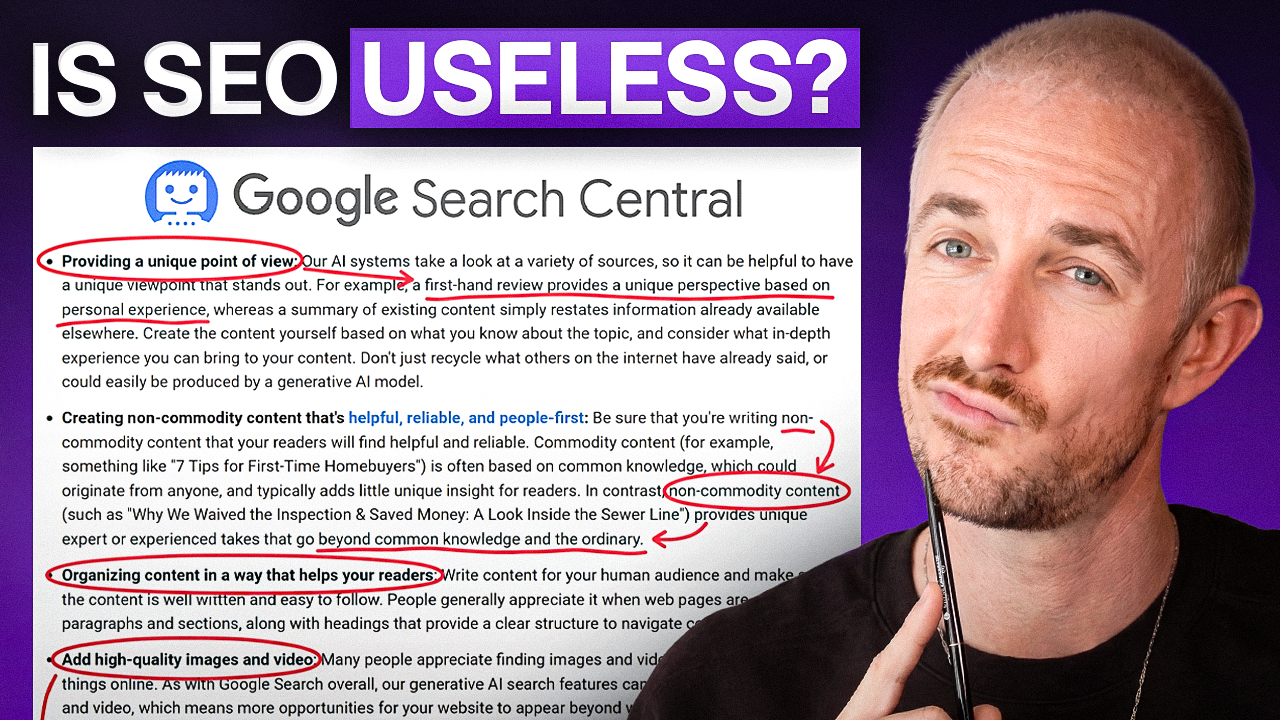
Well, Google’s AEO guidelines have finally dropped, and they’ve said it plainly. The same SEO best practices still apply for Google’s generative AI experience. That matters because a lot of advice around AEO, GEO (Generative Engine Optimization), and AI search strategies has been sold as if the Search Generative Experience suddenly changed every rule overnight.
I’ve worked in SEO for more than a decade. I’ve seen what happens when search behavior shifts faster than the industry talking points. Most of the time, the fundamentals don’t disappear. They just get repackaged.
That’s why the new Google Search Central guidance is worth paying attention to. It cuts through the noise and shows what actually protects your organic traffic.
At its core, the message is simple: the format of search is changing. But the pages that win still earn visibility the old-fashioned way. In the era of AI-led search, the foundations of SEO matter more than ever. Watch my full breakdown with commentary and practical advice on how to implement Google’s AEO guidelines:
Key Takeaways of Google’s AEO Guidelines (SEO for Generative AI)
- Google’s generative AI features still rely on the same core ranking and quality systems behind regular search.
- AI Overviews pull from live pages in the Google index, so your site must stay crawlable, indexable, and authoritative.
- Search journeys now branch into multiple related queries, which makes topical authority and depth more effective than thin pages.
- Generic, easy to copy content is losing ground. Pages with first-hand proof, real examples, and original media have a better shot at being cited.
- You do not need AEO tricks or scaled long-tail pages. The pages that win still come from real experience, clear structure, and a technically sound site.
Search may look different on the surface, but the work that earns trust still comes from the page itself.
How Google’s Generative AI Search Really Works
In Google’s generative AI search guide, one idea keeps coming up: its AI features are built on top of existing search systems. That sentence does a lot of work because it reframes how people think about AI visibility.
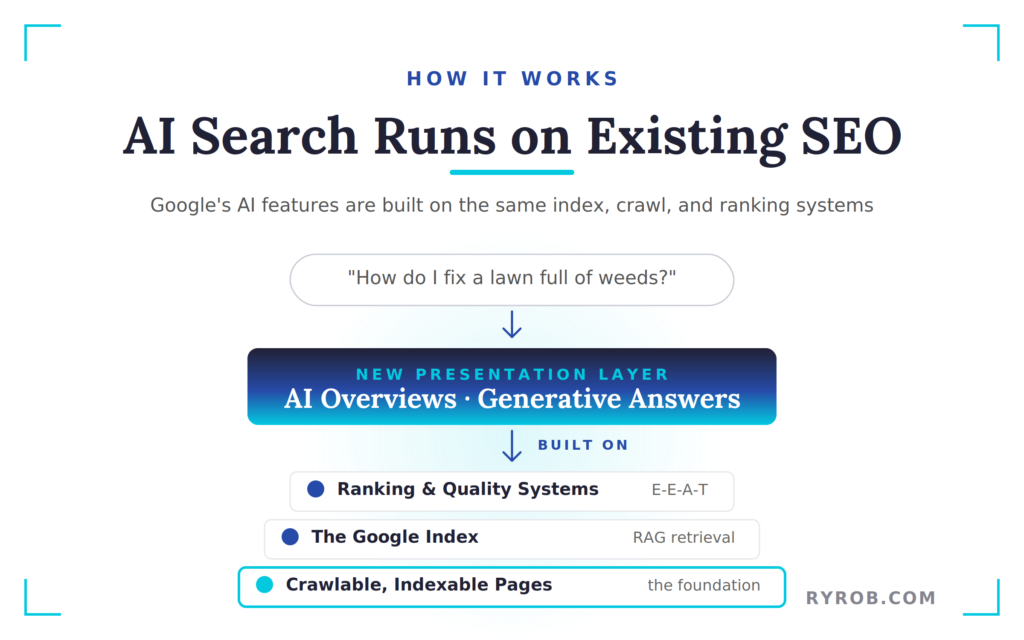
AI search is not a separate system where old ranking signals disappear. Google is still pulling from the web it has already crawled, indexed, and evaluated, just presenting the answers in a different format.
That also explains why so much new advice around AI visibility feels recycled. The labels changed, but the source is still the same web pages, ranking systems, and quality standards.
Retrieval-Augmented Generation (RAG) Still Pulls From Google’s Index
A lot of people talk about AI answers as if the model makes them up from memory. That is only part of the picture. Within the broader Search Generative Experience ecosystem, Google relies heavily on Retrieval-Augmented Generation or RAG.
The basic idea is simple. When Google needs a current answer, it can pull live pages from its index and use those pages to support the response provided by Large Language Models.
If your page is not indexed, or if it is not strong enough to surface, it has a much smaller chance of becoming part of that answer.
That is why old-school search basics still matter so much. If a page cannot appear in normal search, it will not magically skip the line and show up in AI Overviews. The page must exist in Google’s view of the web, and it must earn trust.
For publishers, the takeaway is practical. Build pages that are worth retrieving. A thin page with vague claims gives Google very little to work with. A page with clear structure, real examples, and evidence gives Google much more.
Query Expansion and Content Clustering
Google also explains query expansion, and this matters more than it may seem at first. One user question can trigger several related searches behind the scenes.
A search like “how do I fix a lawn full of weeds” might branch into questions about herbicides, prevention, timing, soil health, and lawn repair. Google uses query expansion to gather pages across that wider cluster and build an answer from several angles.
This is where effective content clustering comes into play. By organizing your site around topical hubs, you demonstrate deep expertise that helps establish your brand authority. That does not mean you should create a separate article for every tiny variation.
In fact, Google warns against doing that when the goal is to manipulate rankings or AI responses. That is where people get in trouble with scaled content abuse.
The smart move is to cover the topic with enough depth that your page can satisfy more than one related need. If you need help mapping those related searches without turning your site into a pile of thin pages, this free keyword research workflow is a much better path.
The better approach is depth. A strong page can answer the main question and support related ones naturally, without feeling forced.
Why the AEO Versus SEO Debate Is Mostly Settled
Google’s position here is direct: optimizing for generative AI search is still optimizing for search. That makes the AEO versus SEO debate much less complicated.
AEO can still be a useful label when talking about visibility inside AI answers. But in practice, Google treats it as part of SEO, not a replacement for it.
This is where a lot of the confusion comes from. Some have positioned AEO as a completely new discipline, when Google’s guidance points back to the same core principles.
That does not mean nothing changed. The shift is in content quality, usefulness, and how clearly your page helps support an answer.
The format evolved, but the foundation stayed the same.
What Google Means by Non-Commodity Content
This is the center of the whole guide.
Google draws a clear line between commodity content and non-commodity content. Commodity content is interchangeable, generic, and easy for anyone to produce.
You see it everywhere:
- “7 tips for first-time homebuyers”
- “10 ways to lose belly fat”
- “best productivity hacks for entrepreneurs”
None of these topics are bad, but thousands of pages repeat the same ideas in almost the same way.
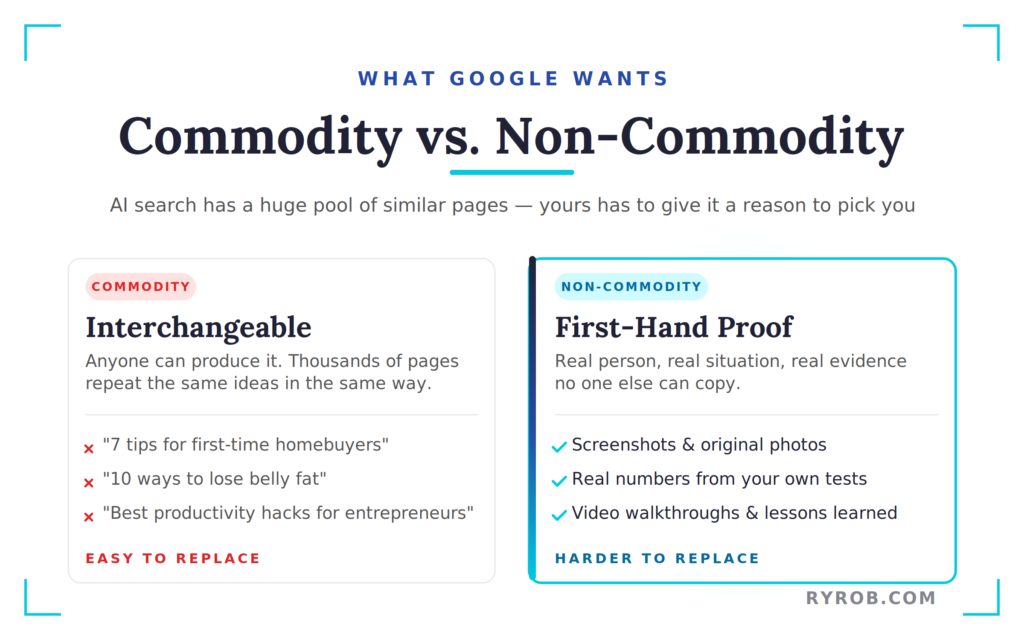
Non-commodity content feels different right away. It has a real person behind it, a real situation, and proof that comes from experience. Instead of another generic home-buying tips article, imagine a post about a real offer on a real house, including the inspection tradeoff that saved money and the surprise issue found in an old sewer line.
That kind of page has texture, stakes, and details another writer cannot copy without living it. By prioritizing these specifics, you align with EEAT principles and build authority through authentic, helpful content.
AI search raises the bar because it has a large pool of similar pages to choose from. If your page blends in, there is no strong reason to use it.
If your page includes screenshots, photos, numbers, examples, lessons learned, or a video walkthrough, it becomes much easier to justify as a source. These elements give Google something concrete to reference.
If your page could be written without doing the work, seeing the result, or learning the lesson, it is likely too replaceable to stand out in AI search.
This is also where original video matters more than most people think. As search moves toward multimodal AI, the ability to process and understand video alongside text becomes more important.
A useful video paired with a strong write-up gives you original proof assets that generic blog posts do not have. That combination makes your content harder to replace.
For bloggers and creators, this is a shift in priority. Do not start with “what keyword can I target?” Start with “what can I show that other pages cannot?” By focusing on unique value, you strengthen your digital presence and make your content more likely to be used in AI-driven results.
The Technical Basics That Still Matter Most
Google’s technical advice in this guide stays grounded in a familiar technical SEO structure. Because these foundations are already well-established, they are still the most reliable way to ensure your content is ready for the future of search.
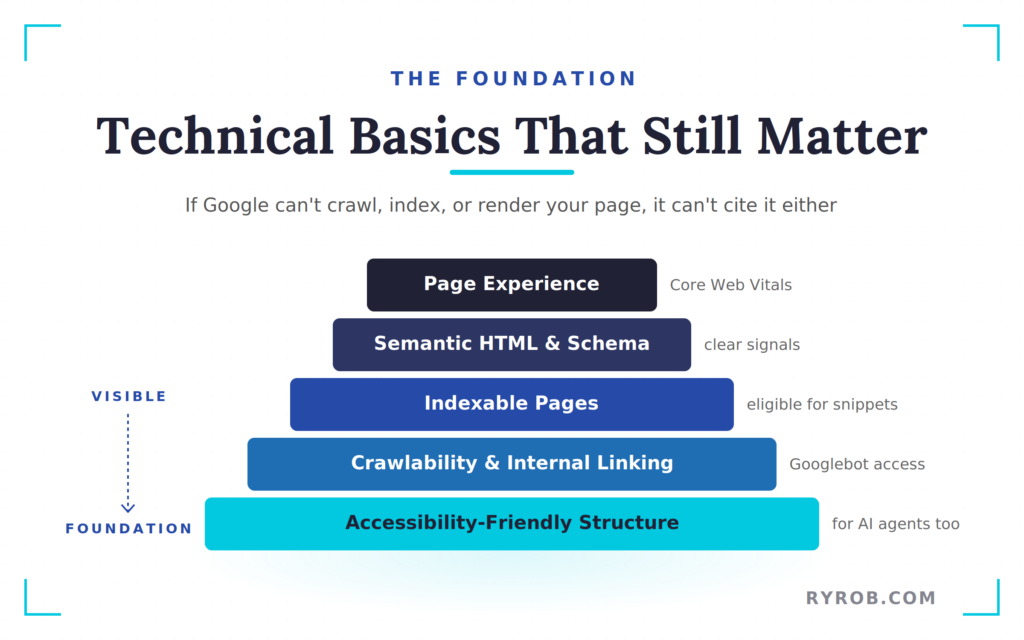
At a high level, these fundamentals still matter most:
- Indexable pages and eligibility for search snippets
- Crawlability and Googlebot access
- Semantic HTML, structured data, and schema markup
- Page experience and Core Web Vitals
- Accessibility-friendly structure
First, pages must be indexable and eligible for search snippets. If Google cannot include your page in standard search results, it cannot use that page in AI-driven features either. This sounds basic, yet many sites still hinder performance by burying valuable information behind blocks that make crawling unnecessarily difficult.
Next is crawlability. If you want a specific section of your site cited by an AI, you must ensure that Googlebot can access it, which means avoiding accidental blocks, messy rendering, and complex setups that hide your content. Internal linking also helps bots navigate your site and ensures that your most relevant pages remain discoverable.
When it comes to formatting, Google emphasizes the value of semantic HTML. You do not need perfect, error-free code, but you do need a clear structure with proper headings and page sections. Structured data and schema markup provide explicit signals that help search engines understand the context of your information.
Page experience also remains a top priority. Your site should be mobile-friendly and fast, since a positive user experience keeps readers engaged. Core Web Vitals should stay on your regular maintenance checklist because they support stability and usability.
Google also highlights how AI agents interact with your content, pointing toward accessibility-friendly structure. Writing clean code that works well with screen readers also helps automated browsing tools parse your information more accurately.
For most creators, this is not a reason to panic or rebuild your site from scratch. These steps are simply an extension of existing best practices designed to keep your site optimized as search continues to evolve.
The AI SEO Myths Google Says You Can Stop Worrying About
This part of the guide is the most satisfying because Google directly addresses some of the loudest claims in the market.
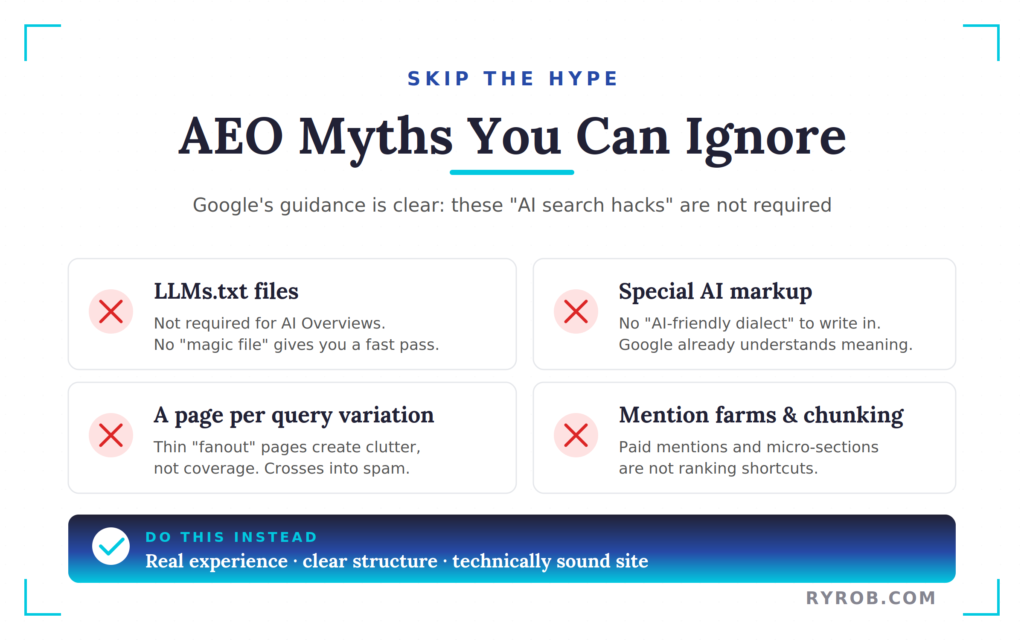
A lot of people have repackaged ordinary search advice into Generative Engine Optimization, or AEO, and sold it at a premium. Google’s message is clear: many of those add-ons are optional, and some are a waste of time.
You Do Not Need LLMs.txt Files or Special AI Markup
If someone is trying to sell you a magic file for AI visibility, slow down.
Google says you do not need new machine-readable files, special AI text markup, or markdown tricks to appear in AI Overviews. That directly cuts through a lot of unnecessary complexity.
You do not need an LLMs.txt file as a fast pass into search results. If it helps your internal Large Language Models workflow, that is fine, but Google does not require it for visibility.
You Do Not Need to Rewrite Content for Every Possible Query Variation
Google also pushes back on the idea that you need to rewrite content in some AI-friendly dialect.
Its systems already understand meaning, synonyms, and related phrasing, so you do not need dozens of slightly different versions of the same paragraph. You also do not need a separate page for every minor long-tail variation.
That kind of content inflation creates clutter instead of coverage. It weakens your site and can cross into spam when the goal is to game rankings rather than help users.
If your page answers the main problem clearly, covers key subtopics, and includes real evidence, Google can do the rest.
Schema, Chunking, and Mention Farms Are Not Magic Fixes
Schema markup still has a place. If you are publishing recipes, products, or articles, keep using the correct tags, but it is not a hidden AEO shortcut.
The same applies to content chunking. Clear structure helps, but slicing content into micro-sections is not a ranking trick and does not automatically improve AI-readability.
Fake authority building also does not hold up. Paying for random mentions, dropping links into irrelevant threads, or using mention farms may look like traction, but Google’s spam systems are built to catch it.
Tools still have value when they support research, outlining, and editing. These best AI tools to optimize search content can save time, but they cannot turn weak ideas into helpful content that people actually want to cite.
A Practical Workflow for Creating Content That Can Rank in AI Search
This is where the guide becomes useful in daily work. The biggest shift is not what you do while formatting a page, but what you decide before the page exists.
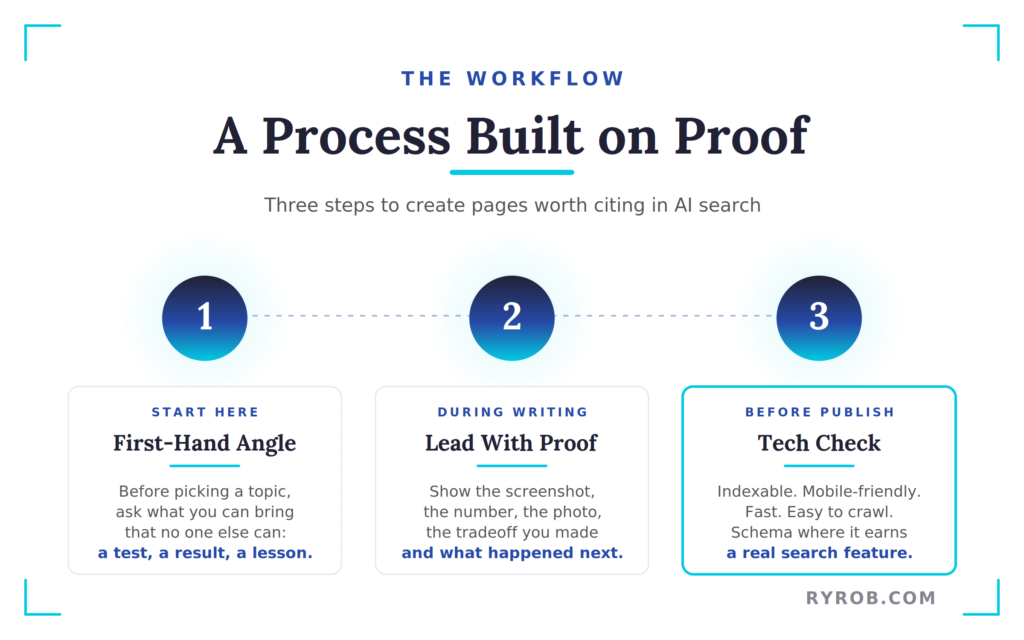
A better workflow starts earlier, asks tougher questions, and puts proof at the center.
1. Start With First-Hand Experience Before You Pick the Topic
Before you write a word, ask what first-hand angle you can bring that another site cannot. This is essential for building topical authority in your niche, and it can come from a project you ran, a test you completed, a failure you learned from, or a client result you can show.
A simple filter helps here: if you could produce the piece without doing the thing, living it, or observing the result up close, it is probably not strong enough. That shift also changes how you plan topics, moving you away from isolated keywords and toward real experiences mapped to search demand.
By organizing these experiences into content hubs and using internal linking, you help search engines understand the depth of your expertise. Understanding entity mapping also clarifies how Google connects your topics to broader industry themes.
2. Build the Page Around Proof, Not Fluff
Once you choose the topic, lead with evidence. Use the screenshot, show the number, include the photo, quote the email, and explain the tradeoff you made and what happened next.
These details turn a generic article into a useful page and give your content something real that AI systems can reference. The same applies to video, where a strong walkthrough or demo on YouTube, paired with written context, adds original proof that generic pages lack.
Write in a natural voice and use headings so the page is easy to scan, but avoid forcing it into an artificial AI format. If it reads like a clear explanation you would give to a friend, you are on the right track.
3. Check Technical Basics Before You Publish
Technical review still belongs at the end, but it should stay in its lane. Before publishing, make sure your technical SEO structure is sound by checking that the page is indexable, mobile-friendly, fast enough, and easy to crawl.
Use schema when it helps the page earn the right search features, and skip it when it is only being added for a perceived AI boost. Then read the introduction again and ask if it sets a clear expectation that the page will deliver real value.
If the answer is yes, publish it. If not, the issue is rarely a missing AI tag, but that the content still feels generic.
FAQs About SEO for Generative AI
Below are additional questions you might be curious about.
Is SEO Still Relevant for Generative AI Search?
Yes, SEO is still relevant for generative AI search. Google’s position is clear on this point, as its generative AI features still depend on core search ranking and quality systems, making traditional SEO the base layer for success in an era increasingly defined by conversational search.
Do I Need an LLMs.txt File to Show Up in AI Results?
No, you do not need an LLMs.txt file to show up in AI results. Google says you do not need special machine-readable files or new AI markup just to appear in generative AI search features.
Should I Create a Separate Page for Every Fanout Query?
No, you should not create a separate page for every fanout query. Cover the topic well enough that your page can support related questions naturally, and focus on semantic clarity to address various user intents without mass-producing thin pages that can hurt your site’s authority.
What Type of Content Has the Best Chance of Being Cited?
Content that demonstrates strong EEAT principles has the best chance of being cited. First-hand experience, original evidence, and clear structure, along with screenshots, real numbers, original photos, video, and honest analysis, make a page much harder for AI systems to replace.
Will Zero-Click Search Impact My Visibility?
Yes, zero-click search can impact your visibility, but it is not entirely new. Generative AI may change how users interact with results, so focus on becoming the primary source of truth for your topic, where unique value encourages users to click through for full context.
Do I Need to Optimize for AI Agents Right Now?
No, most sites do not need to optimize for AI agents right now. Clean structure, accessibility, semantic HTML, and good page experience already put you in a strong position, and incorporating real-time monitoring helps keep your content relevant as AI systems evolve.
Final Thoughts on SEO for Generative AI Search
Google did not kill optimization for AI answers. It simply removed the idea that you need a separate bag of tricks to compete there, and instead points back to the fundamentals behind Generative Engine Optimization.
The pages most likely to win in AI search are still the ones that earn trust through original content, clean structure, and consistent application of EEAT principles. By keeping your site easy for Google to crawl and full of unique value, you protect your organic traffic and build a resilient digital presence.
Search may look different on the surface, but the work that matters still comes from creating high-quality, authoritative content that others cannot easily copy.
Disclaimer: This story is auto-aggregated by a computer program and has not been created or edited by budgetbuddy.
Publisher: Source link
Publisher: Source link