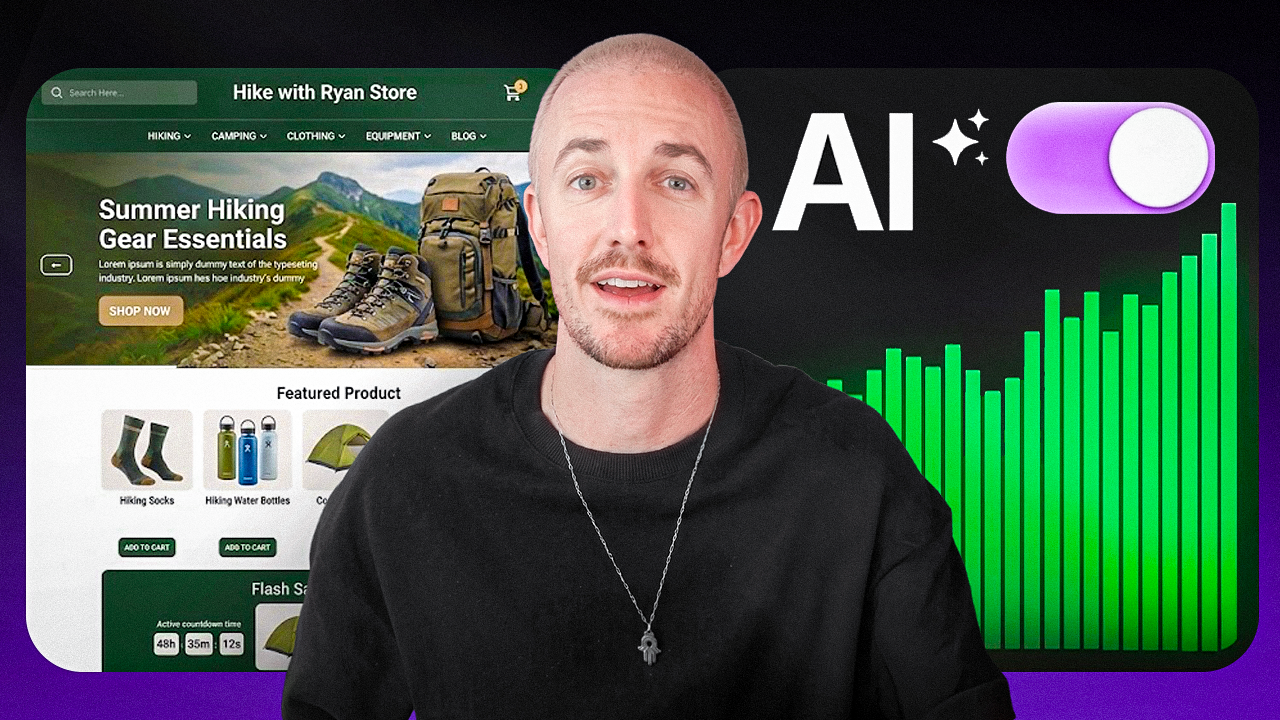
I wanted to test something… can you learn how to start a dropshipping store with AI and get a real store live before dinner, without buying inventory, touching a single box, or losing two weeks to supplier spreadsheets?
I decided to actually run this experiment, building a working outdoor dropshipping store from a blank screen while modern ecommerce AI tools handled most of the tedious setup.
The result was a live Shopify store, nine products ready to buy, connected inventory, and a real test order that went through.
Affiliate disclosure: This post is sponsored by Doba and includes affiliate links. Join through my link and you’ll get 10% off your first purchase. I may earn a small commission at no extra cost to you, and it helps keep the content here free.
Key Takeaways for How to Start a Dropshipping Store With AI
- Pick products with real research. Base the choice on demand, competition, returns, and margin, not only because they seem fun to sell.
- Vet suppliers carefully. Filter dropshipping suppliers for fast shipping, reliable fulfillment, and domestic warehouse options when your customers are in the US.
- Do the full profit math. Calculate profit margins after product cost, shipping, advertising, payment processing, and platform fees.
- Review every AI listing. AI gets you close, but it doesn’t know your customer as well as you do, so check each one before it goes live.
- A fast setup isn’t a finished business. Traffic, trust, marketing, and customer support are still your job.
Want to Build the Same Store? Start With Doba
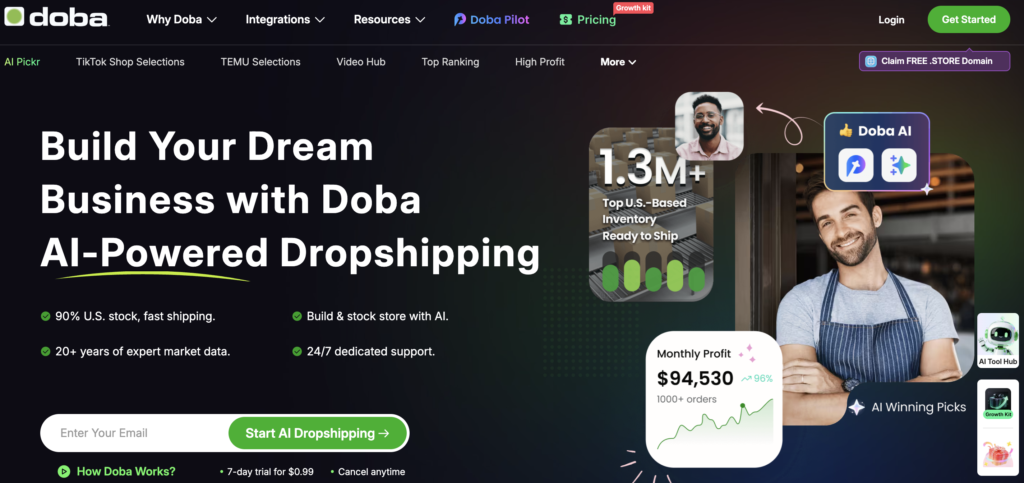
I’ll be honest, the part of dropshipping I always dreaded was finding suppliers I could trust, and that’s exactly where Doba earned its spot in this build. The real-time inventory sync is the quiet hero, since it stops you from selling something that’s already out of stock. Use my link and enjoy 10% off your first purchase👇
Does Dropshipping Still Work in 2026?
Dropshipping is a retail model where you sell products through your own store, while a third-party supplier stores, packs, and ships each order to the customer. You don’t buy a garage full of products before you make your first sale.
That low upfront cost is the appeal. You can test an online business without tying up thousands of dollars in inventory. Though you also give up some control over product quality, fulfillment, packaging, and shipping speed.
I’ve had enough experience with physical products to know where this gets messy. When I was trying to source a product years ago, half the dropshipping suppliers I contacted never responded. A few couldn’t communicate well enough to work through product details, and supplier research can burn weeks before you even have something to sell.
That’s why the supplier side matters so much. A fast-looking storefront can’t save a business with late shipments, poor-quality products, and customer support refund requests piling up in the inbox.
Dropshipping still works when you treat it like a real online business. That means finding a useful product, choosing suppliers carefully, building a credible store, and putting real work into getting the right people to it.
If you’re comparing other low-cost models, these ways to make money online can give you a broader view of what’s worth testing.
A dropshipping store is not a passive-income button. It’s a margin-based business where your paid advertising and profit margins decide whether the numbers work.
The market itself isn’t the issue. Plenty of people still buy products online, so the hard part is creating an offer that earns the click, gets the sale, and leaves enough margin after the costs hit. Generative AI can speed up the building, but it can’t manufacture that demand for you.
The Old Way vs. the AI Way
The old version of starting a dropshipping store was a bit of a circus.
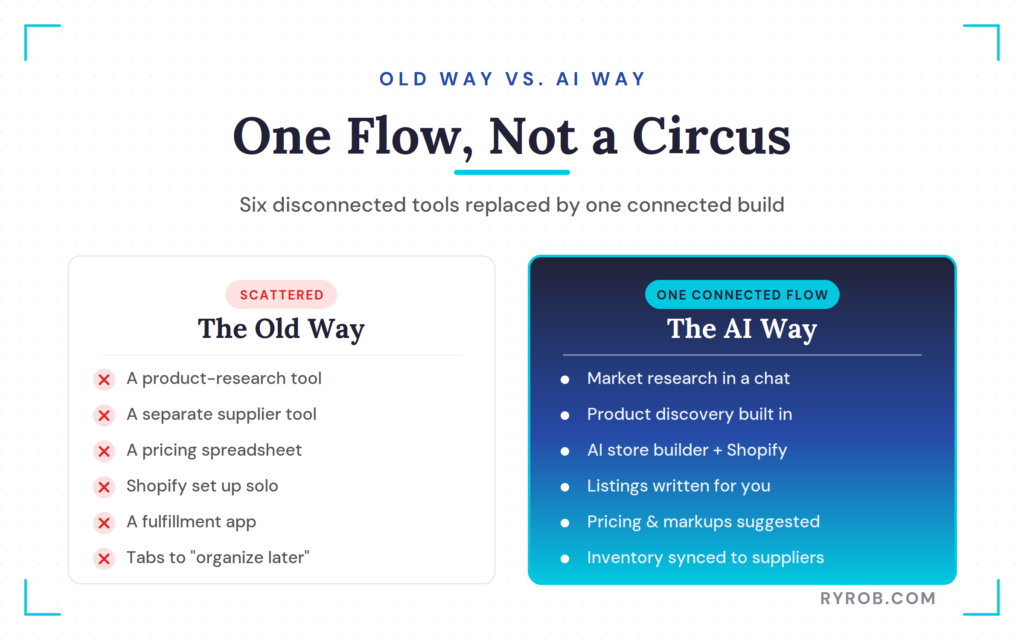
You would use one tool for product research, another for suppliers, a spreadsheet to track pricing, Shopify for the store, an app for fulfillment, and a pile of browser tabs you would swear you would organize later. Somewhere in that process, a lot of people gave up.
The AI-assisted version brings much of that work into one connected workflow. In this build, Doba Pilot acted as an end-to-end AI dropshipping agent, supporting the process from market research and product sourcing to Shopify store creation, product listing, pricing setup, inventory connection, and order workflow preparation.
Within Doba Pilot, its Market Scout capability helped evaluate the niche and identify product opportunities, while its AI store-building and listing capabilities helped create the Shopify store, prepare product pages, configure initial pricing, and publish the selected products.
The question wasn’t whether a Shopify store builder could create a perfect site. It cannot. The real question was whether it could get a complete store setup from a blank screen to something live and sellable in one sitting.
The answer was yes, with a few important caveats. AI removed the repetitive work, but it didn’t remove the need to make decisions.
Step 1: Find a Product With AI, Not Gut Feelings
The niche for this store was outdoor gear, with an early focus on camping and hiking-related products. Instead of starting with “what would be cool to sell?”, the first move was to pressure-test the niche with product research.
Doba Pilot’s Market Scout surfaced categories including camping grills, cooler accessories, camping stoves, hand warmers, bear protection, survival kits, and more. For each category, it showed information like available products, seller counts, monthly revenue activity, ratings, search-to-purchase conversion, and return rates.
That gives you something much better than a hunch.
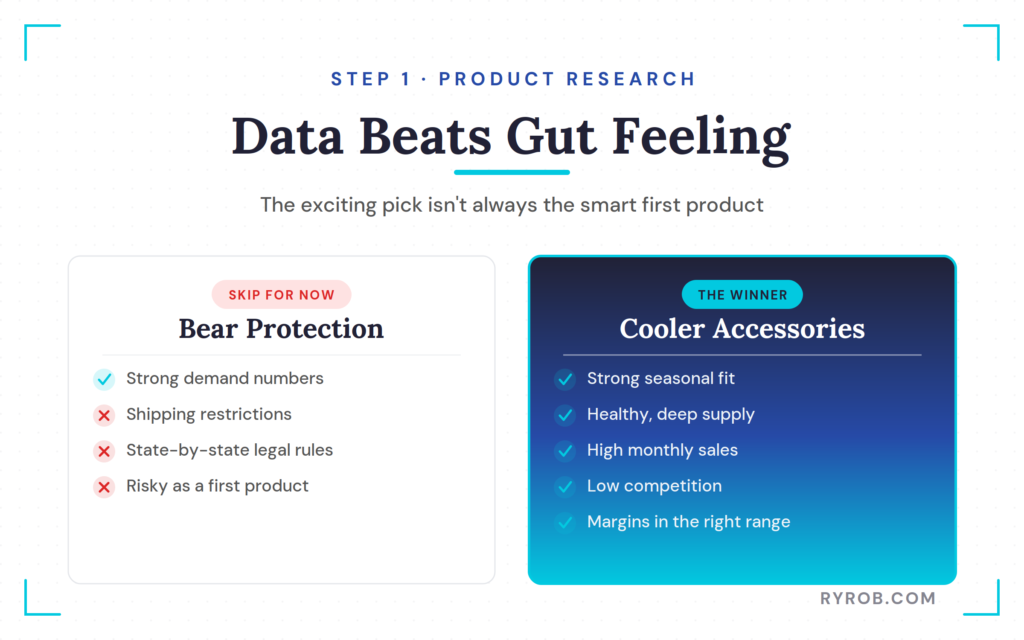
For example, competitor research and the analysis of current sales trends showed that bear protection products had stronger numbers than survival kits in the initial comparison. That might sound like the obvious winner, especially during hiking season. But bear spray can face shipping restrictions and state-by-state rules, which makes it a more complicated first product.
So the store went in a different direction, cooler accessories.
At first, that category felt less exciting. Then the numbers made the choice clearer, since cooler accessories had strong seasonal fit for summer, healthy supply, high monthly sales activity, solid product ratings, lower competition than some alternatives, and margins in the right range.
That is the kind of decision you want to make early. Don’t build a store around the product that sounds most interesting at dinner. Build it around winning products that have demand, room for profit, and fewer headaches.
Prompts to run your own product research:
Want to try the same research approach? Paste prompts like these into your AI product-research tool to get started.
- “Show me the best-selling product categories in the [your niche] niche right now, with monthly revenue, competition, and return rates for each.”
- “Compare [product A] and [product B] on demand, profit margin, conversion rate, and return rate, and tell me which is the safer first product.”
- “Find products under $[X] in the [your niche] niche with strong margins and low shipping or legal complications.”
What to Look for Before Adding a Product
Before you bring a winning product into your store, look at more than the selling price. A little competitor research and a look at recent sales trends will tell you whether demand is climbing or already fading.
Ask yourself a few direct questions.
- Is there enough demand right now, or am I betting on a trend that has already passed?
- Are there enough suppliers and products to avoid depending on one shaky listing?
- What does the conversion rate suggest about buyer intent?
- Are return rates high enough to eat into margin?
- Will the product create legal, shipping, or customer-expectation problems?
For this build, thorough product research took minutes instead of weeks. That doesn’t mean research no longer matters. It means you can get to the useful part faster.
If you want to gauge real demand before committing, a little keyword research can show you what people are actually searching for.
Step 2: Source Products From Suppliers You Can Trust
This is where a lot of first-time dropshippers get burned.
A cheap product from an unreliable supplier isn’t a bargain. It’s a future refund, a bad review, and an angry customer asking where their order is three weeks after they paid you.
Platforms like Doba give access to more than a million products through a vetted supplier network. In the build, a large share of available products showed US warehouse options, which is a big deal for a US-focused store. Domestic fulfillment can cut shipping time and remove a lot of mystery from the customer experience.
Doba Pilot then carried the research into product sourcing. The initial search for ice coolers and accessories returned a broad set of products, which Pilot refined to “portable ice packs for outdoor use” to surface more relevant options.
That’s a strange product in a good way. Someone searching for a head ice pack likely has a clear problem and strong buying intent, and those are often better customers than people casually browsing generic products.
Check Supplier Speed and Reliability First
When comparing dropshipping suppliers, pricing matters, but it’s not the only thing you should look at.
The two big questions are simple. How fast do they ship, and how reliably do they fulfill orders?
In this build, a supplier that had been on the platform for three years with a 99.66% fulfillment rate stood out. Strong fulfillment data doesn’t make a supplier perfect, but it gives you a better starting point than guessing based on a product photo.
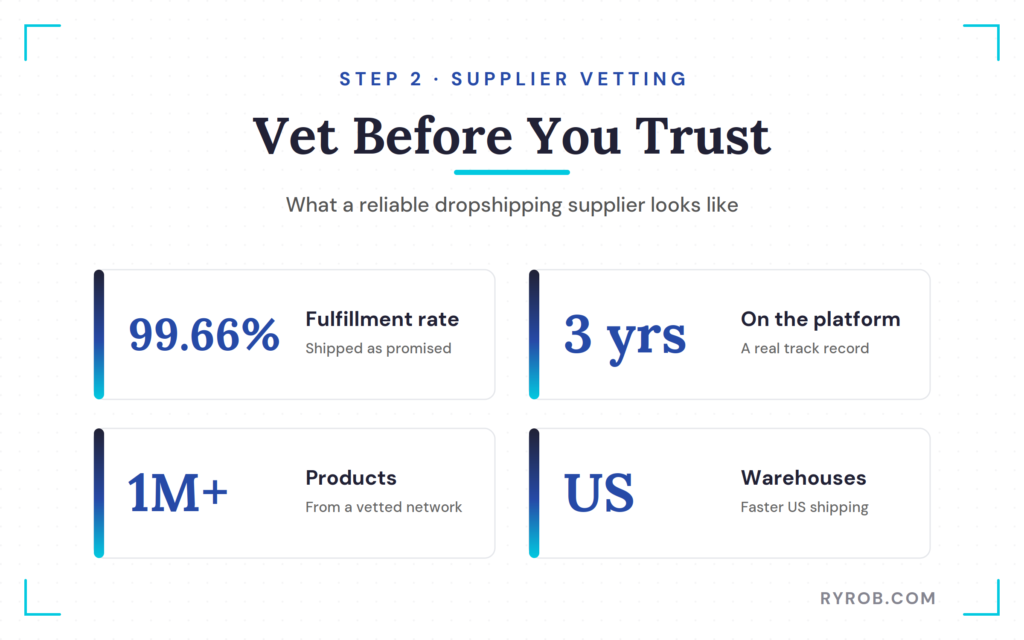
Look for suppliers with strong track records.
- Strong fulfillment performance
- A meaningful history on the platform
- Good seller ratings
- Clear shipping details
- US warehouse options for US customers
The goal is to stay out of the cheap, slow, flaky corner of the market. That’s where customer support becomes your full-time job and drains the momentum of your online business.
For a different spin on selling physical products without stocking a warehouse, check out this guide to starting a phone case business. The product is different, but the core question is the same. Can you make enough margin while delivering something people want?
Steps 3 and 4: Build the Store and Generate Listings
Once the products were selected, the store setup and listing process started to blend together.
Doba Pilot’s AI store-building capability connected the workflow with Shopify. The store setup involved selecting the outdoor niche, choosing a color theme, picking a banner template, creating a Shopify trial store, and installing the Doba app inside Shopify.
After the connection was authorized, the new store was ready to receive its first nine products.
The store was called Hike With Ryan Outdoors, and if you’re stuck on what to name yours, a domain name generator can shake loose a few ideas. Doba Pilot then continued the workflow by generating initial product titles and descriptions, configuring the starting prices, and preparing the selected products for Shopify. The pricing strategy used Doba’s suggested default multiplier to get started, with room to adjust later.
Within about four minutes, all nine products were listed in Shopify, and the AI dropshipping store was ready to take orders.
That’s the part that would’ve taken me hours in the old workflow. Writing marketing copy, formatting listings, setting basic prices, moving images around, and repeating the same process nine times isn’t difficult. It’s just tedious enough to make you lose momentum.
AI Listings Need a Human Review
The AI-written marketing copy in the product descriptions gave me solid starting points, but they weren’t perfect. That’s normal.
Before you publish a listing created by generative AI or a Shopify store builder, review the details that can hurt your store if they’re wrong.
- Product dimensions, materials, and compatibility
- Shipping expectations
- Medical, safety, or performance claims
- Product titles that sound awkward or generic
- Brand voice and customer-facing language
AI can get you 80% of the way there fast. The final 20% is where you make the listing accurate, useful, and worth trusting.
Does a Dropshipping Store Actually Make Money?
This is the part that gets skipped in too many dropshipping videos.
The real profit per order isn’t your selling price minus the supplier’s product cost. That’s the fake version of the math, and it’ll get you in trouble fast.
Your real calculation looks like this.
Selling price – supplier cost – shipping – ad cost – platform fees – payment processing fees = profit per order
Every one of those expenses matters.
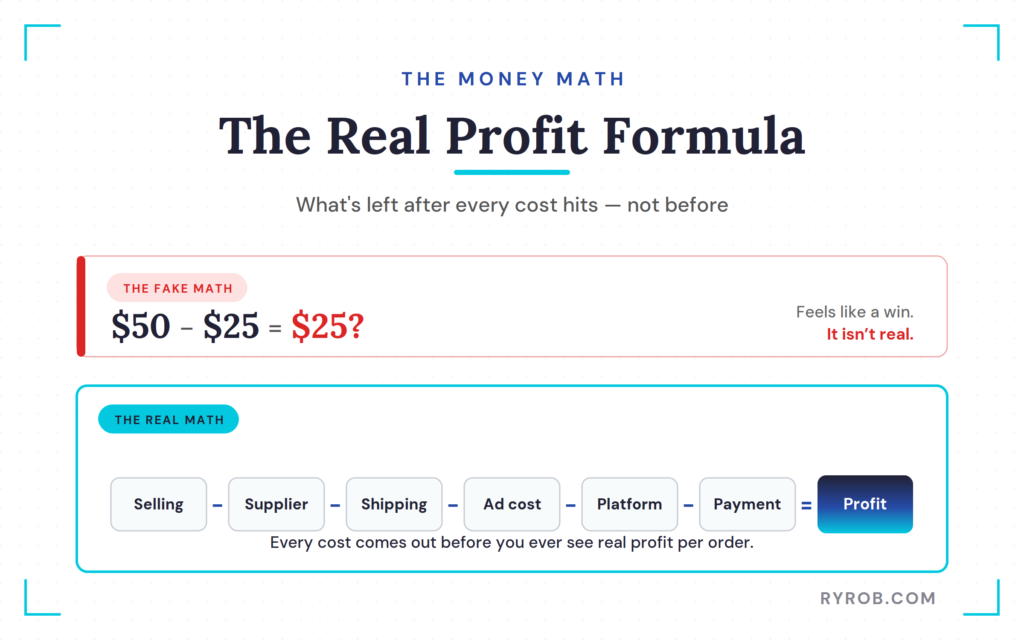
If you sell a product for $50 and pay $25 to the supplier, it might feel like you’ve got a $25 profit. Then you pay for shipping, a Meta or Google ad that brought in the customer, Shopify costs, and payment fees, and that $25 can disappear quickly.
The profit margins in dropshipping are often tighter because you’re not buying inventory in bulk or handling fulfillment yourself. That’s the trade-off. You take less upfront risk, but you need consistent traffic and a strong pricing strategy to make the model work.
If paid advertising is part of your plan, ad costs belong in your profit math before you launch, not after your first few sales.
This is also why broad market growth figures don’t tell you whether your store will succeed. Ecommerce may keep growing, as projections collected in these ecommerce and dropshipping statistics suggest, but your store still needs products people want at a price that leaves room for every cost.
By balancing paid channels with organic traffic, you can protect your profit margins over the long term.
Run the numbers for each product before you spend money on ads. If the margin only works in a perfect spreadsheet, it won’t hold up when returns, fees, or higher ad costs show up.
Step 5: Sync Inventory, Route Fulfillment, and Test the Store
Doba Pilot’s role did not end once the products were published. The workflow continued through Doba’s connected inventory and order-management capabilities, allowing the store, product data, supplier inventory, and order flow to remain connected.
The final piece is the least flashy and one of the most important, your inventory management and order routing.
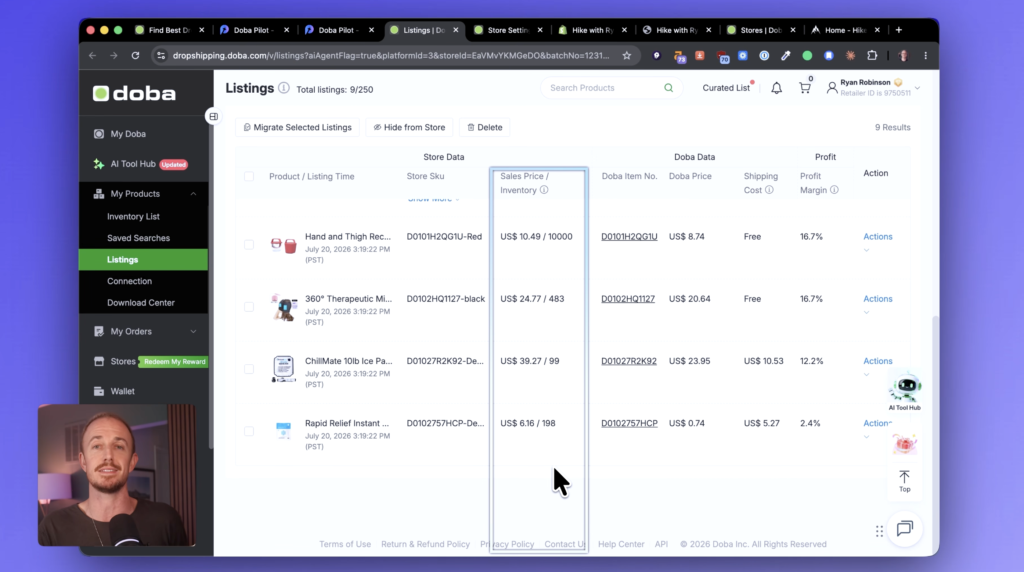
When a supplier’s available inventory changes, the connected store can update too. Proper inventory management helps prevent a customer from buying a product that is already out of stock. It also reduces the chance of canceled orders and late shipments that can damage a new store’s reputation.
When an order comes through, automated fulfillment routes it to the supplier instead of requiring you to box up products in your kitchen. That is the appeal of building a turnkey online store with automated orders.
A live test order went through after the store launched. The store was working, the products were listed, and the order flow was connected.
The next move would be bringing in organic traffic. In this case, Hike With Ryan Outdoors could be linked from an existing hiking blog, added to a navigation menu, and featured naturally within relevant articles. That is a much better place to start than launching a store with no audience and hoping ads somehow solve every problem.
What AI Nailed and What It Didn’t
AI did a lot of the heavy lifting in this store build.
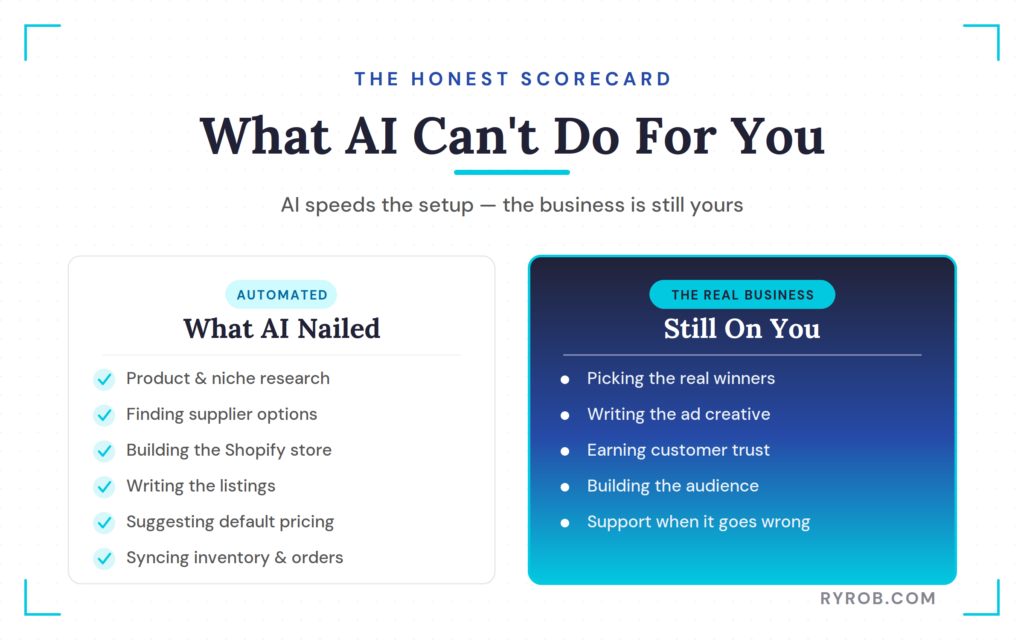
Doba Pilot supported the workflow from end to end. It accelerated market research and product sourcing, helped create and connect the Shopify store, generated the initial listings, supported pricing setup, and worked with Doba’s connected inventory and order-management capabilities to prepare the store for fulfillment.
But technology didn’t magically pick winning products with full conviction. It didn’t write the ad creative or craft the digital marketing campaign that convinces a stranger to buy. It didn’t build trust with customers, and it didn’t create the audience.
That part is still on you.
You need to understand who you’re selling to, why they would choose your AI dropshipping store, how you’ll reach them, and what happens when something goes wrong. AI makes it easier to start. It doesn’t make the business automatic.
FAQs About How to Start a Dropshipping Store With AI
Here are quick answers to the questions people ask most about building a store this way.
Can You Really Start Dropshipping With AI?
Yes. An AI dropshipping agent such as Doba Pilot can connect multiple stages of the setup process, including market research, product sourcing, supplier evaluation, Shopify store creation, listing preparation, pricing setup, and inventory connection. Sellers still need to review the outputs, make business decisions, handle marketing, and manage the customer experience.
Is Dropshipping Still Profitable in 2026?
It can be profitable, but it isn’t easy money. Your success comes down to product selection, supplier reliability, traffic costs, pricing, and how well you earn customer trust.
How Much Does It Cost to Start a Dropshipping Store?
The costs depend on your store platform, supplier tools, domain, apps, advertising budget, and any creative work you outsource. The appeal of an AI dropshipping store is that you don’t need to buy inventory upfront, but you should still budget for testing products and getting traffic.
What’s the Best Way to Find Dropshipping Suppliers?
Start by evaluating dropshipping suppliers that have clear fulfillment data, strong ratings, reliable shipping records, and warehouse options that match where your customers live. Don’t choose a partner from a supplier network based on the cheapest product price alone.
Do You Need a Business License to Dropship?
Requirements vary by state, city, product category, and how your business is structured. Check local business licensing rules, sales tax obligations, and any product restrictions before you launch.
How Long Does It Take to Set Up a Dropshipping Store?
In this walkthrough, Doba Pilot connected market research, product sourcing, Shopify store creation, listing preparation, inventory, and order workflows, allowing the first version of the store to be prepared in one afternoon.
The store in this walkthrough went from a blank screen to a connected store with nine products, including features like Shopify tracking, in roughly 20 minutes of core setup work.
Final Thoughts on Starting a Dropshipping Store with AI
The five steps are simple. Research a niche, choose winning products, vet suppliers, complete your store setup, and connect inventory and fulfillment. AI can make every one of those steps faster for your AI dropshipping store.
But a live store is the starting line, not the finish line. The real business begins when you figure out how to bring in the right customers and give them a reason to come back.
Watch the video above for the full visual build, then use the sponsored Doba offer near the top if you want to test the same workflow.
Want to Build the Same Store? Start With Doba
I’ll be honest, the part of dropshipping I always dreaded was finding suppliers I could trust, and that’s exactly where Doba earned its spot in this build. The real-time inventory sync is the quiet hero, since it stops you from selling something that’s already out of stock. Use my link and enjoy 10% off your first purchase👇
Disclaimer: This story is auto-aggregated by a computer program and has not been created or edited by budgetbuddy.
Publisher: Source link
Publisher: Source link