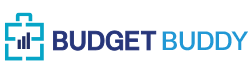
I’ll be honest, I used to think ranking #1 on Google was everything. Then, I watched pages of mine pulling thousands of visits a month get completely ignored by ChatGPT, Claude, Gemini, Perplexity, and even Google’s AI Overviews. Turns out the top Google spot doesn’t guarantee you’ll reach your audience anymore, and it says nothing about your AI visibility. So, I embarked on an experiment, and the result is my complete AI visibility guide.
Here’s what’s going on… traditional SEO and AI visibility are no longer the same game. Google rankings still matter, but a whole new layer of discovery has shown up. The industry is calling it GEO (Generative Engine Optimization) or AEO (Answer Engine Optimization), and it’s the new wave of SEO.
Platforms like ChatGPT, Perplexity, Gemini, and Google AI Overviews are changing how people find information. They hand users a direct answer instead of a list of links. If your brand isn’t cited in those answers, a growing chunk of your audience may never find you.
So in my research-backed AI visibility guide, I’ll show you how to spot your AI visibility gaps. Then I’ll walk you through seven steps to get cited in the right AI answers where your customers are searching for you. Watch the full video breakdown here:
Key Takeaways for AI Visibility and Google Rankings
A strong Google ranking is a starting point, but no longer the finish line. Here’s what actually moves the needle on AI visibility in 2026:
- Rankings alone aren’t enough. A strong Google ranking doesn’t guarantee high visibility in AI-generated answers.
- AI optimization complements SEO. Optimizing for AI answers works alongside organic search. It complements your current strategy rather than replacing it.
- Four things matter most for AI visibility. Discovery, clarity, authority, and trust. Similar to foundational SEO best practices, with some new twists to take into account.
- Start with the gaps competitors are winning. Your fastest AI visibility win is finding search-backed prompts where competitors get mentioned and you don’t.
- Small, consistent fixes add up over time. Clean schema, answer-first formatting, consistent brand signals, and stronger proof can all improve your odds of being cited.
See Where AI is Skipping You with Semrush
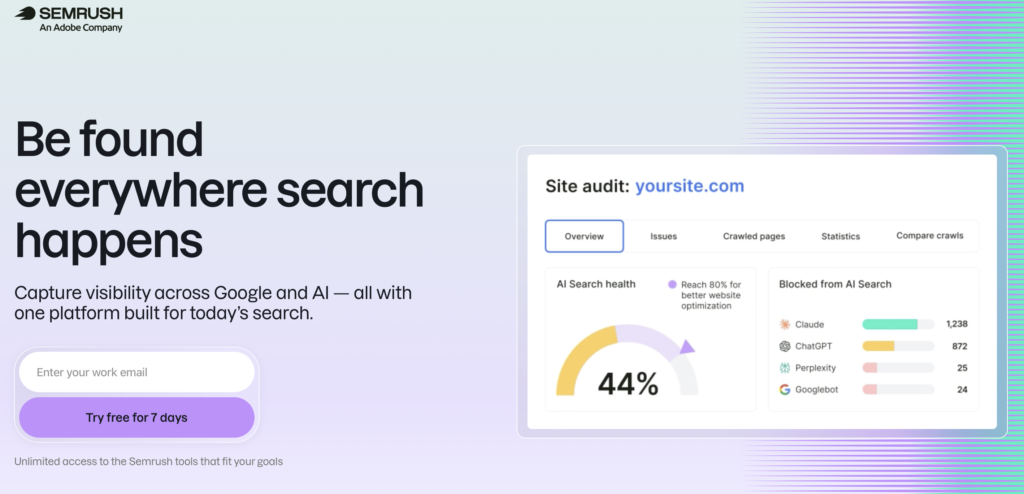
Want to see where your AI visibility stands? Semrush is offering a free 7-day trial for my readers, so you can run the same AI visibility check on your own site and find your gaps too👇
Why Ranking #1 on Google Does NOT Guarantee AI Visibility
A #1 Google ranking can still win clicks. But AI tools aren’t trying to show a page full of blue links. They’re trying to answer a query in one shot, then cite the sources they trust enough to back that answer.
This new reality calls for a shift toward Answer Engine Optimization, or AEO.
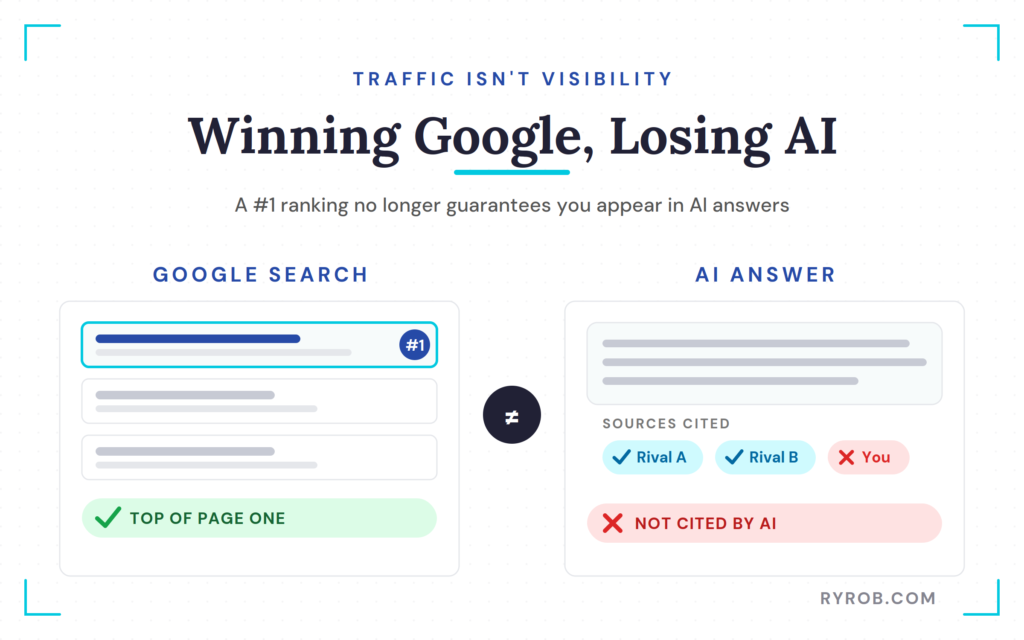
Google can reward a page for its authority, links, and relevance for a keyword. An AI assistant like ChatGPT might skip that same page for other reasons. Maybe the answer is buried too deep, the site sends mixed brand signals, or a competitor has cleaner proof and a more direct answer block up top.
That means you can win in traditional search while losing in AI search at the same time.
If you are still dialing in the traditional side, it is worth brushing up on my guide to how to rank higher on Google. Once that foundation is set, AI visibility becomes its own problem to solve.
What AI Search Looks For That Google Often Does Not
AI systems retrieve, summarize, compare, and decide what to cite. They don’t only care about who ranks first. They care about who is easy to understand, easy to quote, and safe to recommend.
That is why structure matters so much more now. Picture a page with a clear heading that matches the question, followed by a tight two or three sentence answer. That is far easier for AI to lift than a page that takes six paragraphs to get to the point.
Clear entity signals matter too. Say your site signals one thing about your identity, your LinkedIn says another, and your author box says something else. Now the model has to work harder to verify your brand presence and decide if those signals point to the same authority.
Why Your Competitors May Show Up Instead
Once AI tools start citing the same brands over and over, those brands become the familiar names in that topic area. They become the safe pick.
This is where it gets uncomfortable. If your competitors keep getting cited and you don’t, they are not only stealing clicks. They are becoming the names AI associates with the answer itself.
For a blogger, creator, SaaS company, or local business, that is a real problem. You lose discovery. You lose authority by association.
Over time, you can lose the chance to even be considered. And that happens even while your old Google rankings still look healthy on paper.
The Four Layers That Drive AI Visibility
The mental model I keep coming back to is simple. AI visibility is a stack, and each layer depends on the one below it.
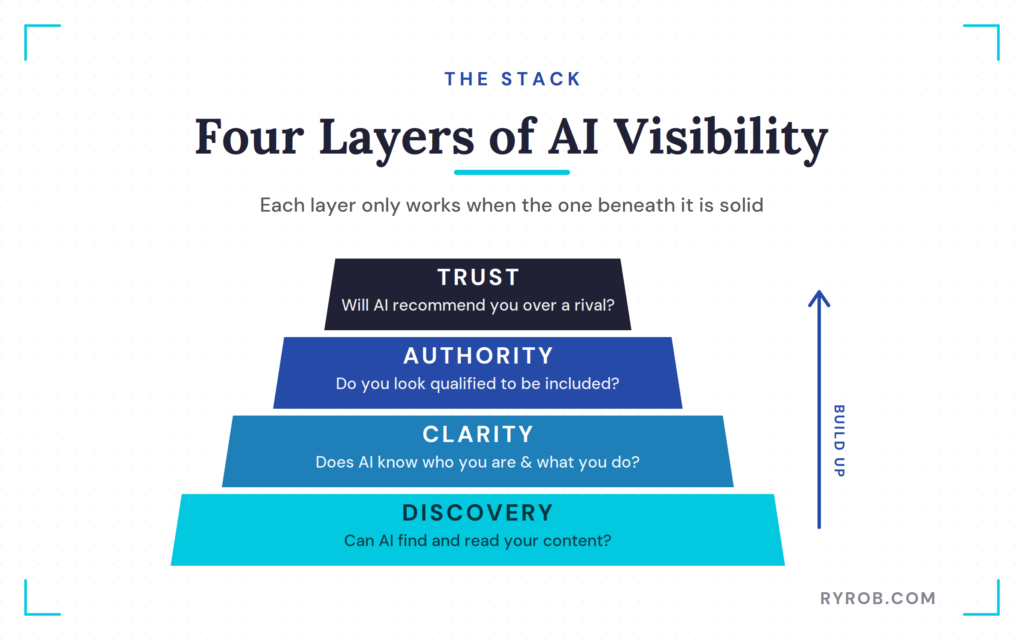
Whether you lean traditional SEO or a more modern generative engine optimization strategy, the hierarchy holds. If an LLM cannot find your content, it cannot understand it. If it can’t understand it, it will not trust it enough to recommend it in answer engines.
| Feature | Traditional SEO | Generative Engine Optimization (GEO) |
|---|---|---|
| Primary Focus | Backlinks, Keywords, Meta tags | Direct answers, Entity signals, Social Proof |
| Goal | Ranking on a SERP | Inclusion in AI-generated responses |
| Success Metric | Click-through rate | Citations and brand mentions |
Start at the bottom and work your way up.
Discovery: Can AI Find and Pull Your Content?
This is the base layer. If your pages are blocked, broken, slow, or hard for crawlers to parse, you will not get far.
Discovery also includes structure. Clean schema helps an LLM understand what it is reading. Is this an article? A service page? An FAQ? Who wrote it? What question does it answer?
Formatting matters here too. If the best answer on your page is buried in the middle, many AI tools will not surface it. Put the core answer near the top and make it easy to grab.
Clarity: Does AI Understand Who You Are and What You Do?
A surprising number of sites fail here.
Clarity is about whether AI can confidently say your brand is known for a specific topic. That comes from consistent naming, consistent bios, consistent links, and pages that state your expertise in plain English.
This is where sloppy branding hurts. If your About page, author bio, LinkedIn, Google Business Profile, and third-party mentions all describe you differently, you create friction where you need confidence.
Authority: Do You Look Qualified Enough to Get Included?
Authority is the layer most marketers already know. Do you have broad coverage on the topic? Do relevant sites mention you? Do you have content that deserves to sit next to the best pages in your niche?
But in AI search, building topical authority is essential. It is not enough to be generally strong. You need deep, high-quality pages for the exact prompts AI is already citing in your space.
That is why prompt-level competitor research matters so much. It tells you where your authority is missing in practical terms, not abstract ones.
Trust: Will AI Confidently Recommend You Over a Competitor?
Trust is where a citation turns into a recommendation.
This layer is built on proof. Real reviews, fresh testimonials, and third-party sites echoing your own claims are all vital. Updated content, first-hand experience, and clear authorship help move the needle.
This is also why the best blogging strategies right now lean so hard on original experience and distinctive voice. AI can summarize common advice all day long. It is much harder to replace content backed by real work, real results, and verifiable outside proof.
The right AI writing tools speed up drafting, but the original experience is still yours to supply.
How to Diagnose Your AI Visibility Gaps
Before changing a page, I want two answers:
- Can AI reach and understand the site at all?
- Where are competitors showing up that I am absent?
That combination tells you whether you have a technical problem, a content problem, a trust problem, or some mix of all three.
Check Your Technical Foundation First
For this kind of audit, I ran everything through a reliable AI monitoring tool, using the Semrush 7-day trial. The original video was sponsored, but the site, pages, and numbers are my own, which is what matters.
The first stop is the SEO dashboard and site audit. I want to know whether anything technical is getting in the way before I start rewriting pages. The basics still count. If your site health is rough, if important pages are not crawlable, or if you are blocking major AI crawlers, you have found your first bottleneck.
In Semrush, this shows up fast. Green checks mean those crawlers can access your site. Red Xs mean you need to fix the foundation first.
This is still table stakes. It is the floor, not the win. But you cannot skip it.
Microsoft’s own guidance on inclusion in AI search answers lines up with this well. Clear structure, crawl access, and direct answers are not optional anymore.
Find Your AI Share of Voice and Cited Pages
Once the technical side looks clean, the interesting part starts. This is where the Semrush AI Toolkit earns its keep.
Here you look at your overall AI share of voice, total mentions, and which pages get cited across major platforms like ChatGPT, Perplexity, and Gemini. Running a competitive benchmarking exercise gives you a quick read on whether you are even in the conversation for AI Overviews.
A score that is lower than you would like can sting a little. Good. That is useful. Better to know the truth than stare at strong Google rankings and assume AI sees you the same way.
What I like most here is breaking that visibility down by platform and by country. If your audience is in the US, that is the slice that matters most. Global averages can hide weak US performance, and search demand, competition, and citation behavior can all shift by market.
You also want to look at historical data to spot trends over time. Specifically, watch:
- Whether your mentions are climbing, flat, or dropping
- Which pages get cited most often
- Which topics keep showing up again and again
If your tool lets you monitor topics or spin up content from those prompts, that is useful. It turns research into an action plan.
And if your data source is using modeled estimates because Google Search Console and GA4 are not connected yet, that is fine for a first pass. A directional read is enough to spot the gaps. Once those accounts are connected, you get the real numbers.
If you are still getting your head around how AI retrieval systems stay current, this overview of how AI search engines work is a helpful primer.
Use Competitor Research to Find Your Missing Prompts
This might be the single most useful part of the whole process.
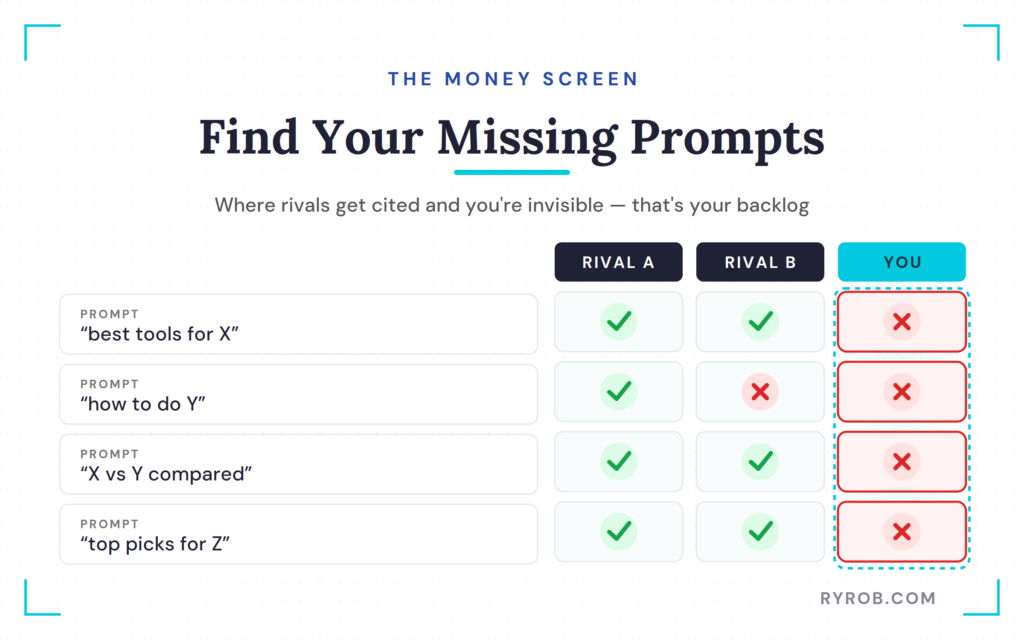
You want the report that shows the prompts where your competitors get mentioned and you do not. Through advanced citation source detection, Semrush can pinpoint exactly where your competitors are winning the visibility battle. That is the money screen. That is not trivia. It is your working list for the month.
Instead of guessing what to publish next, you now have prompt-level proof of where you are invisible.
Some of those gaps will call for new pages. Others will call for major refreshes to old pages that already rank, but do not answer the question cleanly enough for AI to cite them.
This is also where it helps to think in systems, not one-off updates. If you need a practical way to turn those prompt gaps into a content backlog, my guide to building an SEO content strategy is the process I would use.
Seven Fixes to Get Cited in AI Answers
Once you know where the gaps are, the work gets pretty straightforward. None of these fixes are exotic. They are mostly the same fundamentals that already work in SEO, aimed at a newer visibility surface.
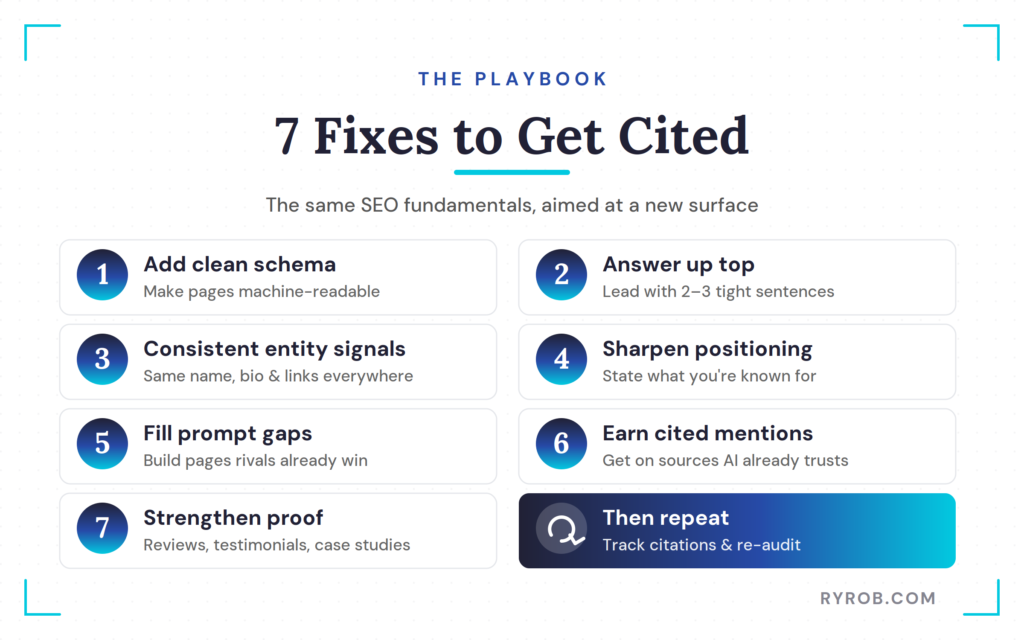
- Make your content machine-readable. Add clean schema to the pages that matter most. Help large language models understand the page type, the author, and any FAQ content. If a model has to guess what it is reading, you are creating friction you do not need.
- Put the answer near the top. Use the exact question as a header when it makes sense, then answer it in two or three tight sentences right away. That is often the chunk AI wants to quote or paraphrase. If the answer shows up in paragraph six, you have made the job harder.
- Clean up your entity signals everywhere. Use the same business name, author name, bio themes, and key links across your site, author boxes, LinkedIn, Google Business Profile, Yelp, and anywhere else you appear. Consistent brand mentions make it easier for AI to connect the dots and verify your authority.
- Tighten your positioning on important pages. Every page you care about should say, fast and clearly, what you are known for and who you help. Do not assume the reader, or the model, will infer it. State it clearly.
- Build better pages for the prompts you are missing. If competitors own certain AI prompts and you are absent, publish stronger pages for those topics or overhaul the ones you have. Strategic content optimization can help you capture these missing opportunities, so do not settle for good enough if your current page is not getting picked up.
- Get mentioned on sources AI already cites. Look at which websites, creators, podcasts, and YouTube channels keep showing up in answers around your niche. Then go earn coverage there. Guest posts, interviews, collaborations, and existing article mentions all help, because AI borrows trust from those citations.
- Strengthen proof on and off your site. Refresh testimonials. Collect current reviews. Add case studies where they fit. Make sure third-party sites back up the same claims you make on your own pages. This is the boring part for some people, but it is often the difference between getting named and getting recommended.
What to Expect After You Make the Changes
You are probably not going to update a page tonight and wake up tomorrow as the most-cited brand in your niche. Improving your AI visibility is a gradual process, not an overnight win.
This is more like classic SEO than people want to admit. You audit, fix weak spots, publish better pages, build stronger signals, and repeat. Over time, mentions start to show up where you were absent before.
The good news is the feedback loop can be faster than traditional SEO. By using an AI monitoring tool to track citations, cited pages, and prompt coverage, you can often spot progress long before organic traffic shifts.
Beyond simple mentions, you should also lean on sentiment analysis to understand how these AI models read your brand tone and authority.
Pay attention to whether more pages are entering the citation mix. Watch whether the same competitor keeps beating you on the same prompt. Re-run the audit, refresh the page, tighten the answer block, and update your supporting evidence. Then check again.
That is the whole rhythm.
FAQs About AI Visibility and Getting Cited by AI
Here are a few more common questions worth answering.
Does Ranking #1 on Google Help With AI Visibility?
Yes, it helps, but a top position does not guarantee high AI visibility. A strong ranking signals that your page already has authority and relevance, which is an excellent foundation.
Platforms like ChatGPT, Gemini, and Perplexity need more than traffic, though. They look for clear structure, strong entity signals, and enough trust to cite your page as a reliable source.
How Long Does It Take to Show Up in AI Answers?
There is no universal timeline for appearing in AI answers. Some technical fixes work quickly, especially if your page already ranks well and just needs better structure or clearer answers.
Other improvements take longer. Building third-party mentions and trust signals depends on outside coverage and how these systems digest content updates over time.
Do I Need New Pages, or Can I Update Existing Ones?
In most cases, updating an existing page is the more effective move. If the page already has rankings, backlinks, and topic relevance, a few targeted edits can go a long way.
Rewrite the top section, add schema, clarify your position, and refresh your proof points. Only create a new page when a specific prompt needs a dedicated answer your current content cannot cover.
What Metrics Matter Most for AI Visibility?
Focus on tracking mentions, citations, cited pages, and prompt coverage. Analyze these over time, broken down by platform and by geographic region.
If you are targeting US readers, US citation data beats a global average every time. I also watch which competitors keep showing up where I am absent, since that gap is often the best roadmap for your next content update or LLM optimization strategy.
Final Thoughts on AI Visibility and Recommendations
The tricky part of today’s search landscape is simple. You can dominate Google rankings and still miss the room where most of the conversation is starting.
That is not a reason to panic. It is a reason to audit your current strategy. Get the foundation right, then work from the bottom up: discovery, clarity, authority, and trust. By prioritizing consistent brand mentions and a strong brand presence, you keep your business relevant across all platforms.
There is still a lot of open space here. The sites that fix these gaps now, through intentional content optimization and a focus on earning quality citations, have a real shot at winning. They can become the primary resources AI reaches for before the rest of their niche catches up.
See Where AI is Skipping You with Semrush
Want to see where your AI visibility stands? Semrush is offering a free 7-day trial for my readers, so you can run the same AI visibility check on your own site and find your gaps too👇
Disclaimer: This story is auto-aggregated by a computer program and has not been created or edited by budgetbuddy.
Publisher: Source link
Publisher: Source link