Author: Jeff Westover, CMO at Geoforce
Field Asset Intelligence Defined
Field Asset Intelligence is the discipline and technology category for connecting, understanding, and coordinating distributed field equipment so organizations can improve readiness, utilization, responsiveness, and economic output. Mature Field Asset Intelligence enables connected, intelligent, coordinated equipment operations, including advanced capabilities such as equipment orchestration.
Every established technology category begins with a problem that existing categories do not describe well enough. Field Asset Intelligence begins with a simple observation: in many industrial businesses, equipment is the revenue engine, but the organization still manages that equipment with incomplete, delayed, or fragmented information.
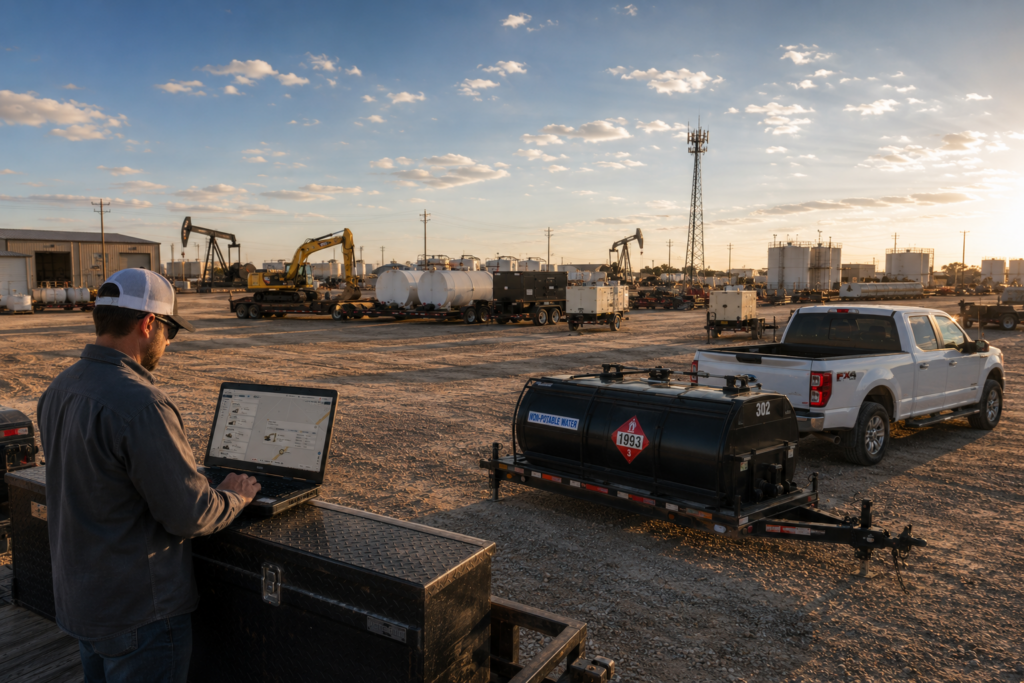
The equipment may be a tank, trailer, container, pump, generator, cable reel, recloser, tool, rental unit, or specialized piece of machinery. It may be powered or non-powered. It may move every day or remain at a remote site for months. It may generate revenue directly, enable a crew to generate revenue, or fulfill a customer commitment. Whatever form it takes, the same three operational questions keep appearing: Where is it? Is it ready? Is it earning?
Traditional asset records can tell you what the company owns. A spreadsheet can tell you where someone last entered it. A fleet system can tell you what a vehicle and driver are doing. Field Asset Intelligence answers a different question: What is happening with the equipment that makes the field operation work right now?
From Dumb Equipment to a Coordinated Revenue Engine
Most field equipment is purchased and delivered “dumb.” A tank, trailer, container, pump, generator, tool, or specialized unit may be essential to revenue, yet it arrives without a native digital identity, a dependable communications path, or a way to tell the business whether it is available and ready. The company owns the asset, but the operating system cannot truly see it.
Field Asset Intelligence changes that state in a deliberate progression: disconnected equipment becomes connected and visible; connected field truth becomes intelligence when the business understands readiness, utilization, condition, custody, and economic state; and intelligence enables coordination when people and systems act on it. Mature Field Asset Intelligence puts the right equipment, ready for the right work, in the right place, at the right time, with the evidence required to operate and earn.
The Category Hierarchy
Field Asset Intelligence is the category and the mature operating state. Equipment orchestration is an advanced capability within Field Asset Intelligence. The Geoforce platform creates trusted field truth and turns it into equipment-first operational intelligence. Greater equipment performance, customer confidence, and economic output are the outcomes.
From a System of Record to a System of Action
Field Asset Intelligence is the category and the mature operating state. Equipment orchestration is an advanced capability within Field Asset Intelligence. The Geoforce platform creates trusted field truth and turns it into equipment-first operational intelligence. Greater equipment performance, customer confidence, and economic output are the outcomes.
- Location: Where the asset is now, where it has been, and whether it crossed an expected boundary.
- Movement: When it started moving, stopped moving, arrived, departed, or changed hands.
- Readiness: Whether it is available, in the right condition, and deployable for a job, customer, branch, yard, or crew.
- Utilization: How often it is moving or working, how long it sits idle, and whether the equipment network is balanced.
- Condition: Whether available equipment signals indicate an operating condition or exception that requires attention.
- Workflow status: Whether the equipment has completed a delivery, rental, maintenance, inspection, or return cycle.
When these signals are connected to workflows, the platform stops being a passive map. It becomes a system of action. It can alert a dispatcher that an asset has left a yard, tell an operations manager which units have been idle for 30 days, verify that equipment reached a customer location, or help finance avoid buying equipment that already exists but is stranded in the wrong place.
Trusted field truth is not the outcome. Better decisions, faster workflows, stronger customer confidence, and more productive equipment are the outcomes.
Why “Field” Matters
The word field is important because field assets operate outside the controlled conditions of an office, warehouse, or factory floor. They are distributed across customer sites, yards, highways, mines, rail networks, farms, construction projects, military routes, and energy operations. Connectivity is uneven. Weather is real. Impacts happen. Equipment gets pressure-washed, buried in mud, left in extreme heat, exposed to chemicals, or transported across borders.
A useful Field Asset Intelligence system must therefore do more than generate attractive dashboards. It must reliably create trusted field data in the places where the work happens. That requires the right combination of rugged devices, long battery life, cellular and satellite connectivity, flexible reporting profiles, sensor support, and software that understands equipment-centric workflows.
Why “Asset” Matters
An asset is not simply something with a serial number and a depreciation schedule. In an operating environment, an asset has a job to do. Its value depends on whether it is available in the right place at the right time and in the right condition.
That definition expands the conversation beyond the highest-value machines. A $100,000 piece of equipment is an obvious tracking candidate, but a lower-cost tank, container, reel, or tool can create an expensive failure when it is missing. The relevant question is not only, “What is the equipment worth?” It is also, “What does the operation lose when this equipment is unavailable?”
Why “Intelligence” Matters
Intelligence means the data changes what someone does. A location update becomes intelligence when it prevents a wasted trip. A movement event becomes intelligence when it triggers a billing milestone. An idle-time report becomes intelligence when it allows a company to redeploy equipment instead of purchasing more. A history of arrivals and departures becomes intelligence when it exposes a bottleneck in a customer service cycle.
The intelligence also becomes more valuable over time. A single event answers a question. A complete history reveals patterns. A connected equipment network enables comparisons across assets, yards, branches, regions, customers, and workflows. As relevant coverage expands, the value compounds because each additional connected asset improves the quality of decisions made about the wider equipment pool.
The Business Value of Field Asset Intelligence
For most operations leaders, the business case falls into five practical categories:
These outcomes are connected. Better readiness improves customer service. Better utilization lowers capital needs. Better workflow data improves billing. More reliable field truth reduces labor. The platform creates value because it allows the organization to manage equipment as a connected network rather than a static list of things.
Who Needs Field Asset Intelligence
Field Asset Intelligence is most relevant when a company creates revenue or operational capacity through distributed equipment. That includes oil and gas service companies, equipment rental businesses, construction contractors, utilities, rail operators, mining companies, industrial manufacturers, waste businesses, logistics providers, government and defense organizations, and many others.
The clearest signal is not industry; it is dependency. When the answer to “Can we serve the customer?” depends on whether the right equipment is available and ready, Field Asset Intelligence belongs in the operating architecture.
Why it Becomes a Competitive Advantage
Imagine choosing between two service providers. One believes it can support your project. The other can tell you exactly what equipment is available, where it is located, whether it is ready, when it can arrive, and how the work will be completed. The second provider can respond faster, commit more precisely, and mobilize with less risk.
That is why Field Asset Intelligence is not only a cost-control program. It can help an equipment-dependent company pursue work with greater confidence, keep promises more reliably, and generate more revenue and profit from the equipment it already owns.
The Category in One Sentence
Field Asset Intelligence gives equipment-driven organizations trusted field truth and the operational context required to make revenue-critical and service-enabling equipment more ready, productive, and valuable.
Frequently Asked Questions
Is Field Asset Intelligence the same as GPS asset tracking?
No. GPS location is one input. Field Asset Intelligence combines identity, movement, condition, readiness, utilization, workflow, and economic context so the organization can make better operating and financial decisions.
How is Field Asset Intelligence different from fleet management?
Fleet Management is primarily centered on drivers and vehicles, including safety, fuel, maintenance, and regulatory workflows. Field Asset Intelligence is centered on equipment availability, readiness, utilization, deployment, and economic output.
Does Field Asset Intelligence apply to non-powered equipment?
Yes. Non-powered assets are often where the largest gaps in trusted field truth exist because they lack an onboard power source or vehicle telematics system.
What is the first use case most companies pursue?
Many begin with location and loss prevention, then expand into readiness, utilization, inventory balancing, workflow automation, service verification, and capital planning.
What is equipment coordination?
Equipment coordination is an advanced Field Asset Intelligence capability that coordinates equipment across jobs, customers, locations, and workflows so the right unit is ready where and when it is needed.
Turn disconnected equipment into Field Asset Intelligence.
Geoforce combines rugged tracking devices, cellular and satellite connectivity, and equipment-first software to create trusted field truth and help operations leaders connect, understand, and coordinate distributed equipment.
Conclusion
Field Asset Intelligence gives equipment-driven organizations a better way to manage the assets their business depends on. By turning disconnected equipment into trusted field truth, companies can answer the questions that matter most: Where is it? Is it ready? Is it earning? As more revenue-critical equipment becomes connected, that intelligence improves decisions across the operation, helping teams respond faster, use existing assets more effectively, keep customer commitments, and generate greater economic value from the equipment they already own.
Disclaimer: This story is auto-aggregated by a computer program and has not been created or edited by budgetbuddy.
Publisher: Source link
Publisher: Source link