The expansion of the financial sector was an important dimension of decolonisation in East Africa. Yet the financial intermediaries through which capital circulated remained shaped by colonial hierarchies, regional commercial networks and unequal access to financial services. Examining the Nairobi Stock Exchange during its formative decades, a new article explores how securities trading became intertwined with the wider political and economic restructuring of Kenya during the late colonial and early postcolonial period.
The financial sector and decolonisation in East Africa
Recent scholarship on East African financial history has highlighted the growing political, economic and social importance of the financial sector in the decades following the Second World War (Bernards, 2022; Donovan, 2024; Velasco, 2024). Marked by new colonial developmentalist policies, the Mau Mau rebellion and the accelerating crisis of empire, the late-colonial period in Kenya reshaped financial institutions and left enduring legacies of economic inequality in the region (Simson, 2024). Historians have emphasised that banking and monetary systems in colonial Kenya were structured by racial and ethnic divisions that privileged European (and Asian) settlers through greater access to credit, investment and state guarantees, while Africans remained largely excluded from formal financial services (Velasco, 2024; Velasco et al., 2025).
Against this backdrop of political upheaval and economic transformation, the early history of the Nairobi Stock Exchange (NSE) offers a distinctive perspective on East Africa’s financial sector during the final decade of colonial rule, as described in a recent article. Unlike the mining-dominated exchanges of Southern Africa, the NSE reflected Kenya’s broader equity market and relatively more ethnically inclusive commercial economy, while rapidly evolving into a regional marketplace serving institutional and individual investors across East Africa. My article shows how the NSE reflected shifting economic conditions, corporate strategies and the wider dynamics of decolonisation in Kenya.
Early organisation and operations
The NSE was incorporated on 1 July 1954 by members of the Kenyan Stockbrokers Association—J.S. Donovan and Co., Francis Drummond and Co., Dyer and Blair, and Chandulal Shah—as a financial intermediary under the Kenyan Societies Act, operating under the oversight of the Ministry of Finance. Its initial operating framework was largely adapted from the Bulawayo Stock Exchange, reflecting both the economic networks shaping Kenya’s early securities market and the settler colonial interests underpinning East Africa’s financial community in the 1950s. Initially lacking its own premises, the NSE operated from the Stanley Hotel, while its administrative offices were housed nearby in Queensway House, headquarters of Barclays Bank D.C.O.
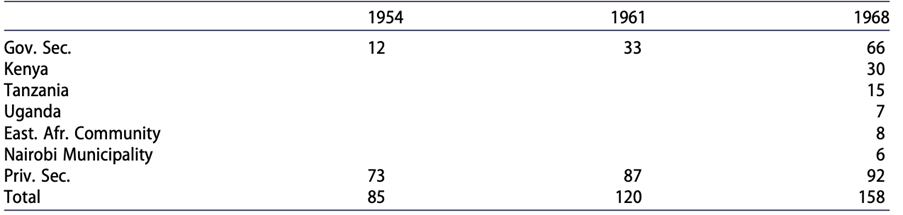
The NSE’s first Official List comprised eighty-five securities, including government and municipal stocks, ordinary shares and preference shares. At the exchange’s opening, London still functioned as the principal market for Kenyan government issues, although the local issue of East African government and industrial securities expanded steadily during the 1950s. In its first full year, £13 million was raised in ordinary share capital. Companies such as East African Power and Lighting dominated trading and accounted for a substantial share of listed capital.
Table 1. Number of Securities Officially Listed on NSE, 1954–1968.
African participation in stockbroking and investment increased rapidly in the late 1950s as technical schools introduced accounting and bookkeeping programmes to support the expanding private sector. The Kenyan Stockbrokers Association supported African financial professionals such as Francis Thuo, the first African stockbroker in Nairobi, while the NSE promoted securities aimed at African investors throughout East Africa. Despite these initiatives, African investor participation remained limited, with trading dominated by Nairobi-based financial institutions and a relatively small circle of European and Asian investors closely connected to major banks.
Independence and Africanisation
After independence in 1963, the NSE expanded as Kenya and its East African neighbours increasingly used capital markets to finance state-led development projects. Government securities from Kenya, Uganda and Tanzania became central to trading, even as the three countries pursued diverging political ideologies. The dissolution of the East African Currency Board in 1966 and the creation of national central banks introduced tighter monetary controls, while regional trade agreements raised transaction costs and weakened financial integration.
Despite these national and regional pressures, the NSE adapted to the postcolonial economy. By 1966, its trade index had reached record levels, driven by industrial firms such as British American Tobacco Kenya, East African Breweries, and East African Power & Light, whose expansion reflected Kenya’s import-substitution policies and the continued dominance of foreign-owned industry. Consequently, the Kenyan government used Africanisation and indigenisation programmes to expand African ownership of publicly traded companies, turning the NSE into a key instrument for reconciling nationalist economic goals with continued participation in international capital markets.
References:
Bernards, N. (2022). Colonial financial infrastructures and Kenya’s uneven fintech boom. Antipode, 54(3), 708–728.
Donovan, K. (2024). Money, value, and the state: Sovereignty and citizenship in East Africa. Cambridge University Press.
Lukasiewicz, M. (2025). Between settler colonialism, regionalisation and Africanisation: The making of the Nairobi Stock Exchange, 1954–1970. Journal of Eastern African Studies, 19(1), 2–23.
Simson, R. (2024). Colonial legacies and wealth inequality in Kenya. Explorations in Economic History, 94, 101623.
Velasco, C. (2022). Monopoly and competition: The Kenyan commercial banks at the end of the colonial period (1954–1963). Business History, 64(6), 1071–1087.
Velasco, C., & Willis, J. (2025). Saving, inheritance and future-making in 1940s Kenya. Past & Present, 267(1), 211–241.
Velasco, C. (2024). Commercial banking in Kenya: A history from colonisation to digital age. Routledge.
Feature image: Trading at the Exchange Bar at the Stanley Hotel in late 1960s. Image rights purchased from Alamy Stockphotos.
Disclaimer: This story is auto-aggregated by a computer program and has not been created or edited by budgetbuddy.
Publisher: Source link
Publisher: Source link