

Quick Takeaway
- Architecture decisions made at implementation determine whether a DAM scales to 10x or 100x asset volume without re-platforming. Feature evaluations rarely ask this question.
- Enterprise DAM architecture is the operational foundation that enables governance, integrations, workflows, metadata, AI, security, and enterprise content operations to function together.
- Performance at scale requires distributed, independently scalable components. Hybrid storage tiering, CDN delivery, and asynchronous processing must be built into the architecture.
- API-first, headless architecture is a prerequisite for enterprise content distribution. A DAM that cannot handle thousands of API calls per minute creates workflow failures across every connected system.
- Metadata architecture determines AI readiness. Approval state, workflow history, rights context, distribution eligibility, and permissions must be built into the foundation. AI cannot reliably determine whether an asset is ready for distribution without them.
- Evaluate architecture before procurement. Re-platforming after performance limits appear in production costs more in disruption than the upfront evaluation would have.
Digital Asset Management Architecture for High Volume Content Environments
Re-platforming a DAM after it hits capacity is rarely a quick swap. It’s a multi-year disruption that pulls in IT, procurement, creative operations, and every team that depends on the system daily, often at a cost that dwarfs the original investment.
The scale of that undertaking is easy to underestimate. Even a well-run enterprise system implementation is neither fast nor cheap: the median runs nine months at a median cost of $450,000, with roughly half of projects exceeding their budget (Panorama Consulting, 2025 ERP Report). A forced re-platform after a system hits its ceiling carries that cost on top of the disruption to every dependent team, and it arrives at the worst possible time, when the content operation has already outgrown the tool.
Most DAM evaluations miss this risk entirely because they focus on features and interface. They assess search quality, workflow configuration, and tagging capabilities, but rarely ask whether the underlying digital asset management architecture can support enterprise content operations at 10x or 100x current asset volume.
That gap creates a predictable problem. A system that performs well in a proof of concept with 50,000 assets can degrade under millions, particularly when concurrent users, high API call volumes, global access patterns, video processing, AI workloads, and multi-system integrations are introduced.
Re-platforming after performance limits become visible in production is expensive, disruptive, and operationally risky. Architecture decisions that go unevaluated during procurement don’t disappear; they become technical debt the organization has to carry, and eventually pay down, later. Architecture evaluation must happen before procurement.
This article is a technical reference for enterprise architects, IT directors, and DAM administrators evaluating whether a DAM platform is built to scale alongside a growing content operations program. It covers performance and storage, global access, API load and integration depth, permissions, metadata architecture, workflow automation, AI readiness, security, and enterprise content operations. These are the architectural layers that determine whether a DAM remains a repository or becomes the operational foundation for the enterprise content supply chain.
Architecture Terminology Quick Reference
Effectively managing enterprise content at scale requires foundational knowledge of its underlying technical pillars.
Before addressing specific design criteria, these definitions provide the necessary vocabulary for high-volume environments and the architectural frameworks that distinguish simple storage repositories from sophisticated content orchestration platforms:
- Digital Asset Management Architecture: The technical foundation that determines how a DAM stores, governs, secures, processes, enriches, and distributes assets across teams, systems, and channels.
- Enterprise DAM Architecture: The architecture required for an enterprise digital asset management system to support large asset libraries, global teams, granular permissions, API-driven integrations, governance, workflow automation, and AI-ready metadata.
- Headless DAM: A DAM architecture that separates backend asset management from the presentation layer, allowing assets and metadata to be delivered through APIs to websites, commerce systems, apps, partner portals, and other channels.
- API-First DAM: A DAM platform designed so core functions, including search, metadata updates, rights validation, workflow actions, and asset delivery, can be accessed programmatically through governed APIs.
- MACH Architecture: An architectural model based on microservices, API-first design, cloud-native infrastructure, and headless delivery. MACH principles help DAM platforms scale services independently and avoid single points of failure.
- Composable Architecture: An approach that assembles best-of-breed services, such as search, metadata, rights, and delivery, into a single platform rather than relying on one monolithic system, allowing enterprises to add, replace, or extend capabilities as needs evolve.
- Event-Driven Architecture (EDA): A model where actions, such as an asset upload, rights change, or approval, automatically trigger downstream processes in real time, rather than relying on scheduled jobs or manual follow-up.
- Multi-Tenant vs. Single-Tenant Architecture: In a multi-tenant model, multiple customers share the same underlying infrastructure with logical separation between accounts. In a single-tenant model, each customer has a dedicated instance. The distinction affects customization, data isolation, upgrade cycles, and compliance posture.
- Hybrid Storage: A storage model that places assets across hot, warm, and cold tiers based on access frequency, performance needs, cost, retention requirements, and compliance rules.
- Metadata Architecture: The structure, governance, taxonomy, relationships, and operational fields that allow assets to be searched, approved, secured, distributed, and used by AI systems reliably.
- Distributed Content Delivery: The use of CDN-backed delivery, edge caching, regional infrastructure, and delivery services to provide low-latency access across global teams and downstream systems.
- Content Orchestration Platform: A platform architecture that coordinates intake, metadata, review, approval, rights validation, localization, distribution, and analytics across the enterprise content supply chain.
- Enterprise Content Operations: The operating model that connects creative production, marketing, commerce, legal, regional teams, partners, governance, AI, and downstream delivery into one managed content lifecycle.
Why DAM Architecture Decisions Compound at Scale
Architecture decisions made during implementation tend to lock in. The metadata model that works for one team requires rearchitecting when taxonomy needs to scale across 12 regions. The storage approach that handles one million assets starts generating latency issues at ten million. The permissions model configured for internal teams creates administrative overhead when external agencies, regional partners, and third-party review platforms join the workflow.
Monolithic DAM architecture, where storage, search, metadata, workflow, and delivery are tightly coupled in a single application layer, creates these scaling ceilings. When one component needs to grow, the others must be reconfigured or replaced in step. For organizations managing content supply chains that span multiple brands, business units, rights restrictions, security requirements, and downstream systems, that interdependency becomes operationally expensive.
Forrester’s Digital Asset Management Systems Landscape, Q3 2025 documents how DAM is evolving from a system of record into a system of action, one that actively participates in content operations instead of just storing finished assets. That transition places new demands on the underlying architecture.
A thorough enterprise architecture evaluation covers performance and storage design, global access and distributed delivery, API load capacity and integration depth, permissions and access control, security, workflow architecture, metadata governance, and AI readiness. Metadata architecture shapes how each of these performs.
Enterprise DAM Architecture Maturity Model
Enterprise DAM programs tend to follow a recognizable progression in architectural capability:
- Repository: Assets are stored and retrievable. Search and basic metadata are present. Integration with other systems is minimal or manual.
- Managed DAM: Metadata standards and taxonomy governance are in place. Workflows handle approvals and version control. Rights management is structured and enforced. The DAM operates as the system of record for finished assets.
- Integrated DAM: The DAM connects to CMS, PIM, eCommerce, ERP, CRM, creative tools, marketing automation platforms, identity providers, and analytics systems through APIs and native connectors. Content distribution is automated or semi-automated. The DAM participates in the content supply chain rather than sitting at the end of it.
- Content Orchestration Platform: Governance, metadata, rights, workflows, security, permissions, integrations, and content distribution operate as a coordinated system. Content moves through intake, review, approval, rights validation, localization, and distribution with the DAM as the operational layer connecting each stage.
- AI-Driven Content Operations: AI agents operate inside governed workflows, using trusted metadata, permissions, rights context, workflow history, and approval state to automate enrichment, routing, rights checks, distribution staging, and next-action guidance. AI readiness at this stage is what architectural maturity produces over time.
Each stage expands operational capability rather than just storage capacity. Organizations evaluating enterprise digital asset management systems should assess the architecture’s trajectory, evaluating both where it starts and where it is designed to go.
|
Capability |
Traditional DAM |
Enterprise DAM |
Content Orchestration Platform |
Business Outcome |
|---|---|---|---|---|
|
Storage |
Centralized |
Hybrid and tiered |
Distributed, multi-cloud |
Performance at scale |
|
Metadata |
Descriptive |
Operational and governed |
AI-ready context layer |
Workflow automation and AI reliability |
|
Integration |
Manual or limited |
API-based |
Event-driven and composable |
System connectivity |
|
Permissions |
Role-based |
Granular and rights-aware |
Attribute-based and API-enforced |
Governance at scale |
|
Workflow |
Basic review routing |
Configurable approvals |
Event-driven orchestration |
Faster content operations |
|
Security |
User access controls |
Granular permissions and audit history |
Policy-based, rights-aware governance |
Enterprise risk control |
|
AI |
Optional add-on |
Embedded enrichment |
Governed, agentic automation |
Reliable automation |
Performance Architecture for Large Asset Libraries
Holding five million assets is a storage problem. Retrieving, processing, securing, enriching, and delivering them quickly is an architecture problem. Enterprise performance architecture involves indexing strategy, metadata optimization, distributed search services, caching layers, asynchronous processing, horizontal scaling, workflow orchestration, API reliability, and storage tiering working together.
In practice, this looks like search indexing clusters that return results in milliseconds across millions of records, distributed object storage that spreads assets across nodes to avoid single points of failure, asynchronous job queues that process video transcoding or AI tagging in the background instead of blocking user requests, and caching layers that serve frequently accessed assets and metadata without hitting the primary database on every call.
DAM scalability at the architectural level means that each component can grow independently. When search indexing becomes a bottleneck, it can be scaled without rebuilding storage. When batch operations on large asset sets create processing queues, asynchronous handling keeps the system responsive for concurrent users. When AI enrichment, video transcoding, and rendition generation add compute demand, those workloads need to run without degrading the base DAM experience.
Digital asset management system features only perform reliably when the infrastructure beneath them is designed for sustained enterprise load. Search, workflow, metadata updates, AI tagging, preview generation, and content delivery all draw on shared architectural resources. The real evaluation question is whether a feature keeps performing when asset volume, user activity, API calls, and downstream distribution all climb at once.
The business outcome is a library that stays fast as it grows: search, approvals, and delivery hold their speed from 500,000 assets to 10 million, so teams keep working instead of waiting on queues, and IT avoids an emergency re-platform.
Why Rights Metadata Is the Foundation of Enterprise Content Governance
Rights enforcement depends on structured metadata, standardized taxonomy, auditability, workflow automation, and operational rules. Contract storage alone cannot support enterprise governance if the rights information is not available to the systems making search, approval, access, AI, and distribution decisions. Automation can only enforce what the metadata actually captures, so at enterprise scale, the quality, consistency, and completeness of that metadata determines whether governance holds or breaks down as volume grows.
Free-text notes or records stored in a separate contract database cannot reliably shape search results, trigger expiration alerts, route approvals, govern AI usage, or block distribution. Structured metadata and taxonomy convert rights tracking into rights enforcement.
For teams building AI-powered content operations, metadata readiness and rights readiness are the same preparation. Every AI recommendation, automated routing decision, and distribution action depends on rights data that is already structured, current, and maintained. Organizations that treat rights metadata as a configuration detail rather than a governance foundation discover the gap when they try to scale or automate.
Establishing rights metadata at ingestion prevents violations from appearing later at distribution. It keeps expired content out of active campaigns, gives approval workflows the information they need to route correctly, and helps AI systems distinguish between assets that can and cannot be used.
Why Standalone Rights Tools Create Operational Gaps
A standalone rights management platform can be entirely accurate about license terms and still fail operationally because rights information lives in one system while content decisions happen in another. The gap is not in data accuracy. The gap is in the data location.
Standalone rights systems still have a place in specialized licensing environments where contract complexity, rather than operational integration, is the primary challenge. But for most enterprise content operations, governance is stronger when rights are embedded directly into the systems where content is found, approved, and distributed.
Legal and rights teams may know exactly what is and is not permitted. The campaign manager searching under deadline, the creative operations team routing content to partners, the eCommerce team publishing product imagery, or the marketer approving a campaign only benefits from that knowledge if it appears in the system where they are working.
When rights records live separately, operational consequences accumulate. Rights repositories drift out of sync. Teams duplicate metadata across systems. Manual verification steps are skipped under deadline pressure. Audit trails split across systems. Reporting becomes incomplete. Campaigns pause while teams chase down approvals for assets that may already be cleared.
The NIST Cybersecurity Framework 2.0, released in February 2024, introduced “Govern” as one of its six core functions, framing governance as foundational to risk management rather than a downstream compliance layer. The same principle applies to enterprise content operations. Governance works best when it is designed into the operating system, not added after work has already moved forward.
A DAM platform that enforces rights within the same system used for search, approval, metadata, AI, permissions, and distribution eliminates the synchronization gap by making rights enforcement part of the workflow itself.
What Operational Content Governance Actually Requires
For governance to work day to day, regardless of which rights management platform an organization selects, the following conditions need to be in place:
- Rights data lives with the asset in the same system used for search, approval, access, reuse, and distribution.
- Enforcement is automatic, so expired, restricted, embargoed, region-limited, and unauthorized assets are flagged, suppressed, routed, or blocked before distribution decisions are made.
- Permissions and rights operate together. Access control reflects both user role and asset-level rights status, not role alone.
- Rights metadata is structured consistently, using standardized taxonomy, expiration fields, usage windows, regional restrictions, channel permissions, licensing terms, and AI usage controls.
- Workflow rules respond to rights status automatically through event-driven triggers, conditional routing, and exception handling.
- Every rights-relevant action produces an audit trail that captures who approved what, when, for which use, and under what terms.
- AI usage policies are governed through the same rights metadata that governs human search, approval, reuse, and distribution.
- Retention policies, expiration management, exception handling, reporting dashboards, and administrative controls are available without requiring developer support for routine changes.
- Rights enforcement extends downstream through APIs and integrations, including CMS, PIM, eCommerce platforms, partner portals, marketing automation, analytics systems, and CDN delivery.
Platforms that satisfy these conditions enforce governance at the point of use. Platforms that satisfy only some shift the operational cost of compliance back to the people using the system.
Storage Models and Hybrid Architecture
Hybrid storage in DAM architecture manages asset tiers based on access frequency, governance rules, business continuity requirements, and cost. Frequently accessed assets remain in high-performance storage. Less active assets move to lower-cost warm or cold tiers without becoming inaccessible.
Enterprise best practice is to automate this movement through intelligent lifecycle policies and rules that monitor access patterns and asset age to automatically shift content between tiers, rather than relying on manual review to decide when something should move.
Organizations with multi-year archive requirements balance performance cost against retrieval speed through intelligent tier management, rather than keeping everything in high-cost storage or moving assets to effectively inaccessible archives. For high-volume content environments, hybrid DAM storage is both an infrastructure decision and an operational governance capability.
Hybrid cloud DAM architecture also supports cloud provider flexibility. Organizations with existing infrastructure commitments to AWS, Azure, or Google Cloud can align DAM storage architecture with broader infrastructure decisions and compliance requirements. Data residency rules governing where assets can be stored are architecture decisions. They should be evaluated before deployment.
Intelligent lifecycle management, automated tier movement, geographic redundancy, disaster recovery, retention policies, archive retrieval rules, and business continuity planning all belong in the architecture evaluation. Storage optimization is about more than cost; it determines how quickly content can be found, governed, retrieved, and delivered years after the library has scaled.
The business outcome is predictable storage economics: active content stays instantly retrievable while archive content moves to lower-cost tiers automatically, so spend tracks with use rather than with total volume.
Performance Under Load
Search performance, preview generation speed, rendition creation, workflow routing, API response times, and bulk operations must remain fast as libraries scale from hundreds of thousands to millions of assets. Batch tagging, batch rights updates, batch metadata changes, large-scale transformations, and batch rendition generation are among the most demanding operations.
Because a proof of concept rarely replicates true production load, buyers should ask vendors for documented performance benchmarks from live enterprise deployments at a comparable scale, not just results from a controlled demo environment.
Monolithic, non-distributed architecture degrades under high asset counts and high concurrent user loads because all operations draw from the same shared resource pool. AI processing workloads, video transcoding queues, automated transcription, search indexing, large metadata updates, and distribution jobs all add computational demand. A platform that cannot separate and scale those workloads eventually forces teams into queues, delays, or manual workarounds.
Pearson’s use case shows what enterprise DAM performance looks like under production conditions. Orange Logic supported 40,000 API calls per minute at peak, across a library of more than 900TB of educational video assets, while delivering a 30% reduction in hosting costs. Those numbers reflect the CDN caching layer, distributed API services, and cloud-native scaling Orange Logic built for Pearson’s load profile.
Performance architecture should be tested against realistic operating scenarios, not clean demonstration environments. Enterprise architects should evaluate concurrent users, API burst behavior, search indexing, video processing, batch metadata updates, AI enrichment, and content delivery under sustained load.
Global Access and Distributed Teams
Enterprise content operations rarely run from a single location. For organizations managing assets across regions, brands, business units, agencies, retailers, distributors, and external partners, the architecture must deliver low-latency access for every team in every region where they operate.
CDN-backed delivery, edge caching, and edge computing are baseline requirements for global asset delivery. Edge functions allow tasks such as image resizing, format conversion, and permission checks to run close to the user rather than round-tripping to a central server, reducing latency for these operations that CDN caching alone cannot address.
Without this infrastructure, teams in markets distant from the primary data center experience latency for previews, downloads, API calls, and downstream content synchronization. That creates adoption problems independent of how well configured the DAM itself is. Global delivery requirements belong in the architecture evaluation. They cannot be retrofitted late in implementation without risk.
MACH architecture, covering microservices, API-first design, cloud-native infrastructure, and headless delivery, supports global distributed access by eliminating single points of failure and allowing each service to scale independently. For DAM, storage, metadata services, search indexing, workflow processing, security enforcement, API services, and delivery can each respond to regional demand without bottlenecking the shared application layer.
Data residency and sovereignty requirements add architectural demands for global enterprises. GDPR and equivalent regional regulations influence where asset data can be stored, processed, cached, and synchronized. Multi-region deployment strategies, sovereign cloud configurations, localization workflows, multilingual metadata, CDN optimization, regional compliance requirements, and cross-region synchronization all carry governance implications. They belong in the architecture evaluation from the beginning.
The business outcome is consistent adoption across regions: a team in Singapore or São Paulo works at the same speed as one next to the data center, so a global rollout doesn’t stall on latency complaints or a market quietly reverting to local file shares.
API Load and Integration Architecture
For enterprise teams distributing content across CMS, PIM, eCommerce platforms, ERP, CRM, PLM, marketing automation, creative applications, collaboration platforms, partner portals, identity providers, analytics platforms, and AI services, the DAM has become the connective layer that feeds them all. That role requires an architecture built around API volume and integration depth as primary requirements.
Postman’s 2024 State of the API Report found that 74% of respondents are API-first, up from 66% in 2023. That shift reflects how deeply API infrastructure has become load-bearing in enterprise content operations. A DAM that cannot handle thousands of API calls per minute under peak conditions creates workflow failures, distribution delays, synchronization gaps, and operational bottlenecks across every connected system.
Event-driven architecture, webhooks, message queues, orchestration services, integration resilience, API versioning, authentication strategies, rate limit management, and API governance determine whether enterprise integrations are durable or fragile. APIs are not a technical add-on. In a modern dam platform, they are operational infrastructure.
API-First and Headless Design
Headless DAM architecture decouples backend asset management from the frontend presentation layer, enabling asset delivery through APIs to any platform or channel. In practice, the DAM can serve assets to a web CMS, a mobile application, an eCommerce platform, a partner portal, a digital signage network, a regional microsite, and an AI service simultaneously. Each receives the appropriate rendition, metadata, approval state, rights context, and distribution eligibility through API calls rather than manual exports.
Headless DAM architecture and REST API in DAM, often alongside GraphQL, make this distribution model operationally sustainable. The DAM becomes a service to the enterprise content stack rather than a repository that teams manually export.
For organizations whose content operations already span multiple channels and systems, API-first DAM architecture is foundational. The DAM has to act as the connective layer between creative tools, CMS, PIM, eCommerce, marketing automation, analytics, rights management, and AI workflows.
API Volume and Reliability at Scale
High API volume is not an abstract benchmark. It shows up during product launches, campaign pushes, seasonal commerce updates, localization releases, partner portal refreshes, AI enrichment runs, and automated content distribution workflows. Thousands of calls per minute can occur when downstream systems request renditions, metadata, rights status, approval state, localization data, and delivery URLs at the same time.
When a DAM is not architected for high API load, rate limits become workflow delays. Queues back up. Downstream systems miss updates. Teams revert to manual exports. Deadlines slip because the content infrastructure cannot keep pace with the content operation.
A scalable API architecture should include governed authentication, clear rate limit behavior, resilient retries, event queuing, webhook management, version control, monitoring, auditability, and error handling. The goal is reliable orchestration across the enterprise content supply chain, measured by whether downstream systems stay in sync under peak load.
Integration Depth Across the Tech Stack
The integration categories that matter architecturally include CMS and web platforms, PIM and product systems, eCommerce and marketplace platforms, ERP, CRM, PLM, marketing automation, creative collaboration tools, review platforms, identity providers, partner portals, analytics systems, and AI services.
The depth of those integrations determines whether the DAM can automate content distribution or only enable it manually. At sufficient integration depth, the DAM stops functioning as one more connected repository and becomes the enterprise’s content service layer, the system every downstream platform relies on for governed, up-to-date assets rather than a source teams periodically pull from.
DAM integration depth covers two models. Prebuilt connectors handle common enterprise systems, and API extensibility handles custom or proprietary tools. Enterprise teams cannot build custom integrations for every tool in their stack. A platform with a strong native connector library reduces integration development cost, while genuine API extensibility handles the edge cases.
For example, a DAM-to-PIM integration can allow product content, regional copy, pricing context, approved imagery, rights status, and localized metadata to move together rather than requiring manual synchronization. In a multi-brand retail environment, that architecture prevents teams from updating content in one system while downstream commerce channels continue using outdated assets.
Content distribution extends beyond the DAM. Every distribution stage connects to CMS, PIM, eCommerce, analytics, and partner systems, and the architecture must support those connections reliably under production load. Orange Logic’s guide to DAM APIs, integrations, and content distribution covers how those systems connect at scale. For teams evaluating enterprise integrations, the question is whether the DAM can function as the content service layer for the full technology stack.
Permissions and Access Control Architecture
Permissions architecture that works for a single team creates administrative burden when extended to 50 teams across 12 regions, multiple brands, and a network of external agencies. Role-based access handles basic team permissions, but it creates overhead when extended across regions, brands, rights states, approval states, and external agency networks without attribute-level governance.
Granular permission models allow access control to scale by attribute rather than requiring administrators to manage every combination manually. Asset type, brand, region, rights status, approval state, campaign, department, partner group, and distribution eligibility are common dimensions for attribute-based access control in enterprise DAM programs.
DAM security and compliance require permissions enforced consistently across every access point, including the primary user interface, APIs, portals, integrations, and downstream delivery services. A permissions model that controls UI access but leaves API access ungoverned creates the same exposure it was meant to prevent.
Permissions architecture and digital rights management belong to the same governance layer. At enterprise scale, access control and usage rights cannot operate independently. Whether a user can download an asset, whether an AI agent can use it in a workflow, and whether a downstream system can receive it for distribution all depend on permissions and rights context operating together.
Audit history, policy enforcement, external collaborator access controls, dynamic permissions, inheritance models, rights-aware permissions, and zero-trust security principles, including least-privilege access and policy-based authorization, are foundational architecture requirements for enterprise DAM programs. For IT teams building the internal case for governance infrastructure investment, IT benefits of enterprise DAM covers the operational outcomes.
The business outcome is governance that scales without adding headcount: access and rights stay correct across regions, brands, and external partners as the program grows, so compliance exposure shrinks instead of compounding with every new team added.
Architectural Implications of AI, Workflow, and Video
AI, workflow automation, and video do not only add features to a DAM. They add architectural demand. Each requires compute capacity, metadata reliability, permissions enforcement, security controls, event handling, and integration with the same governance foundation as the core DAM.
This is where enterprise content architecture separates modern DAM platforms from first-generation repositories. A DAM cannot support AI-ready DAM programs, automated approvals, and high-volume rich media workflows if those capabilities sit beside the core architecture as disconnected modules. They need to operate on the same metadata, rights, permissions, workflow, and distribution foundation.
Why Metadata Architecture Determines AI Success
Storage architecture governs where assets live. Metadata architecture determines whether the system can act on them reliably.
For AI to automate enrichment, route assets through workflows, check rights before distribution, and generate recommendations that content teams can trust, it needs more than file data and basic descriptive tags. It needs governed metadata that captures approval state, workflow history, rights context, distribution eligibility, permissions, relationships, localization state, and downstream channel requirements.
At enterprise scale, this becomes the limiting factor for agentic AI: an agent can only act as reliably as the metadata it reads, so incomplete or inconsistent metadata caps what autonomous workflows can safely do, regardless of how capable the underlying AI model is.
AI in digital asset management produces unreliable results when the metadata foundation is inconsistent. Auto-tagging can add descriptive metadata to an image, but it cannot determine whether that image is cleared for distribution without approval status, usage rights, permissions, and downstream requirements. That distinction separates AI that performs well in demonstrations from AI that performs reliably in production content operations.
For teams building AI-powered content operations, metadata readiness and AI readiness are the same preparation. The metadata architecture decisions made at implementation determine what AI can and cannot do years later. Field design, taxonomy governance, rights field structure, relationship modeling, workflow state tracking, and semantic indexing all belong in the pre-deployment evaluation.
Well-designed metadata at scale becomes the operational context layer that workflows, governance, rights management, and AI systems depend on to function reliably. Poor metadata design produces consequences beyond degraded search. When rights fields are incomplete, expired or restricted content enters active distribution. Governance gaps compound across approval workflows. AI recommendations become inconsistent as taxonomy drifts across teams and regions.
DAM metadata and taxonomy should be evaluated at the infrastructure level. Field structure decisions, governance design, and rights metadata belong in the technical evaluation alongside storage, APIs, permissions, and security. This is the layer Forrester scored Orange Logic 5.0 out of 5.0 on for asset onboarding and metadata management in its Wave: Digital Asset Management Systems, Q1 2026 evaluation, the operational foundation content orchestration depends on.
AI Architecture Requirements
AI features such as auto-tagging, natural language search, semantic search, agentic automation, metadata recommendations, and rights checks are only as reliable as the architecture underneath them. An AI bolted onto a weak metadata foundation produces inconsistent results because the model lacks a trusted operational context.
Enterprise AI architecture for DAM should support vector search, semantic indexing, retrieval-augmented generation, AI orchestration, model governance, AI confidence scoring, enterprise knowledge retrieval, auditability, and agentic workflows. These capabilities depend on governed metadata, rights context, permission boundaries, and workflow state.
Agent-to-agent and composable AI patterns matter for organizations planning multi-year DAM investments. Standards such as the Model Context Protocol (MCP) now define how AI agents connect to enterprise systems and data sources in a governed, interoperable way, and enterprise buyers evaluating DAM architecture should ask vendors how they support it today.
AI agents already enrich assets, flag missing rights, route approvals, stage distribution, summarize usage history, and coordinate with other enterprise systems. They should act only inside governed workflows, with clear permission enforcement and auditable decision trails.
Workflow Architecture at Scale
Workflow engines need to support multi-step, multi-approver configurations without custom development for every variation. Enterprise content operations often include legal review, brand review, regional approval, rights validation, localization, agency collaboration, and channel-specific distribution rules.
A simple approval queue cannot support those operating patterns at scale. In a composable architecture, workflows should scale as their own services, independent of storage and search, so an increase in approval volume or workflow complexity doesn’t require re-architecting how assets are stored or indexed.
Workflow architecture has to integrate with the same permissions and metadata layer, not operate as an isolated module. Approval state, rights status, region, brand, product line, content type, usage expiration, and distribution eligibility should all influence routing.
Event-driven workflows, orchestration engines, conditional routing, approval hierarchies, reusable workflow templates, exception handling, workflow analytics, and governance automation determine whether workflow automation scales. Orange Logic’s workflow automation software and content generation and distribution tools are built around this operating model.
Video and Rich Media Architecture
Video and high-resolution media introduce distinct architectural demands. They require transcoding pipelines, GPU-based transcoding for high-volume or high-resolution workloads, proxy generation, streaming optimization, adaptive bitrate delivery, preview services, storage and bandwidth planning, frame-level metadata, automated transcription, caption generation, and AI-assisted media analysis.
A DAM architecture that handles static images well does not automatically handle enterprise video libraries. Video workflows require review tools, versioning, time-based comments, format conversion, rights enforcement, and distribution workflows that differ from those for static assets.
Architecture needs to support MAM-specific workflows within the same governed system as DAM, not as a disconnected tool. Frame-accurate review, proxy workflows, transcription, captioning, and AI-assisted rich media analysis should inherit the same metadata, permissions, rights, and audit framework as every other asset type.
Digital Asset Management Architecture Examples
Digital asset management architecture examples help clarify what architecture changes in real enterprise conditions:
- Global Product Launch: A retail or manufacturing organization needs approved product imagery, campaign assets, localized copy, usage rights, and channel-specific renditions distributed to CMS, PIM, eCommerce, marketplace, and analytics systems. The DAM must coordinate metadata, rights, workflow state, and API delivery so every downstream system receives the correct asset for the correct region.
- Enterprise Video Library: A media, education, or healthcare organization manages hundreds of terabytes of video. The DAM must support hybrid storage, proxy generation, transcoding queues, CDN delivery, rights-aware permissions, transcription, search indexing, and API access without slowing daily user activity.
- Regulated Industry Compliance: A healthcare or financial services organization manages patient consent forms, clinical trial imagery, regulatory-approved marketing claims, or compliance disclosures that must be retained, access-controlled, and auditable for years after publication. The DAM must enforce granular permissions, retention schedules, consent expiration, and a complete audit trail, so that every access, approval, and distribution event can be reconstructed on demand for a regulator or auditor.
- AI-Ready Content Operations: A global brand wants AI agents to enrich metadata, flag incomplete rights, route approvals, and stage content for distribution. That requires governed metadata, approval state, rights context, permissions, audit trails, and workflow history. AI cannot operate reliably if those fields are inconsistent or disconnected.
- External Agency Collaboration: A marketing organization works with internal teams, agencies, legal reviewers, and regional partners. The DAM must support secure external access, attribute-based permissions, audit history, workflow routing, and rights-aware downloads without requiring administrators to manually manage every user scenario.
These examples show why architecture cannot be evaluated as storage capacity alone. Enterprise DAM architecture is the foundation for governance, workflow automation, integrations, security, AI, and content distribution.
Enterprise Architecture Evaluation Checklist
Architecture evaluation covers more than digital asset management system features. Before procurement, use this checklist to assess what actually determines long-term viability.
Scalability and storage:
- Does the platform support distributed, hybrid storage with hot, warm, and cold tiers?
- Can storage, search, API services, workflow, AI processing, and media processing scale independently without system-wide reconfiguration?
- What is the documented performance at 1M, 5M, and 10M+ assets under concurrent load?
- How does the platform handle lifecycle management, automated tier movement, geographic redundancy, disaster recovery, and archival retrieval?
- How does the platform approach scalability in digital asset management?
API and integration: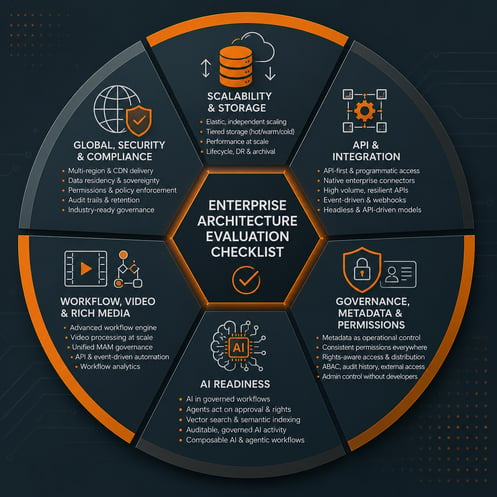
- Is the platform API-first, with all core functions accessible programmatically?
- What native connectors exist for CMS, PIM, eCommerce, ERP, CRM, PLM, marketing automation, creative tools, identity providers, analytics systems, and AI services?
- How does the platform handle high API call volumes, rate limiting, authentication, retries, versioning, and integration resilience?
- Does the platform support event-driven architecture, webhooks, message queues, and orchestration services?
- Can the DAM support headless and API-driven deployment models for channel flexibility?
Governance, metadata, and permissions:
- Is metadata enforced as an operational control layer across governance, rights, workflow, security, and distribution functions?
- Do permissions apply consistently across the UI, APIs, portals, integrations, and downstream system connections?
- How does the platform connect access control to rights management and distribution eligibility?
- Does the platform support attribute-based access control, dynamic permissions, rights-aware inheritance, audit history, and external collaborator access?
- Can administrators configure metadata fields, taxonomy, workflow logic, and permissions without developer support for routine changes?
AI readiness:
- Does AI operate inside governed workflows using trusted metadata, permissions, approval state, and rights context?
- Can AI agents act on assets based on approval state and distribution eligibility, beyond descriptive tags alone?
- Is the metadata model designed to support vector search, semantic indexing, retrieval, AI confidence scoring, and model governance?
- Can AI activity be audited, governed, and constrained by enterprise permissions?
- Does the architecture support composable AI services and agentic workflows without disconnecting AI from the core DAM governance layer?
Workflow, video, and rich media:
- Does the workflow engine support multi-step approvals, conditional routing, reusable templates, exception handling, and workflow analytics?
- Can video processing, transcoding, proxy generation, transcription, and caption generation scale independently from core DAM activity?
- Are MAM workflows governed by the same permissions, metadata, rights, and audit framework as other asset types?
- Can workflow automation connect to downstream delivery systems through APIs and event triggers?
Global, security, and compliance:
- Does the platform support multi-region deployment with CDN delivery and edge caching?
- How does the architecture address data residency and sovereignty requirements?
- Can permissions, rights, and compliance policies be enforced across regions, business units, and external partners?
- Does the platform support audit trails, policy enforcement, retention rules, and secure API access?
- Are industry-specific requirements addressed through configurable governance rather than custom rebuilds?
How Orange Logic Approaches DAM Architecture
Orange Logic approaches digital asset management architecture as an enterprise content infrastructure. Rather than assembling storage, metadata, workflow, governance, AI, security, and integrations as separate modules, Orange Logic unifies these capabilities within a composable architecture that operates as a Content Orchestration Platform across the full content supply chain.
Most DAM platforms are built by layering features onto a fixed underlying structure, which means capabilities like AI, workflow, and governance often depend on how well each module connects to the others. Orange Logic starts with the architecture itself, designing metadata, rights, permissions, and workflows to operate as a single, governed system from the outset, so new capabilities extend the platform rather than sitting alongside it as another integration to maintain.
The architectural foundation includes API-first development, headless deployment options, multi-cloud storage support, including AWS infrastructure, distributed content delivery, configurable metadata models, event-driven workflow automation, granular permissions, rights-aware governance, enterprise security, and a library of prebuilt connectors plus API extensibility. The platform and storage architecture are designed for the load profiles generated by enterprise content operations.
Pearson shows what this looks like in practice. Orange Logic supported 40,000 API calls per minute at peak and delivered a 30% reduction in hosting costs.
Administrators configure metadata fields, workflow rules, permissions models, and rights policies without custom development for routine changes, which means the operating model can evolve without requiring engineering resources as programs scale. That directly affects how quickly governance can adapt when business requirements change.
Orange Logic’s Agentic AI for DAM, through Agent Studio, is built on the same governed metadata, permissions, and rights infrastructure as the core DAM. AI agents can check rights status, flag incomplete metadata, route assets based on approval state, stage distribution-authorized content, and provide next-action guidance within governed workflows. Those agentic operations depend entirely on the metadata and governance architecture underneath them.
AI readiness is a workflow maturity question, not a model capability question. Metadata quality, rights governance, permissions architecture, and content state reliability determine whether AI can act confidently on enterprise content.
Orange Logic was recognized in the Forrester Wave: Digital Asset Management Systems, Q1 2026. Among its top scores (5.0 out of 5.0) were asset onboarding, metadata management, and rights management, the capabilities that enable content orchestration at scale. Those scores reflect the architectural choice that runs through the platform. Metadata management and rights management are built as the operational foundation, woven into the architecture rather than layered on top.
Orange Logic also supports industry-specific DAM solutions for organizations that need governance, permissions, workflows, and content distribution to adapt to different operating environments, including media and entertainment, technology, GLAM, finance, healthcare, retail and manufacturing, education, corporate archives, and nonprofits.
Book a demo to review how Orange Logic’s enterprise content architecture supports your content operations, integrations, governance, and AI readiness requirements.
Architecture Decisions Made Now Determine Scale Later
The right architecture compounds in your favor. A DAM that scales cleanly becomes the operational backbone for governed AI, automated distribution, and content reuse across every brand and region, and it keeps paying that dividend as the program grows. Organizations rarely regret investing in that headroom. They regret selecting software built for today’s asset volume and integration footprint, then hitting the ceiling once content operations outgrow it.
Enterprise DAM architecture is a long-term operating decision, not a one-time software purchase. The platform selected today has to coordinate governance, workflows, integrations, metadata, rights, security, AI, and content distribution across brands, regions, and partners at whatever scale the program eventually reaches. Most enterprises live with that choice for five to ten years, and it either accelerates the content operation or holds it back. Evaluating architecture before procurement is how you make sure it’s the former.
The evaluation checklist above is a practical place to start: use it to pressure-test your current platform against 10x and 100x growth, and see where the architecture holds and where it breaks.
FAQs
What Architectural Capabilities Should Enterprise Architects Evaluate Before Selecting a DAM Platform?
Enterprise architects should assess storage scalability and hybrid tiering, API-first design, headless deployment support, permissions architecture, metadata architecture, workflow automation, security, and integration depth across CMS, PIM, eCommerce, ERP, CRM, and marketing automation systems.
They should also evaluate how access control is enforced at the API layer and how metadata connects to governance and AI readiness. Feature comparisons miss the architectural decisions that determine whether a digital asset management system scales to enterprise volume without re-platforming. The evaluation should include documented performance data at realistic asset volumes, concurrent user loads, and API call rates.
What Is MACH Architecture, and Why Does It Matter for DAM?
MACH is an architectural model built on microservices, API-first design, cloud-native infrastructure, and headless delivery. Each principle addresses a specific enterprise need: microservices let individual capabilities scale and update independently, API-first design enables integration with any downstream system, cloud-native infrastructure supports elastic scaling, and headless delivery separates content management from presentation.
For DAM specifically, MACH principles mean the platform can add new capabilities, support new channels, or scale specific services under load without requiring a full system overhaul.
What Is Headless DAM, and How Does It Differ From a Traditional DAM?
A headless DAM separates the backend asset management layer, where assets, metadata, and rights are stored and governed, from the presentation layer used to browse and manage them. Assets and metadata are delivered through APIs directly to websites, commerce platforms, apps, and partner portals, rather than requiring every downstream system to interact with the DAM’s own interface.
A traditional DAM ties content delivery to its native interface, which limits how assets reach systems the DAM was never built to talk to. Headless architecture removes that constraint, making the DAM a service other systems can consume programmatically.
How Does DAM Architecture Support Agentic AI?
Agentic AI depends on governed metadata, rights context, permissions, and workflow state to act reliably, since an agent can only make decisions as trustworthy as the data it reads. DAM architecture supports this by structuring metadata consistently, enforcing permissions at the API layer, and maintaining audit trails that record every action an agent takes.
Without that foundation, agents may enrich, route, or distribute content based on incomplete or inconsistent information, creating risk faster than a person could catch it. Architecture that unifies metadata, rights, and workflow into a single, governed system enables agentic AI to operate safely at enterprise scale.
How Many Assets Should Enterprise DAM Architecture Support?
There is no fixed number, because the right architecture depends on growth trajectory, not current volume. An organization with 500,000 assets today may reach several million within a few years through acquisitions, new markets, video libraries, or AI-generated content variants.
Enterprise DAM architecture should be evaluated against 10x or 100x current volume, along with the concurrent users, API call volume, and integration load that come with it, since re-platforming after those limits appear in production is far more disruptive than selecting for scale from the start.
How Do You Integrate a DAM With Existing Martech Stacks Without Custom Development for Every Connection?
Integration without custom development for every connection requires a DAM platform with a strong library of native connectors for common enterprise systems and genuine API extensibility for proprietary tools.
Native connectors handle high-frequency integrations across CMS, PIM, eCommerce platforms, marketing automation, creative tools, analytics, and partner portals. REST API and event-driven architecture handle custom internal systems and emerging channels. The evaluation should distinguish between prebuilt connectors and API wrappers because prebuilt connectors are maintained by the vendor, while API wrappers typically require ongoing engineering to stay current.
What Should Enterprises Evaluate in DAM Platforms With API Integrations Before Procurement?
Enterprises should evaluate API call volume capacity under peak load conditions, rate limiting behavior, authentication and API governance architecture, event-driven integration support, and the breadth of native connectors available for the systems already in the stack. API architecture determines whether the DAM can participate in real-time distribution workflows or only support batch exports.
For content operations that depend on downstream synchronization across publishing platforms, commerce channels, and analytics systems, API reliability under load is a production requirement. The DAM should also support monitoring, retries, versioning, and resilient error handling.
How Does a Modern DAM Architecture Support Enterprise Commerce, CMS, PIM, and Marketing Technology Ecosystems?
Modern DAM architecture supports enterprise commerce, CMS, PIM, and marketing technology ecosystems through API-first, headless design that delivers assets and metadata to downstream systems without requiring those systems to interact with the DAM’s presentation layer. CMS integrations pull approved assets and metadata directly through API calls.
PIM and eCommerce integrations keep product imagery, metadata, rights status, localization data, and distribution eligibility synchronized across systems. Marketing automation platforms receive distribution-authorized assets staged through governed workflows, making the DAM an active content service rather than a repository teams export from manually.
How Does Hybrid Storage Architecture Affect DAM Performance for Libraries With Millions of Assets?
Hybrid storage architecture separates assets into access tiers and manages movement automatically based on access patterns, performance requirements, retention rules, and cost. Frequently accessed assets stay in high-performance storage, while less active assets move to warm or cold tiers based on usage frequency.
For libraries with millions of assets, tiering means the system’s high-performance resources serve the content teams actively use rather than the entire archive. Search indexing, preview generation, and API delivery remain fast for active assets because they are not competing with infrequently accessed archive content for the same resources.
Disclaimer: This story is auto-aggregated by a computer program and has not been created or edited by budgetbuddy.
Publisher: Source link
Publisher: Source link