
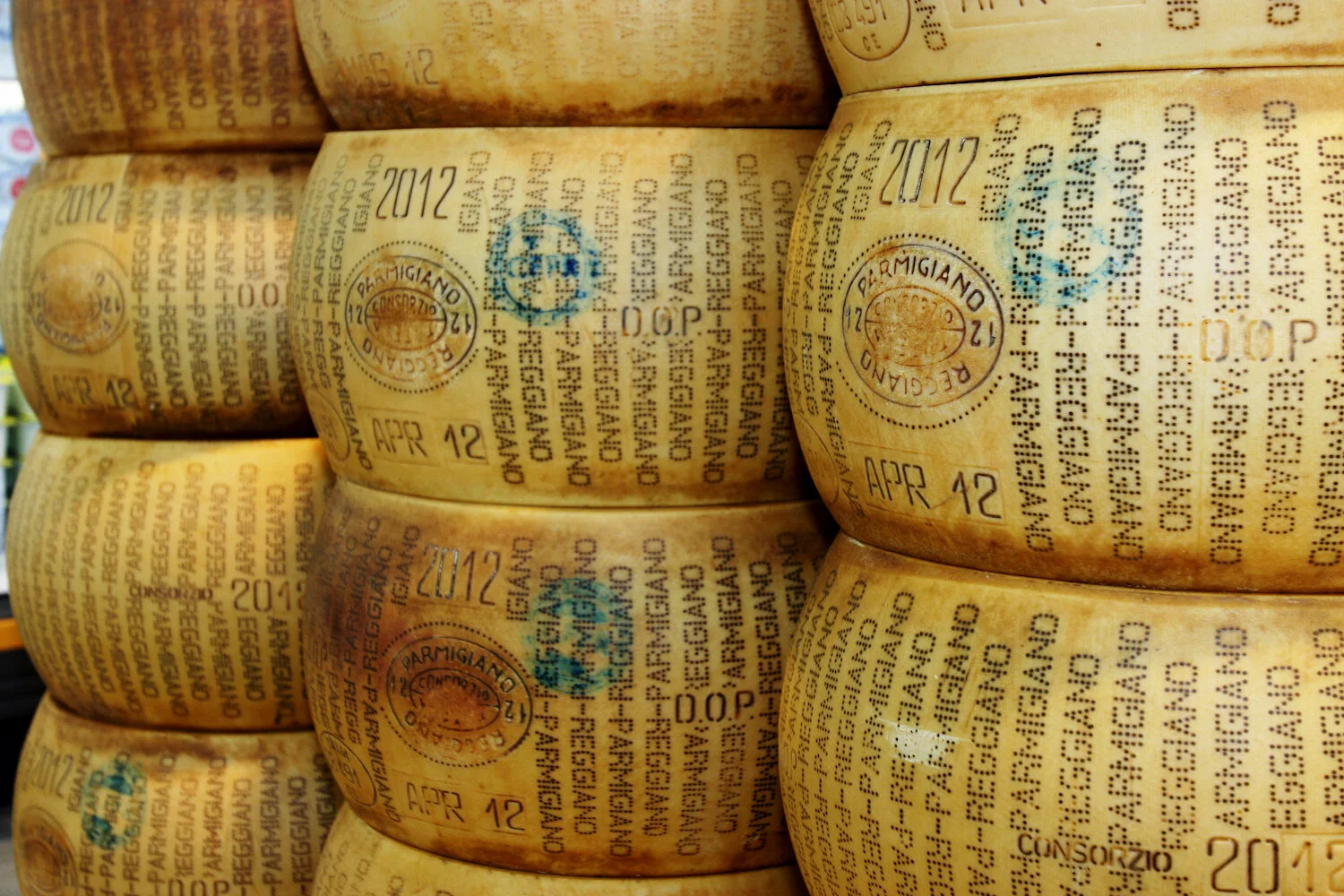
Don’t threaten my parmesan! My olive oil! My coffee. My maple syrup. I love a good food commodity story line to highlight the climate disaster, delivered with a humourous punch. Many of us do. It’s financial and climate news in a relatable headline. It’s economic news for everyday life. Of course it’s no laughing matter.
This August we learned that the punishing heatwave this summer is affecting the Italian $4.7-billion-euro parmiagiano market. The story immediately captured our attention not only because – well parmagiano – but because the wheels of parmesan are so reliably valuable that a regional bank accepts them as loan collateral, aging in climate-controlled vaults. Cheese as gold for the gold of cheese. Now the warming climate is threatening this financialised arrangement.
The point that is often missed is that financial solutions to solve crises of accumulation, debt, or value may temporarily ameliorate threats, but are kicking the can down the road. More than this, they are part of the problem – depleting resources and reproducing a world built on inequality.
In the Italian cheese case, banks store cheese as loan collateral so producers can borrow more money to make more cheese and have additional storage to hold supplies. Cheese needs time to reach its highest value, like other products such as wine (another commodity under threat from climate change).
Banks of cheese may make Canadians think of maple syrup and the global strategic maple syrup reserve which sits in Quebec, Canada. Set up by Producteurs et productrices acéricoles du Québec – a collective of Quebec-based maple syrup producers – it is often called the OPEC of maple syrup for its cartel-like qualities. (Quebec produces around 70% of the world’s maple syrup). It’s a strategic reserve housed across three warehouses to balance against low and high harvest years. Its self-acclaimed goals are to ensure constant supplies to national and international markets and to stabilise prices.
These economic solutions aim to solve accumulation challenges facing food markets with over or under production based on demand needs, storage problems to save for a rainy day or wait until the good becomes more valuable, or to mitigate against environmental (heat waves, droughts) or other ecological threats (like insects) affecting yields.
At the same time, they also expose the goods to other risks – from ecological ones like cheese storage becoming more difficult to keep at the right temperature in a heating planet or grain storage challenges managing moisture or insect exposure, to human risks like fraud or theft where both cheese warehouses and the maple syrup reserve have been victims of major burglaries worth up to $875,000 and 14.4 million respectively.
Moreover these economic solutions that help on the one hand reinforce a system that got us here in the first place. Overconsumption spurs producers to degrade the diverse ecosystems that support healthy maple forests to maximise short term syrup production, store more and more parmesan in warehouses requiring complex safe storage conditions, and ship more coffee ahead of regulations meant to fight deforestation. It also hides the labour behind the food – and who hurts most when the climate emergency hits us or when debts cannot be repaid.
Other commodity markets – oil for example – similarly look for fixes to their economic woes. Consider when oil traders buy oil cheap and store it in tankers at sea until prices recover. We can see a key example of this in the 2020 COVID-19 crisis where there was so much demand for oil storage that “even old rust-buckets were brought out from mothballs.” Sales when prices recovered were a bonanza for the trading industry. Futures trading in oil – a key part of the financialisation of the industry – was a market innovation to the price shocks stemming from Middle Eastern oil company nationalisation and the embargo in 1973 and the Iranian revolution in 1979.
It’s a common capitalist tale – how to add value and increase wealth – how to ‘win’ out of a crisis. But ask, who loses for that win? Managing transportation and “storage in the built environments of capitalist accumulation” can have devastating consequences for workers, animals, and the environment. While these fixes relieve pressure on supply chains, they also disguise the inequality built into them, each financialised solution adding time and distance between producers and the people who labour and the people who consume. What gets masked? Central American coffee bean farmers facing seasonal food insecurity. Cocoa farmers who have never tasted chocolate and can barely afford to feed their families (Oxfam found that up to 90% of Ghanaian cocoa farmers do not earn a living income). Gambian, Senegalese, and Tunisian irregular migrants picking premium olives for Italian gangmasters in any temperature, for pennies while living in squalor. Grape pickers dying in the heat to pick the grapes for champagne. All for our indulgence. We become disconnected from the ecological life sustaining our food, the animal life supplying it, and the human life – the labour – that goes into our consumption practices.
The world of eating and working is changing not only from our heating climate, but from new technologies. Automation eases labour but also displaces workers. Blockchain allows farmers to pledge wheels of cheese to the banks even when the cheese stays in their own storage, doubling lending capacity. Alongside LLMs, Blockchain’s trusted transactions rely on massive data centres further draining our resources and putting pressure on our environment. Commodity and other value chains hide labour behind distance, storage, and technology.
This is about our climate emergency, like all the climate shock on our luxury food articles suggest. But the deeper concern should not be our palates and the last time we may enjoy coffee, chocolate, wine, cheese, or real maple syrup coated pancakes. It’s the systems that push us to continue to grow our economies and consume ever and ever more. If these stories help us address the capitalist machines pushing our planetary and human boundaries, then perhaps we should collectively cry for our gastronomy-loving first world lives. But let’s also give a thought about how we might really address it and who is really bearing the brunt of climate change – a capitalist crisis. These market fixes are not the solution but a paper over of an unequal system that fails the environment, workers, animals, and consumers of food.
Crystal A. Ennis is a scholar of global political economy based at Leiden University in the Netherlands.
Disclaimer: This story is auto-aggregated by a computer program and has not been created or edited by budgetbuddy.
Publisher: Source link
Publisher: Source link