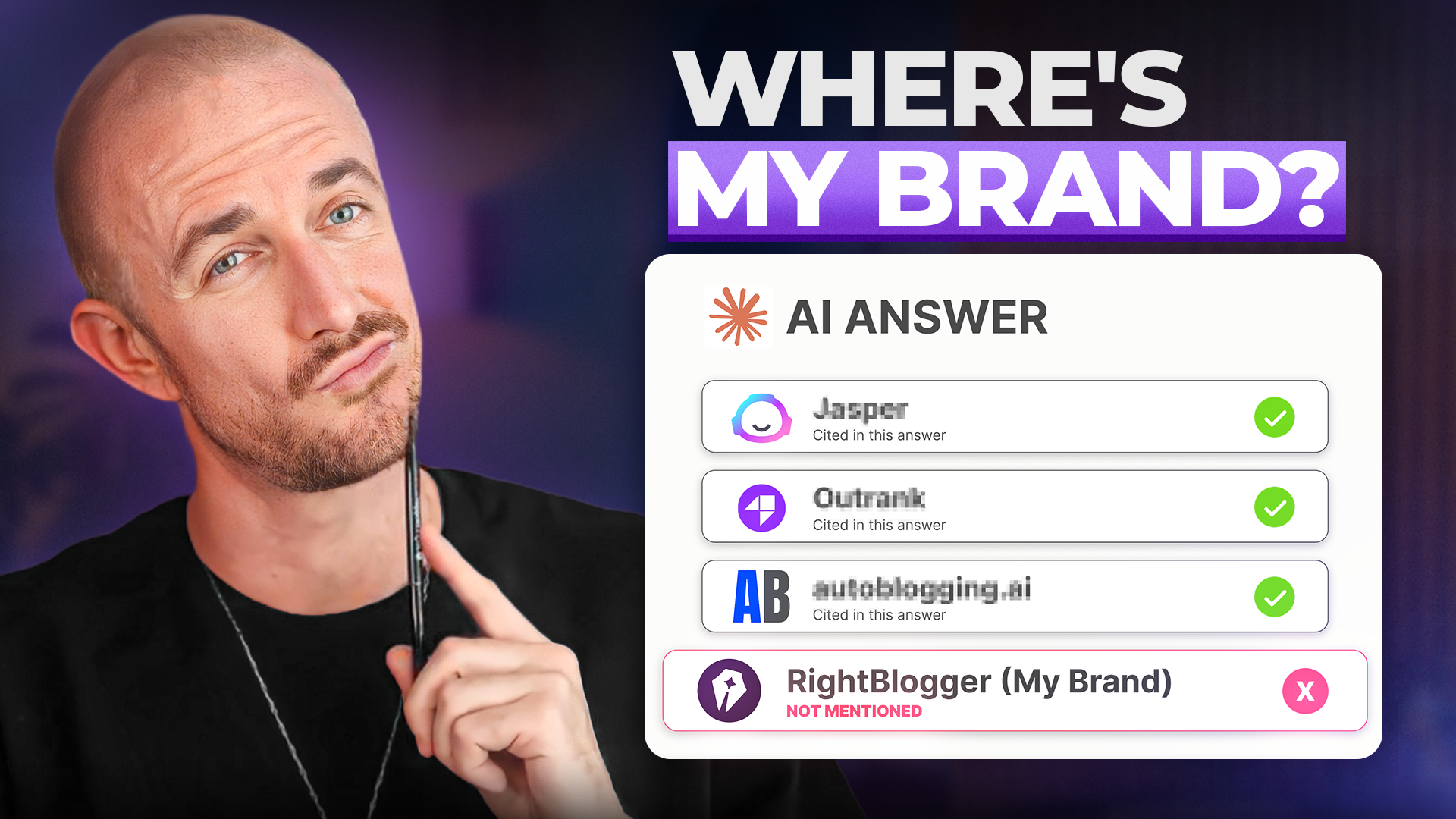
Your customers are typing direct queries about your category into ChatGPT, Perplexity, and AI Overviews, and if your brand isn’t in those answers, a competitor’s is. Building an AI search content strategy is how you show up, yet most businesses still fixate on coverage percentages and other vanity metrics like a report card while organic traffic slips away through zero-click searches.
Real tracking means analyzing earned brand mentions and how modern AI search engines use query fan-out to source citations. From there the workflow is simple. You monitor the prompts customers ask, diagnose content gaps, and turn them into research-backed briefs with Claude, then align each with keyword research, conversational search intent, and answer engine optimization before you publish.
Here’s my full video walking you through the real numbers, brand reports, and citations behind it all:
Key Takeaways for Building an AI Search Strategy
- AI search visibility is an underused traffic signal. ChatGPT, Perplexity, and Google AI Overviews decide which brands show up in their answers, and most businesses never measure their generative engine optimization results.
- Brand coverage and share of voice reveal where you stand. Coverage is the share of tracked prompts where you appear, while share of voice is how many AI mentions you own next to everyone else in your niche. Entity consistency across those citations turns those numbers into brand authority.
- The real intel lives inside each prompt. A single dashboard number won’t help you much, but clicking into one prompt shows the actual AI answer, the competitors named, and the exact URLs cited. It also reveals how large language models use query fan-out to split complex prompts into smaller searches.
- Claude turns raw data into a brief in minutes. With the right connection, Claude reads your real brand reports and writes a research-backed content brief for the exact gap you found.
- Citation-worthy content needs six specific elements. Direct answers, question headings, named entities, primary sources, structured data, and freshness signals.
Find the AI Citations You’re Missing with: Otterly AI
I’ve tested a lot of AI visibility tools, and OtterlyAI is the one that earned a permanent spot in my workflow. It turns a vague feeling of not knowing whether I show up into a clear map of where competitors get cited instead of me. Set up your first brand report for free and see your own gaps today!
Why Your AI Search Visibility Is a Treasure Map, Not a Report Card
Search is shifting fast. Fewer than one in three Google searches now ends in a click, because people are getting their answers directly inside AI assistants. If you only track traditional blog SEO rankings, you’re blind to everything happening inside those chat tools.
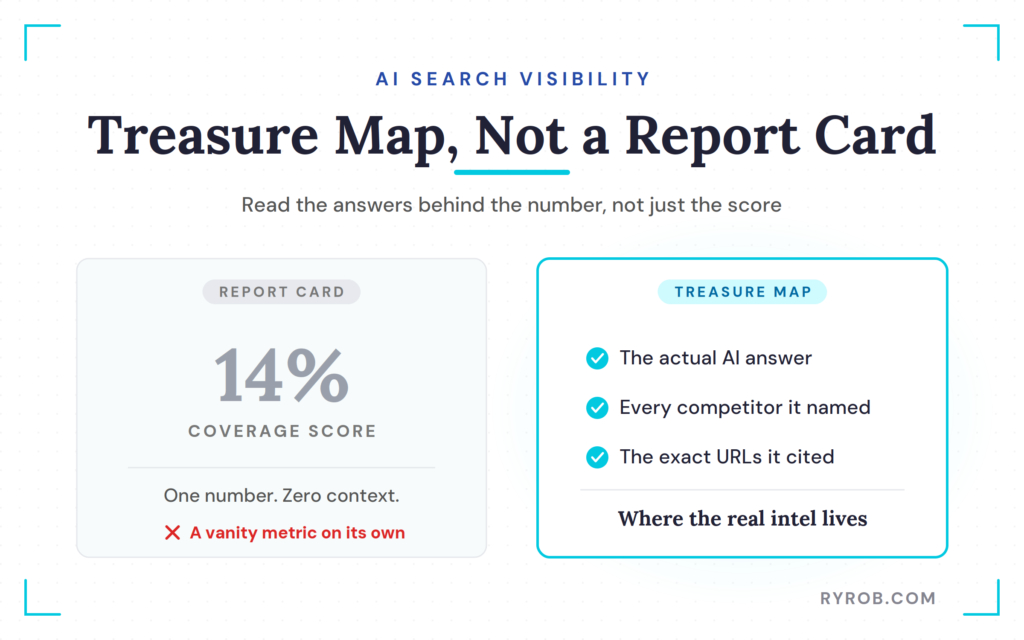
A coverage percentage on its own won’t tell you much. Say your brand shows up in 14 percent of relevant prompts. Does that feel bad? It honestly depends on what’s underneath the number.
The raw statistic matters far less than the actual AI answers, the brands they mention, and the URLs they choose to cite. That’s where the real intel lives, and that’s the treasure map part.
Let me use my own work as an example. In OtterlyAI, I track prompts for my blog automation company, and the data showed me at lower coverage than the category leader, Jasper. On the surface, that looks like a loss.
But digging into the prompt details showed an even playing field where I had a wide-open chance to pull ahead. That’s exactly the spot where one strong piece of content shifts the balance.
What Brand Coverage and Share of Voice Actually Tell You
Let’s get the definitions straight. Brand coverage is the percentage of the prompts you’re tracking where your brand appears in the AI’s answer. Share of voice is how much of the total AI mentions in your category belong to you compared to everyone else named.
Raw numbers matter less than the trend across weeks. A coverage figure that feels small still counts once it’s climbing on prompts your real customers use. Traffic, trust, and revenue tend to follow.
How to Build an AI Search Content Strategy From Scratch
The method comes down to four steps. You monitor, you find the gap, you brief it, and you publish. You can run this whole play as a solo blogger or a small team, and it works because it’s really just a modern SEO content strategy built for a new kind of search.
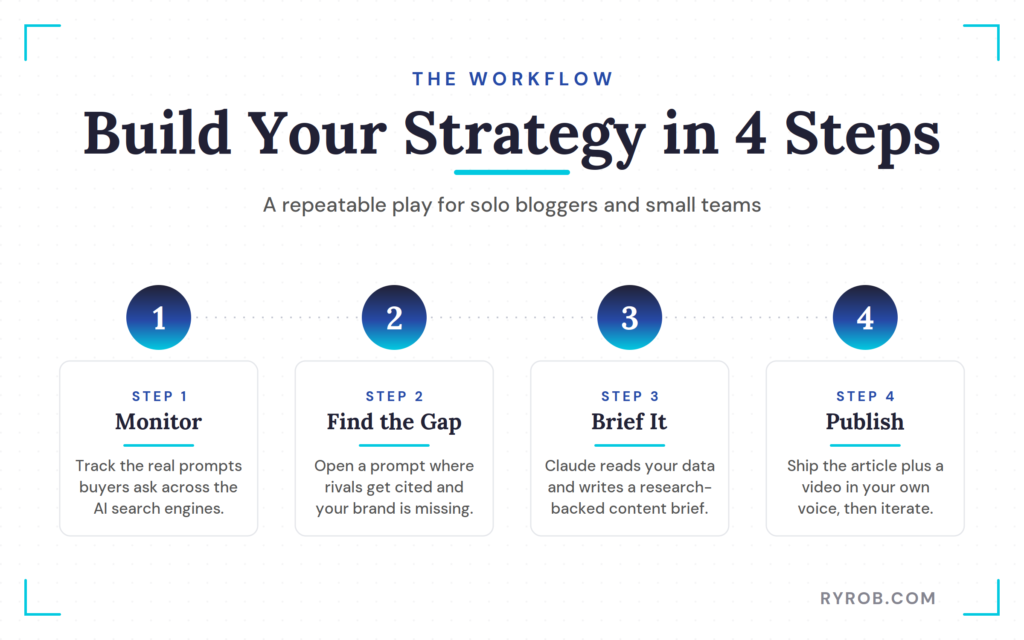
Instead of guessing what to write, you track your visibility and then create content where AI already cites someone other than you. That’s where you have the most to gain.
Step 1: Set Up Your Prompts and Brand Report in Otterly AI
The most important part of this step is building the right prompt set. Instead of leaning only on traditional keyword research, track the questions you actually hear from buyers in sales calls, support tickets, and email replies. Those real phrasings are what reveal authentic search intent.
If buyers word a question a certain way, track that exact wording. A single prompt can trigger query fan-out across different AI search engines, which surfaces the related questions they pull together to form an answer.
In the blog automation space, that looks like something such as “Can I automate my blog using AI writing tools?” OtterlyAI runs those prompts across the AI platforms on a daily or weekly schedule, then saves the answer each time so you can inspect it later.
Step 2: Diagnose a Real Content Gap Your Competitors Are Missing
Click into a specific prompt and open the stored answer. A gap shows up when your brand isn’t in the response, competitors are named, and the citations point straight at their pages. Those are the shortest routes to a win.
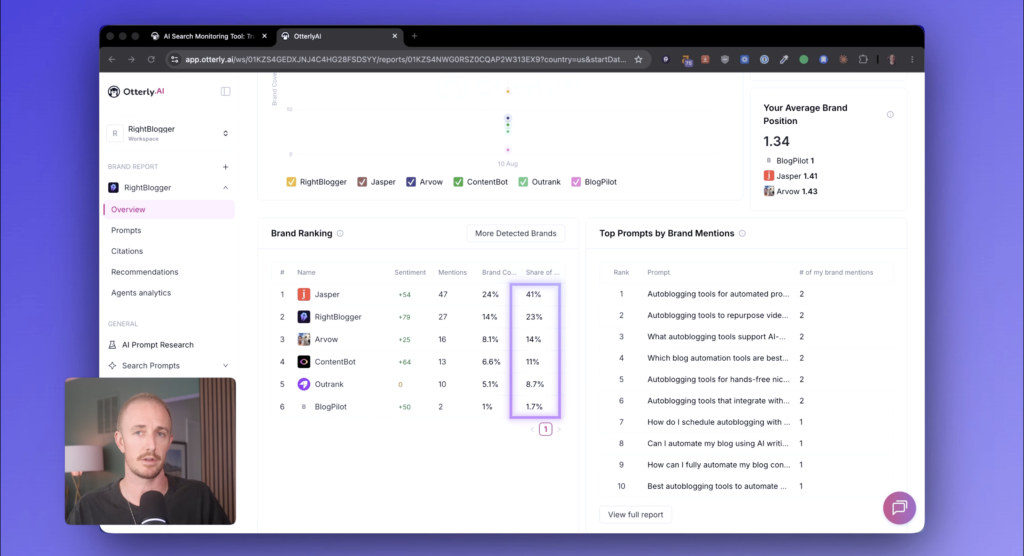
From there, analyze the competitor citation patterns to find untapped openings. Look for prompts where competitors dominate through unlinked brand mentions, or where they don’t have dedicated comparison pages. Also watch for competitors cited about as often as you are, especially when their content honestly isn’t that strong.
And keep an eye out for articles that name one of your competitors without linking to them. That’s a classic outreach opportunity, where you ask the author to add your brand and earn both a mention and a future citation.
Step 3: Turn the Gap Into a Brief With Claude and the MCP Connector
This is where the magic happens. You connect Claude to your OtterlyAI data through the Model Context Protocol, an open-source standard for connecting AI apps to outside systems. Once it’s linked, Claude can pull your Otterly data to analyze competitor comparison pages and evaluate the sub-queries created by query fan-out.
Give Claude your actual reports and citations rather than a copy-paste. In my case it picked the prompt “blog automation tools for generating optimized product roundups,” pointed out that one of my competitors sat at zero coverage, and built a full brief.
The plan covered the questions to answer, the topic structure, the sources to include, and even a video story. It was built for semantic depth and clear entity consistency. Claude handled the analysis, but the actual writing still falls to me, and no AI writing tool changes that part.
Step 4: Pair Your Written Content With a YouTube Video
Claude flagged more than an article in the brief. It pointed out that video platforms like YouTube dominate citations in AI search results, which lines up with research from Search Engine Land on where AI answers pull their sources.
A video that answers the question, published on your own channel and embedded in the page, gives you a decided edge.
Use the video and article together in an iterative content optimization workflow. That’s how you secure multi-format citations while improving the page over time.
That’s the winning formula: pair the written article with a real video where you speak in your voice. That makes a unique piece nobody else can copy. It’s not just generated copy; it’s your story, your experience, your take.
The 6 Structural Elements That Make Content Citation-Worthy
Even the best brief fails if the content isn’t built to earn citations. Generative engine optimization requires adapting to evolving AI ranking factors, not just classic Google signals.
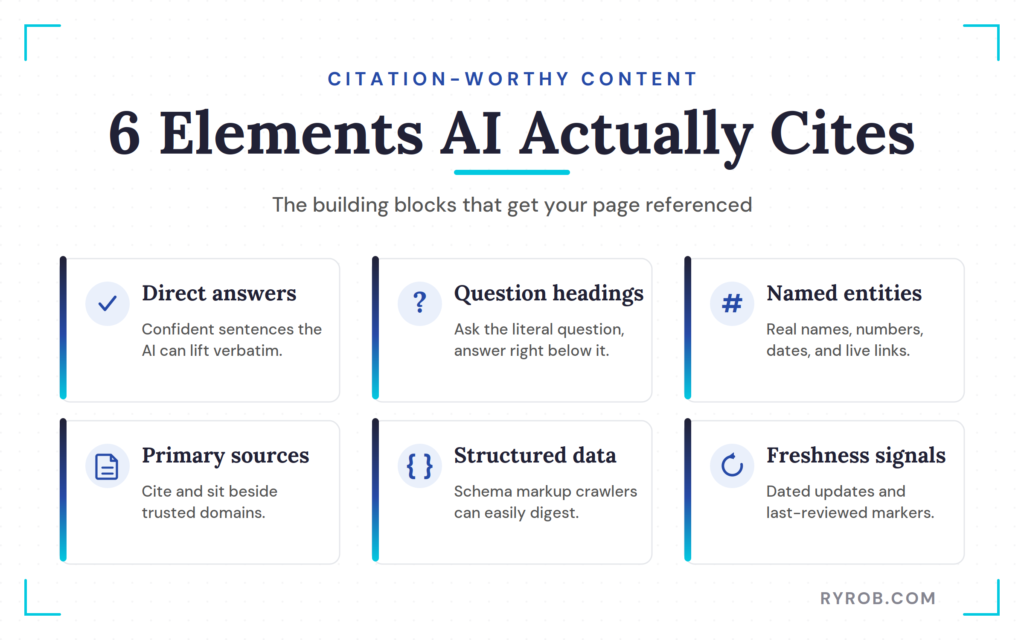
These 6 principles separate the pages AI references from the pages AI skips:
- Direct factual claims. Write confident sentences the AI can lift verbatim. Clear facts provide the semantic depth large language models need. Vague marketing language doesn’t make the cut.
- Question-answer structure. Use the literal question as a subheading, then answer it directly below. This format satisfies sub-queries created during query fan-out, so hand AI systems the answer they’re looking for.
- Named entities and specifics. Use real names, numbers, dates, and links. Maintain entity consistency across product entities and comparison pages. Don’t reference an anonymous customer.
- Authoritative citations. Link to primary sources. Being adjacent to trusted domains strengthens the authority signals needed to build recognized topical authority.
- Structured data. Combine structured data with schema markup so AI crawlers can easily digest entity relationships. Keep the setup clean for FAQs and articles without sacrificing user experience. Add real authors with bylines and linked trusted profiles.
- Freshness signals. Dated updates and “last reviewed” markers matter because AI models favor current sources.
Setting Realistic Expectations for Getting Cited in AI Search
Let me be straight with you. No tool can promise you’ll get cited by ChatGPT, because nothing can. AI answers shift constantly, models change, and citations move around all the time.
The good news is you don’t need perfection. Continuous monitoring keeps your baseline organic traffic protected, and the workflow turns that monitoring data into real publishing decisions. You stop guessing which piece to write next, and you start writing where the AI is already looking for an answer.
If you want to try this on your own site, you can set up a free OtterlyAI account in about two minutes and pull up your first brand report. From there you’ll see the citations your competitors are winning, and you’ll know exactly what to do about them.
FAQs About Building an AI Search Strategy
A few quick answers to the questions I hear most about this.
Do I Need to Check My AI Visibility Even if I’m New?
Yes. New sites often beat the big names here, because your content can compete the moment it’s aimed at the right prompts. Those prompts are your edge.
Which AI Tools Actually Cite Their Sources?
ChatGPT, Perplexity, Google AI Overviews, Gemini, and Claude all cite web pages. They use AI crawlers to parse source content, so that’s the audience you’re trying to impress.
Is Getting Cited a Guaranteed Result?
No. This is a scale, not a switch. Consistent brand mentions depend on satisfying ranking factors across multi-step queries, and query fan-out can change which sources get evaluated. The workflow improves your odds, but nothing promises a mention.
How Long Before I See Changes?
AI updates constantly, so watch the trend over a month or more, not a few hours. Steady entity consistency across your web properties helps create compounding gains. This is a long game, and the compounding is real.
Final Thought About Having an AI Search Content Strategy
AI search is the biggest traffic source almost nobody is optimizing for yet. The gap is real, and the map is sitting right there in your visibility data. Monitor, flag the gap, brief a piece with Claude, publish it, and watch what happens.
You don’t need to be a big brand or an SEO wizard to run this. You just need to watch the structural elements and keep the promise of writing only where you can actually win. Your next customer is already asking someone this question, so make sure the answer points back to you.
Find the AI Citations You’re Missing with: Otterly AI
I’ve tested a lot of AI visibility tools, and OtterlyAI is the one that earned a permanent spot in my workflow. It turns a vague feeling of not knowing whether I show up into a clear map of where competitors get cited instead of me. Set up your first brand report for free and see your own gaps today!
Disclaimer: This story is auto-aggregated by a computer program and has not been created or edited by budgetbuddy.
Publisher: Source link
Publisher: Source link