

Quick Takeaway
-
DAM metadata succeeds only when users maintain it consistently, which requires fields tied to measurable business outcomes rather than classification categories.
-
Every field should justify its existence through at least one of five outcomes: discovery, governance, content reuse, or automation and intelligence.
-
The most valuable metadata fields support multiple outcomes simultaneously, and controlled vocabularies are essential for any field that feeds into governance, automation, or AI.
-
AI readiness and metadata readiness are increasingly the same problem: AI amplifies the need for structured, accurate metadata rather than replacing it.
What Is DAM Metadata?
DAM metadata is the structured information that describes, governs, routes, secures, and enables the use of digital assets throughout their lifecycle. While metadata is often associated with search and organization, enterprise metadata also powers workflow automation, rights enforcement, governance controls, reporting, and AI-powered content operations. 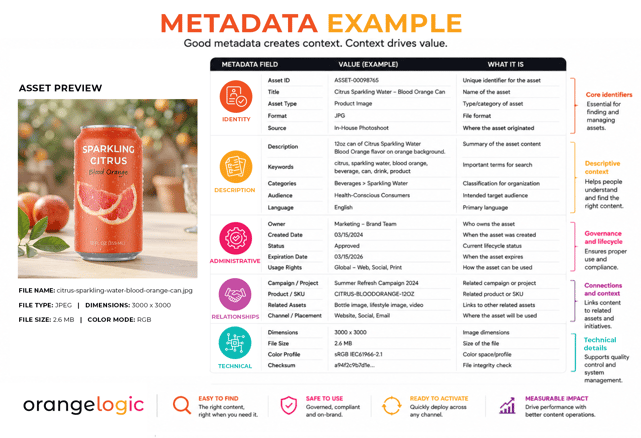
Per Alatio’s summary of Gartner’s metadata research, by 2027, organizations with active metadata management are projected to deliver new data assets up to 70% faster than those without it. For enterprise DAM programs, that gap shows up in content reuse rates, workflow automation performance, rights and governance enforcement, AI readiness, and search quality. It spans the full scope of what content operations requires to function at scale.
The difference between organizations on either side of that gap is rarely effort. Schemas built around classification categories rather than business outcomes follow the same pattern of failure. Teams add fields for every new use case; adoption declines as contributors skip or guess at inputs; metadata quality degrades; and improvements to discovery, governance, and reuse never arrive.
Metadata that actually scales is built on one constraint: every field should justify its existence through at least one measurable business outcome. At scale, well-designed metadata becomes the operational context layer that workflows, governance, rights management, and AI systems depend on to function reliably.
For teams building AI-powered content operations, that connection is direct. Metadata readiness and AI readiness are the same question: AI outputs are only as reliable as the structured metadata those systems work from.
DAM Metadata Is Only Valuable If People Use It
Enterprise metadata initiatives fail for a predictable reason. Teams design schemas around classification categories such as department, file format, and asset type, treating metadata as a DAM configuration task rather than a content operations decision, and wonder why search quality stays poor, why assets get re-created instead of reused, and why governance audits surface the same gaps year after year. When poor metadata is the foundation, the consequences go beyond search. Approvals route to the wrong reviewers, rights restrictions go unenforced, AI surfaces expired or restricted assets, and governance breakdowns become recurring rather than isolated.
When fields exist because someone thought they might be useful someday, contributors skip them or enter inconsistent values. When upload forms have 40 fields, users fill in 10 and guess on three. When controlled vocabularies don’t map to how teams actually describe their work, free-text entries proliferate, and search quality degrades across the entire library. When rights and approval metadata is missing or inconsistent, distribution controls fail, and content reaches channels or markets it was never cleared for.
More fields, in this context, produce worse metadata, not better coverage. Excessive schema complexity also creates governance overhead and erodes confidence in automation and AI outputs. Systems cannot act reliably on metadata that contributors do not maintain consistently.
Sustainable DAM metadata models start with a different question: not “What information could we capture about this asset?” but “What business outcome does this field support?” A field that supports no measurable outcome has no place in an enterprise schema. That constraint produces leaner, higher-quality metadata that people maintain because it makes their work easier, not harder.
What Happens When Metadata Is Designed Around Outcomes Instead of Categories?
Every metadata field in a well-designed schema supports at least one of four business outcomes.
|
Outcome |
Business Question |
|
Discovery |
Can users find content? |
|
Governance |
Can content be used safely? |
|
Reuse |
Can content be leveraged again? |
|
Automation & Intelligence |
Can systems understand and automate content? |
|
Workflow/ Orchestration |
Can content be routed, reviewed, and acted on through the right processes? |
This framework shifts digital asset management metadata from a cataloging exercise to an operational system. Workflow and orchestration capabilities are embedded in the automation and intelligence dimension. Metadata in this category enables content to move through automated approval, rights validation, localization, and distribution workflows, eliminating manual handoffs at each stage.
Discovery
Discovery metadata supports search relevance, faceted filtering, and asset retrieval. Fields like Product, Campaign, Region, Language, Asset Type, and Content Owner let users filter results to what they actually need rather than sorting through everything that matches a keyword. Discovery is not only about finding content, it’s also about finding existing approved content before commissioning new work. When metadata is accurate enough for contributors to identify what already exists, production volume decreases, and the content library becomes more valuable over time.
The most direct measures are time-to-find, search abandonment rate, and search success rate. When discovery metadata degrades, teams stop trusting the system and default to manual requests, shifting work onto library managers rather than eliminating it.
Governance
Governance metadata keeps content safe to use. Full governance coverage extends beyond compliance to include rights management, permissions controls, workflow authorization, regional licensing restrictions, and AI governance guardrails. When these are embedded in structured metadata rather than enforced manually, governance scales with the content operation rather than falling behind it. The Rights Status, Expiration Date, Approval Status, and Legal Classification fields allow enterprise teams to enforce usage restrictions without relying on institutional memory or manual pre-distribution checks.
For DAM programs managing licensed photography, talent agreements, regional restrictions, or embargo periods, this metadata separates compliant content operations from liability exposure. Rights metadata also shapes how content moves through workflows. When Rights Status, Approval Status, and Expiration Date are accurate, content routes through the correct approval steps, distribution permissions are applied automatically, and AI systems operate within authorized parameters. When those fields are missing or inconsistent, controls fail silently.
A well-implemented DAM governance framework connects rights data directly to the asset, so controls can be enforced at scale rather than spot-checked by hand. Governance health shows up in compliance incident rates, expired asset usage, and audit performance.
Reuse
Reuse metadata connects current assets to future use cases. Fields like Campaign, Product Family, Related Assets, and Localization Status help teams identify what exists before commissioning new work, and adapt approved content for different channels and markets without starting from scratch.
Content reuse rate is the primary metric here, but the business case also shows up in reduced duplicate content creation and lower production costs over time. When reuse metadata is accurate, content created for one campaign becomes raw material for the next. Faster campaign cycle times and improved return on content investment follow when metadata makes existing assets easy to find, adapt, and repurpose at scale.
Automation & Intelligence
Automation and intelligence metadata enable automated workflow routing, reporting, AI enrichment, and agentic operations across the content lifecycle. Fields such as Content Category, Audience, Channel, and Performance Tags give systems the context they need to trigger automated workflows, surface relevant recommendations, and generate accurate reports.
Automation is one of the most direct ways metadata produces operational value. When fields like Approval Status, Rights Status, and Expiration Date are accurate and structured, systems can take action without manual review, routing content to the right teams, blocking expired assets from distribution, and triggering AI enrichment at the appropriate stage of the workflow.
As organizations bring AI into their content operations, the quality of automation and intelligence metadata directly affects the quality of the output. AI tools can identify objects in an image or suggest captions, but they cannot reliably determine workflow stage, approval status, usage rights, or content relationships without structured metadata to work from. For teams building AI-powered content operations, metadata readiness and AI readiness are the same preparation.
Workflow Orchestration
Workflow orchestration metadata determines how content moves through the processes that govern its creation, review, approval, and distribution. Fields like Workflow Stage, Approval Status, Distribution Eligibility, Permissions, and Localization Status give systems the context they need to route content to the right reviewers, enforce rights restrictions at the appropriate lifecycle stage, and trigger the next workflow step without manual coordination.
When orchestration metadata is accurate, content supply chain management becomes operational rather than administrative. Assets enter localization when the metadata record confirms they are approved and rights-cleared. Distribution controls activate automatically when Expiration Date or Rights Status fields change. Downstream systems, including CMS, PIM, commerce platforms, and partner portals, receive content with the context needed to act on it correctly rather than waiting for manual handoffs at each stage.
The primary measures of orchestration health are approval cycle time, content velocity, and error rate at each workflow stage. When workflow orchestration metadata is incomplete or inconsistently maintained, content stalls in queues, governance checks happen manually at distribution rather than automatically at each lifecycle stage, and downstream systems receive assets without the context they need to use them correctly.
Why Do Metadata Models Break Down as Content Operations Grow?
A schema that works well at 100,000 assets often shows strain at 500,000 and breaks down at 1 million or more. But asset count is only one dimension of scale. The same breakdown happens when content operations expand across multiple brands, regions, business units, content types, workflows, and connected systems, even before asset volumes reach enterprise thresholds. The mechanics of this failure are consistent.
Schemas expand over time as teams add fields for new use cases without retiring fields that no longer serve their original purpose. This creates metadata bloat: schemas with 60 or 80 fields, most of which are inconsistently populated or entirely ignored. Governance becomes harder to enforce as the number of required inputs grows.
Multi-brand and multi-region environments amplify the problem. When different business units, agency contributors, and vendor teams are all ingesting assets, metadata inconsistency compounds without centralized vocabulary management and clear tagging rules. A controlled vocabulary that works for one region may not map to another; a taxonomy built for marketing content may not serve archive or compliance requirements.
The complexity compounds further when multiple content types, workflows, and connected systems are involved. Metadata that governs marketing assets may not map cleanly to product content, compliance content, or media operations, and schemas that don’t account for these differences break down when teams try to enforce consistent governance across all of them.
Manual tagging at scale introduces another layer of degradation. Even well-trained contributors make different choices when applying subjective fields, and those differences multiply across thousands of assets. The result is a schema in which the same asset might be tagged in three different ways by three different contributors, producing inconsistent search results for the same query.
Addressing this requires simplifying the schema to fields that support measurable outcomes. That means establishing controlled vocabularies for high-value fields, automating tagging where possible, and building governance processes designed for enterprise scale.
Which Metadata Fields Deliver the Greatest Enterprise Value?
The most valuable metadata fields support multiple outcomes simultaneously.
|
Field |
Discovery |
Governance |
Reuse |
Intelligence |
Workflow/Orchestration |
|
Rights Status |
✓ |
✓ |
✓ |
✓ |
|
|
Campaign |
✓ |
✓ |
✓ |
||
|
Approval Status |
✓ |
✓ |
✓ |
||
|
Region |
✓ |
✓ |
✓ |
||
|
Expiration Date |
✓ |
✓ |
✓ |
||
|
Workflow Stage |
✓ |
✓ |
✓ |
||
|
Distribution Eligibility |
✓ |
✓ |
✓ |
✓ |
Fields like Rights Status and Approval Status earn their place in any enterprise schema because they simultaneously power search filtering, enforce governance, support reuse decisions, and feed automated workflow logic. Workflow Stage, Distribution Eligibility, Permissions, and Localization Status are equally operational. These fields determine how content routes through approval workflows, which distribution channels it can enter, and what AI systems are authorized to do with it at each stage of the lifecycle.
Asset Title, Product, Brand, Language, and Content Owner consistently produce measurable operational value across discovery, rights enforcement, and cross-channel publishing, without creating a significant tagging burden when backed by controlled vocabularies. In practice, the same fields that support marketing content operations also power product content management, compliance content tracking, retail content distribution, and media operations. The metadata schema that works for one content type should be designed to scale across all of them.
Over-engineered fields tend to be hyper-specific categorizations that made sense to the schema designer but don’t map to how users search, how systems route content, or how governance is enforced. These fields are populated inconsistently and deliver little value at the cost of significant friction for contributors.
What Is the Difference Between Metadata, Tags, Taxonomy, and Controlled Vocabulary?
Enterprise DAM teams often use these terms interchangeably, creating downstream governance confusion.
Metadata is the structured information that describes an asset’s attributes, context, rights, technical specifications, and lifecycle status. It is the broader category that encompasses everything else. The types of metadata in DAM include descriptive, administrative, technical, rights, and structural, each serving a distinct function in how assets are found, governed, and reused.
Tags are informal, often user-generated keywords attached to assets to support search. They are flexible but ungoverned by default. In large content libraries, unconstrained tagging produces thousands of near-duplicate terms (marketing, Marketing, MARKETING, mktg) that degrade search quality over time.
Taxonomy is the formal hierarchical classification structure used to organize assets and their associated values. A well-designed DAM taxonomy might define that Campaign values follow a hierarchy of Brand, Region, Year, and Campaign Name.
Controlled vocabulary is the approved list of terms for a given field, enforced through dropdowns or selection menus. Where tags allow free text, a controlled vocabulary enforces consistent entries: contributors select “North America” from a list rather than typing “NA,” “N. America,” or “Americas.” Consistent controlled vocabulary values also improve workflow routing, automation reliability, and reporting quality. When field values are standardized, systems can match and act on them predictably; when they are not, automation degrades, and AI recommendations lose confidence.
Ontology defines the relationships between entities and concepts, enabling systems to understand not just that an asset belongs to a campaign, but how that campaign relates to a product line, a market, and a distribution channel. Standards bodies like IPTC define widely adopted metadata schemas for media and DAM environments that support interoperability across systems.
For enterprise DAM programs, high-value fields that feed discovery, rights management, and automation should use controlled vocabularies. Lower-stakes descriptive fields may allow open tagging with periodic cleanup. Taxonomies should map to how teams actually organize work, not to how the original system admin thought work should be organized. The operational stakes of these distinctions become clear at scale. An asset tagged with “mktg” instead of “Marketing” is effectively invisible to search, workflow, and AI systems that expect the controlled value. A taxonomy that doesn’t reflect how teams organize work produces metadata no one maintains consistently, and ontology gaps mean AI systems cannot traverse the relationships between campaigns, products, and markets to make reliable decisions.
What Is the Difference Between Metadata, Tags, Taxonomy, and Controlled Vocabulary?
Enterprise DAM teams often use these terms interchangeably, creating downstream governance confusion.
Metadata is the structured information that describes an asset’s attributes, context, rights, technical specifications, and lifecycle status. It is the broader category that encompasses everything else. The types of metadata in DAM include descriptive, administrative, technical, rights, and structural, each serving a distinct function in how assets are found, governed, and reused.
Tags are informal, often user-generated keywords attached to assets to support search. They are flexible but ungoverned by default. In large content libraries, unconstrained tagging produces thousands of near-duplicate terms (marketing, Marketing, MARKETING, mktg) that degrade search quality over time.
Taxonomy is the formal hierarchical classification structure used to organize assets and their associated values. A well-designed DAM taxonomy might define that Campaign values follow a hierarchy of Brand, Region, Year, and Campaign Name.
Controlled vocabulary is the approved list of terms for a given field, enforced through dropdowns or selection menus. Where tags allow free text, a controlled vocabulary enforces consistent entries: contributors select “North America” from a list rather than typing “NA,” “N. America,” or “Americas.” Consistent controlled vocabulary values also improve workflow routing, automation reliability, and reporting quality. When field values are standardized, systems can match and act on them predictably; when they are not, automation degrades, and AI recommendations lose confidence.
Ontology defines the relationships between entities and concepts, enabling systems to understand not just that an asset belongs to a campaign, but how that campaign relates to a product line, a market, and a distribution channel. Standards bodies like IPTC define widely adopted metadata schemas for media and DAM environments that support interoperability across systems.
For enterprise DAM programs, high-value fields that feed discovery, rights management, and automation should use controlled vocabularies. Lower-stakes descriptive fields may allow open tagging with periodic cleanup. Taxonomies should map to how teams actually organize work, not to how the original system admin thought work should be organized. The operational stakes of these distinctions become clear at scale. An asset tagged with “mktg” instead of “Marketing” is effectively invisible to search, workflow, and AI systems that expect the controlled value. A taxonomy that doesn’t reflect how teams organize work produces metadata no one maintains consistently, and ontology gaps mean AI systems cannot traverse the relationships between campaigns, products, and markets to make reliable decisions.
How Does Metadata Influence AI Readiness?
AI raises the stakes for metadata quality rather than reducing the need for it. Poor metadata creates governance risks, enables rights violations, and produces AI recommendations that cannot be trusted. These are not edge cases. They are predictable outcomes of operating AI systems on metadata designed for cataloging rather than operational decision-making.
Metadata and AI are increasingly treated as the same readiness question, and for good reason: AI needs context to produce reliable outputs, and metadata is how that context is structured. The 70% faster data delivery finding from Gartner reflects a direct relationship between metadata maturity and operational performance that applies to AI use cases across the board.
An AI agent can suggest classifications and surface related assets, but it cannot reliably determine whether a rights window has expired, whether an asset is approved for a specific market, or where content sits in the production workflow without structured metadata to work from.
When metadata quality is low, AI outputs reflect it directly. Search results surface outdated or expired assets, automated recommendations ignore usage restrictions, rights violations occur when expired or restricted content enters active distribution, and governance gaps compound across every workflow that depends on the metadata record.
Teams preparing for AI-supported content operations can assess their AI metadata readiness by asking four questions about any asset: Is it approved? Can it be used for this purpose? Where does it fit in the current workflow? What related content exists?
Permissions and workflow state are equally important readiness indicators. When an AI system cannot determine what actions it is authorized to take on an asset, it either acts on incomplete information or requires manual intervention that defeats the purpose of automation.
Why Metadata Is the Foundation of Content Orchestration
In mature content operations, metadata has expanded well beyond the DAM to become the connective layer across every system, team, and workflow that handles enterprise content. At this scale, metadata governs workflow orchestration, enforces rights at every lifecycle stage, provides the framework that AI governance depends on, and supports content supply chain management across every brand, region, system, and distribution channel the enterprise operates.
In practice, metadata connects assets to campaigns and products, governs who can access and distribute them, and routes content through approval and localization workflows. It triggers automated actions based on rights expiration or workflow stage, and provides the context AI agents need to support discovery and enrichment. At the orchestration layer, metadata also connects the DAM to downstream systems: CMS, PIM, PLM, commerce platforms, analytics, and partner ecosystems all depend on structured asset metadata to receive and act on content correctly. Without it, each system integration requires manual coordination rather than automated handoffs.
Metadata provides the operational context layer that makes content orchestration possible at enterprise scale. Without it, workflows have no rules to enforce, AI has no context to act on, and governance exists only as a policy document rather than an operational reality. Permissions management, rights controls, localization decisions, and AI actions all require the same foundation: metadata that is accurate, structured, and current at every stage of the content lifecycle.
This shift from metadata as a filing system to metadata as operational infrastructure carries direct implications for how enterprise teams should treat schema design. Metadata decisions carry consequences for marketing, legal, creative, IT, and every other team that produces or distributes content. Teams treating it as a DAM administration task will find it increasingly inadequate as AI and orchestration requirements grow.
In practice, metadata powers content supply chain management: the operational system that moves content from creation through rights validation, approval, localization, and multichannel distribution at enterprise scale. Workflow orchestration, rights enforcement, and AI governance all depend on the same structured metadata foundation, which means schema decisions made at the asset level carry consequences across the entire content supply chain.
Why Metadata Has Become a Strategic Enterprise Asset
Enterprise organizations increasingly recognize metadata as more than a search mechanism. Metadata determines how content is governed, how workflows operate, how rights are enforced, how AI systems make decisions, and how content moves through the enterprise. Organizations that treat metadata as operational infrastructure consistently outperform those that view metadata as a cataloging exercise.
How Orange Logic Helps Enterprise Teams Scale Metadata Governance
Orange Logic is built to operationalize metadata.
Orange Logic’s flexible metadata architecture allows enterprise teams to design schemas that match how their content actually moves through the organization, without requiring developer support for routine configuration changes. Metadata fields, controlled vocabularies, taxonomy structures, and field-level permissions are all administrator-configurable, so the schema can evolve alongside your business. That includes custom object types, relationship modeling between assets and business entities, and metadata-driven workflow configurations that reflect how content actually moves across teams, regions, systems, and content types.
The platform connects metadata to workflows, approvals, digital rights management, and distribution controls so that governance is enforced operationally rather than documented separately and checked manually. When a Rights Status field changes or an Expiration Date triggers, the system responds automatically. Permissions management, localization routing, and AI governance guardrails are also metadata-driven. Content enters each stage of the workflow only when the metadata record authorizes it to do so.
Orange Logic’s Agent Studio brings AI enrichment to metadata management directly within the DAM. Agents can suggest tags and write rich descriptions for assets, and enforce rights and licensing rules, giving content teams more reliable metadata without requiring manual review of every asset. Beyond enrichment, Agent Studio agents perform governance functions: validating rights status before distribution, blocking assets that fail authorization checks, routing content based on workflow stage and permissions, and making metadata-driven decisions that keep AI actions inside defined governance parameters.
For mature enterprise teams asking why use a DAM beyond basic storage, Orange Logic provides the governance infrastructure and operational flexibility that scaled metadata programs require.
Better Metadata Creates Better Content Outcomes.
Better metadata pays dividends that compound. Faster content discovery reduces time-to-find and unnecessary production, stronger governance reduces compliance exposure, higher reuse lowers per-asset production costs, workflow efficiency improves when metadata drives automated routing and permissions, and AI systems perform reliably when the metadata foundation is accurate. Those outcomes come from designing fields around measurable business results, not from expanding schema to capture everything that might matter someday.
Orange Logic operationalizes metadata across content operations, governance, workflows, rights management, and AI. This is the full scope of what enterprise content programs require at scale. For teams ready to move from metadata as a cataloging task to metadata as operational infrastructure, let’s talk.
FAQs
How Do You Design DAM Metadata That Scales Across Multiple Teams and Regions?
Design the schema around business outcomes first. Every field should support at least one of four outcomes: discovery, governance, content reuse, or automation.
Back high-value fields with controlled vocabularies, retire fields that are inconsistently maintained, and build governance processes for enterprise scale. Review the schema annually and adjust as team structures and content operations evolve. Include workflow automation and orchestration in the design from the start. Fields like Workflow Stage, Distribution Eligibility, and Permissions determine whether content can move through automated workflows without manual intervention. A schema that ignores operational metadata will not support the orchestration requirements that enterprise content programs eventually face.
What Is The Difference Between Metadata, Tags, Taxonomy, and Controlled Vocabularies?
Metadata is the broader category of structured information about assets. Tags are informal, user-generated keywords. A taxonomy is a hierarchical classification structure that organizes values.
A controlled vocabulary is the approved term list for a specific field, enforced through selection menus rather than free text. High-value fields that feed into governance, automation, or AI should use controlled vocabularies to maintain consistency at scale.
Why Is Metadata Important for AI?
AI systems require structured metadata to understand approval status, rights restrictions, workflow stage, permissions, and asset relationships. Without metadata, AI cannot reliably make governed decisions.
How Much Metadata Is Too Much?
The best metadata models prioritize quality over quantity. Every field should support a measurable business outcome such as discovery, governance, reuse, workflow orchestration, or automation.
What Metadata Fields Should Every Enterprise DAM Include?
Rights Status, Approval Status, and Expiration Date are high-priority fields that support discovery, governance, reuse, and automation simultaneously. Campaign, Product, Brand, Region, Language, Content Owner, and Asset Type are essential for most enterprise content operations. These fields should use controlled vocabularies wherever consistency matters for search, reporting, workflow routing, or AI-driven enrichment. Workflow Stage, Distribution Eligibility, Permissions, and Localization Status are also operational necessities for teams managing automated workflows, rights enforcement, and multichannel distribution. These fields connect metadata records to the systems and rules that govern how content moves through the enterprise.
How Does Metadata Support AI-Powered Search, Automation, and Reporting?
AI tools operate on the metadata they can access. Structured metadata covering approval status, rights windows, workflow stage, product relationships, and content category allows AI to surface relevant assets, trigger automated workflows, generate accurate reports, and support agentic operations within governed content systems. Poor metadata quality produces unreliable AI outputs regardless of the underlying model’s capability. AI governance is also a metadata function. When fields like Permissions, Rights Status, and Distribution Eligibility are accurate, AI systems know what actions they are authorized to take on a given asset. Without that foundation, AI operates without guardrails: surfacing restricted content, routing through the wrong workflows, or violating distribution controls.
What Role Does Metadata Play in Content Orchestration?
Metadata provides the context layer that enables content orchestration. It connects assets to campaign information, product data, rights rules, approval states, and workflow positions. Without structured metadata, orchestration systems have no rules to enforce, and AI agents have no context to act on. Metadata design is a content operations decision, not just a DAM configuration task. Metadata is the operational context layer connecting content, workflows, governance, rights, systems, and AI. Every orchestration action (routing, permissions checks, localization handoffs, distribution authorization, AI enrichment) depends on metadata being accurate, structured, and current. Schema decisions made at the asset level carry consequences across the entire content supply chain.
Disclaimer: This story is auto-aggregated by a computer program and has not been created or edited by budgetbuddy.
Publisher: Source link
Publisher: Source link