
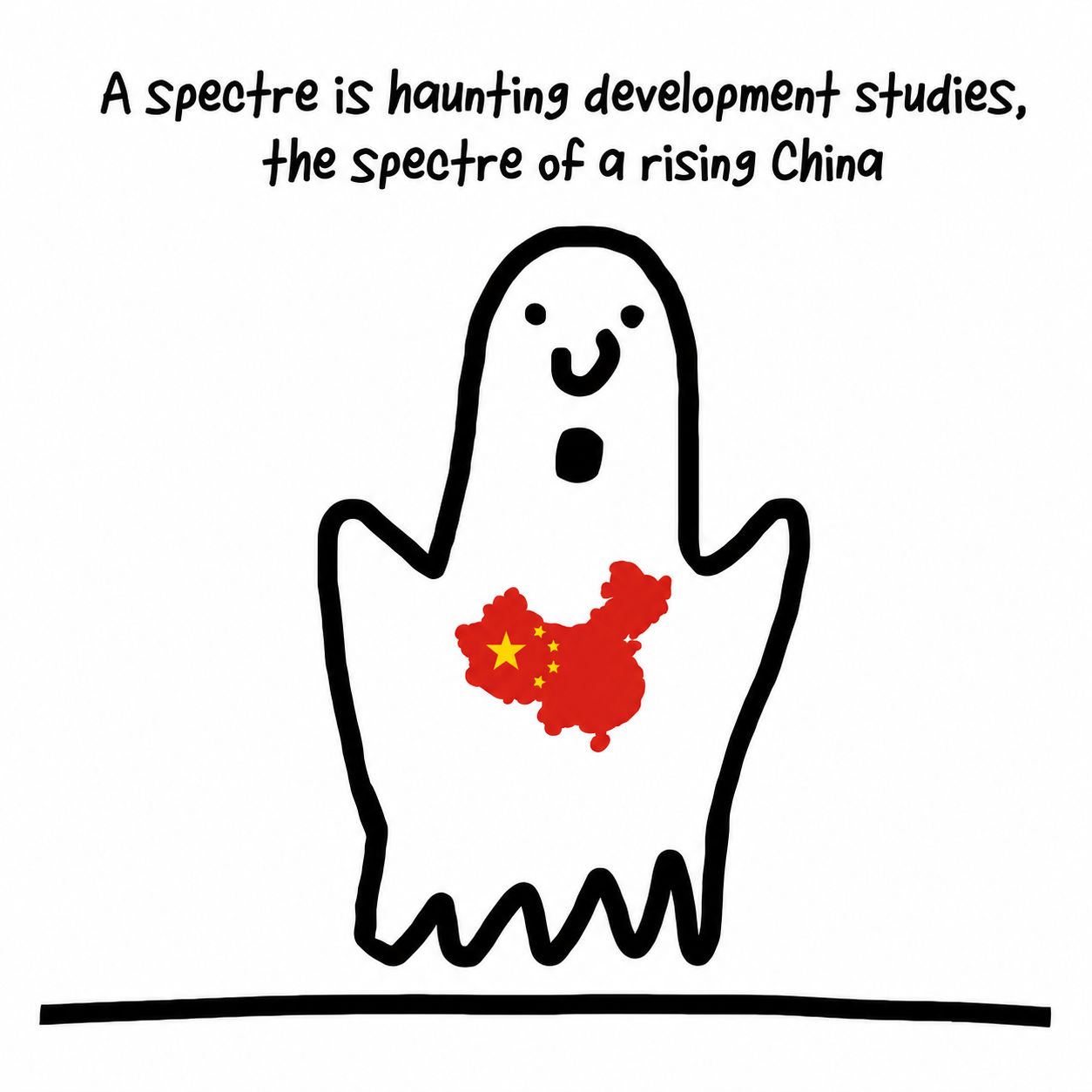
In September 2025, Adam Tooze sent a shock wave through Development studies circles (in the West) with an essay entitled “The End of Development”. He declared the evident truth that “the West’s aid model was always a mirage” and that “the UN Sustainable Development Goals now look less like a new dawn than the final gasp of a unipolar, end-of-history fantasy”. Yet, so-called ‘development’ speaks to more than aid and Western dominance. This blog post argues that what might be the end of aid could be the beginning of understanding and studying development as an endogenous process within international constraints and opportunities. For this to happen, we, as development scholars, need to resist falling back into narrow conceptions of ‘Development’ as either aid-based or big power rivalry and overcome anxious paralysis and self-pity over the end of uncontested US hegemony. Instead, we need to use the current moment as an opportunity to rethink and finally effectively conceptualise how national politics and global economic structures condition each other.
Development as an interventionist project (rather than an endogenous process) was first declared dead at the end of the Cold War. Yet, Gilian Hart already argued in the early 2000s that its remnants actually survived under a neoliberal cover-up. Disguised as state-intervention averse humanitarian aid, the West penetrated much of the developing world via an international aid industry concerned with individual social capital indicators in health and education rather than with nation-wide industrialisation. This new focus on the “small”, “the local” and so-called “civil society” and local actors’ aid-driven ‘empowerment’ as non-threatening junior partners not only spread market-focused neoliberal ideology but also reduced pressure on governments and international financial institutions to deliver economic transformation. While the World Bank and Co. eventually had to recognise that government intervention had actually played a major role in East Asia’s economic rise between 1960 and the late 1990s (Fine 1999), the ‘tigers’’(Hong Kong, Singapore, South Korea, Taiwan) heavy economic reliance on and political alliance with Western forces ultimately buttressed rather than threatened US-hegemony.
It is only now, with the rise of China that these interventionist continuities and claims to power come back into full sight. At the same time, Development studies, a discipline that made major contributions to demystifying the ‘East Asian Miracle’ by centring the Development State literature, now seems reluctant to study China as anything but an actor in geopolitical rivalries. Many who focused on China’s development experience are now either retired (e.g. Chris Bramall, Peter Nolan) or seem to stay away from broader development studies debates (e.g. Isabella Weber), with Yuen Yuen Ang being a notable exception. In general, it seems fair to say that the West (and this includes Western Development studies) has long remained in what Tooze has called a mix of “overconfidence, complacency and myopia” in relation to China, only to now frame the country’s success mainly as a geopolitical threat – much like Japan in the 1980s or Germany in the post-war era – rather than an opportunity for renewed multilateralism, the potential possibility for a post-carbon future and, most of all, an empirical phenomenon worth studying.
In this context, the Global Development Institute’s recent conference at the University of Manchester on the 13th and 14th of April seems like an unfortunate missed opportunity. Convening around the question “What is the future for global development?”, the conference mainly seemed to be addressing “What is the future of American hegemony in the face of China’s rise (and declining aid)” with little being said on the future of global capitalism as a process or pathways for developing countries towards economic transformation and sustainable futures alongside China.
The conference’s first day was largely framed around the idea of a Second Cold War, despite Yuen Yuen Ang’s keynote exposing the term “polycrisis” (popularised, according to her, by Adam Tooze) as, at its core, a catch-all phrase for Western Angst in a world of changing hegemonic structures. Ang’s alternative call for polytunity, which sees current disruptions and uncertainty as an opportunity for structural renewal instead of global decay, remained mostly unheard, exposing Development (studies)’ continuous entanglement with big power games.
It took Ken Opalo’s keynote on the second day to overcome the conference’s nostalgic offset, reminding us that aid never really helped achieve development but encouraged and reinforced dependency by stunting states’ fiscal capacity, distorting national political economies, scrambling clear understandings of how national development happens by fetishising measurable ‘nanodevelopment’ and externalising donor countries’ ideological culture wars. Even though Opalo did not distinguish between pre- and post-structural adjustment aid, with the former actually having played an important role in addressing late developers’ balance-of-payment disequilibria (Fischer 2009, Behuria 2025), his remarks did help to expose the indulgent direction that the conference had taken so far.
Echoing John Maynard Keynes, Daniela Gabor reiterated in her keynote address that political or economic shocks should trigger a fundamental questioning of existing economic paradigms and worldviews rather than nostalgic clinging to old frameworks. To do so, she did the obvious: She compared China’s industrial policies – which managed to navigate Washington Consensus orthodoxies – to what she has coined as the “Wall Street Consensus”, exemplified in US IRA green industrial based on fiscal and regulatory derisking. According to Gabor, the main flaw of this new version of the Washington Consensus is that it ‘brings the state back in’ as a ‘de-risker’ but not as a strategic discipliner of private capital. Gabor argued that this approach differs substantially from Chinese industrial policy, which replicates the East Asian “carrots and sticks-approach” by combining fiscal incentives with strict performance requirements to direct private capital into strategic priorities.
Her comparison, taking Trump’s derisking-focused AI strategy to “revive US Hegemony” as an example, offered the important insight that there is actually a lot of continuity in economic policy between the Biden and the Trump administrations. But it also clarified that if we really want to understand ‘global development’, we need to focus on “the massive complication of finance” and macro-financial institutions in particular, as they form the linchpin of states’ developmental capacity. Gabor insisted that the neoliberal consensus persists in that most developing states are still excluded from monetary policy making. Yet, for Gabor monetary measures like directed credit lies at the heart of China’s developmental success.
This policy analysis begs, of course, the question, what internal forces have allowed for and sustained China’s governmental capacity in the first place, and whether they are sustainable? Hence, Gabor’s intervention pointed to the major theoretical building site of Development studies today, which concerns the linking of macroeconomic analysis to countries’ national material and relational circumstances. This interlinking is key to better understand the conditions for the institutional reforms that Gabor wants to see. While China’s development of equity and derivative markets might give it ways to circumvent financial US hegemony (see Petry 2020), the International Financial Subordination (IFS) literature makes the important point that most developing countries are situated in subordinate positions in the global monetary and financial system, which condition their state–finance relations. In Johannes Petry and Andreas Nölke’s edited volume, State, Capitalism, and Finance in Emerging Markets (2025), IFS scholar Ilias Alami calls for a closer investigation of states’ “double imperative of fostering capital accumulation and [italics added] managing class relations” (p. 37). Yet, apart from a few notable exceptions in the book’s chapters (e.g. Kapadia and Musthaq 2025,) a richer understanding of states’ agency within the constraints of the global economic and monetary system remains to be developed (see book review for more detail).
The current conjuncture of Western fear and the hypocrisy it reveals about the West’s value-based development industry might lead some to reiterate the end of Development and the redundancy of Development studies. However, instead it should serve as a wake-up call for development scholars reminding us that the discipline can explain development as multiscalar, historically embedded and politically steered processes rather than the sheer outcome of great power competition or momentous contingency. The end of the end of history, as Lee Jones has called it, as well as the resurgence of big power debates, are helpful in that they make us realise, that Western value claims are, in fact, claims to power. “[I]t is not clear that American politics can digest plurality other than from a position of dominance”, as Larry Summers put it. Yet, rather than retreating into self-satisfaction or self-consciousness over the gradual collapse of US hegemony, we, as critical development scholars and practitioners, should follow Ang in refusing to blindly fall into crisis mode and instead approach China’s rise as a potential beginning of a politically, economically and epistemically richer world in which much about development as a process remains to be understood.
Caroline Cornier is a PhD Candidate at the Global Development Institute (GDI), University of Manchester.
Disclaimer: This story is auto-aggregated by a computer program and has not been created or edited by budgetbuddy.
Publisher: Source link
Publisher: Source link