What actually constitutes the key agenda for workers in Indonesia beyond celebrating May Day as a symbol of struggle? Wages in Indonesia are never truly “negotiated”; they are determined, stabilized, and at the same time separated from the political power that should be able to challenge them. Since the authoritarian New Order regime, the state has built a corporatist framework that not only suppresses independent worker organizations but also fragments the possibility of forming an effective collective force. Reformasi did open space for freedom of association, yet instead of producing consolidation, what emerged was fragmentation—many unions, but weak and divided. Thus, when integrated into global value chains, this configuration finds its function: the state no longer needs to repress workers overtly; it suffices to stabilize wages through mechanisms that appear technocratic, while allowing fragmentation to persist. In this way, low wages in Indonesia are not a failure, but rather the result of a strategy historically shaped and continuously reproduced—a form of partial class accommodation, uneven, and spatially conditioned.
Control over workers today no longer operates primarily through open repression, but through the way wages are calculated and normalized as a technical matter. Wage-setting formulas that link minimum wage increases to inflation and economic growth are presented as rational policies to maintain balance between worker and business. Yet this is precisely where the politics operates: wage conflict is removed from the arena of collective bargaining and locked into calculations that from the outset limit bargaining space. This shift becomes clear when compared to the mechanism based on Decent Living Needs (KHL), which—although not entirely free from depoliticization—still opened space for surveys and the articulation of demands, particularly in industrial areas with high concentrations of workers. Because it was seen as disrupting worker cost stabilization, this space was later closed through formulas that standardize increases while simultaneously dampening conflict. Concessions to workers are not entirely eliminated, but emerge as the result of struggles that under certain conditions succeed in forcing the state and capital to grant space, as in the case of THR and the expansion of social security through BPJS. However, these achievements do not alter the fundamental structure of wages, which remains low and fragmented; rather, they appear as limited and segmented compromises. Thus, what is produced is not merely wage stabilization, but also the management of workers’ power itself: on the one hand, there are forms of protection that are concentrated and appear progressive, while on the other, the underlying structure continues to maintain spatial differentiation and the collective weakness of worker. In this condition, class compromise does not occur comprehensively, but is produced partially, unevenly, and remains locked within a low-wage regime.
Historical roots: Depoliticising workers
The roots of Indonesia’s industrial relations configuration cannot be reduced to a mere chronological stage of industrialization, but rather must be understood as the outcome of how the state has shaped and managed power relations between worker and capital. Compared to South Korea, authoritarian regimes did suppress worker organizations, yet they did not entirely close off space for the articulation of opposition. The existence of the Korean Confederation of Trade Unions (KCTU), which emerged in opposition to the Federation of Korean Trade Unions (FKTU), demonstrates that class conflict remained institutionalized, albeit in limited and often repressive forms. This cannot be separated from the model of industrialization pursued by the state, in which, through mechanisms of reciprocal control, the state not only regulated worker but also disciplined capital by linking access to credit, protection, and state support to productive performance and export orientation. Within this configuration, industrial expansion did not merely generate economic growth, but also indirectly created the material conditions for the emergence of a more organized worker force capable of enhancing its bargaining power.
In contrast, the Indonesian as a late industrial country case reflects a different logic of state accommodation during the authoritarian period. Rather than developing disciplinary mechanisms toward capital, the state constructed a form of corporatism designed to control and simultaneously fragment worker organizations from the outset. Structures such as the All-Indonesia Workers Union (SPSI) functioned not merely as representative bodies, but as instruments to ensure that worker remained fragmented and disconnected from the possibility of autonomous political articulation. Unlike in South Korea, where worker opposition could still emerge within constrained spaces, depoliticization in Indonesia operated more deeply and systematically. This condition later became the foundation for the post-crisis configuration, when integration into the global economy further intensified the state’s need to maintain worker cost stability. Thus, worker fragmentation in Indonesia is not an anomaly, but a historical product of a model of state accommodation that, from the beginning, did not allow space for the consolidation of working-class power. Reformasi did open opportunities for the revival of worker organizations and even political representation such as the Worker Party; however, this space continues to operate within boundaries defined by the imperative to maintain an investment-friendly climate. In this context, the emergence of the Worker Party is often read as a form of opposition, yet in practice it does not fully exist outside existing power structures. Participation in electoral politics necessitates compromise—and under conditions where worker remains fragmented, such compromises become difficult to avoid. As a result, rather than fostering broader class consolidation, worker’s political representation risks being absorbed into elite logics, thereby reinforcing the very pattern of fragmentation it seeks to overcome.
Wage calculation as political control
If previously wage regulation through the Decent Living Needs (KHL) survey mechanism still opened space—albeit limited—for class compromise through tripartite forums, then over the last decade that space has gradually been closed (Wulansari, 2015). Indeed, from the outset KHL was never entirely detached from the logic of depoliticisation, since negotiations took place within an institutional framework already constrained by the state. Nevertheless, it still provided room for workers to articulate demands through surveys and negotiations that were more political in character, particularly in regions with high industrial concentration. The shift toward a wage calculation formula based on macroeconomic indicators marked a more fundamental transformation: conflict was no longer managed through negotiation, but instead absorbed into technocratic mechanisms that predetermined its limits from the outset. In this context, wage regulation no longer functioned as an arena of compromise, but rather as an instrument of control, through which the state stabilised labour costs while effectively restricting the space for workers’ collective articulation.
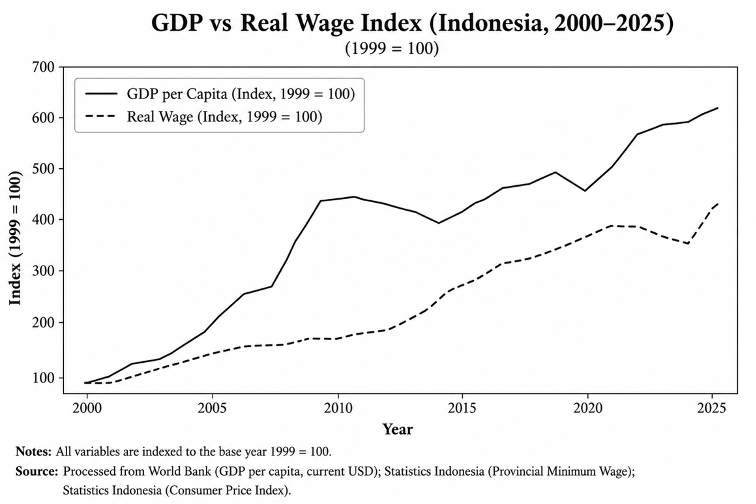
Departing from the transformation of data into index form (base year = 100), this graph should be read not as a comparison of absolute values, but rather as a comparison of the relative growth rates between output and wages. The GDP per capita line represents the growth of average output per person, while the real wage line indicates the development of workers’ purchasing power. When the two lines move together, it suggests that output growth is relatively accompanied by wage increases. However, when the GDP per capita line rises more rapidly and diverges from the real wage line, this indicates the existence of a distributional gap. In this context, the difference or distance between the two lines can be read as a simple proxy for wage share, namely an indication of how much of output is relatively translated into workers’ income. The wider the gap, the smaller the share received by workers relative to the value produced. This reading must also be situated carefully in relation to the common macroeconomic claim that GDP per capita is not equivalent to income or wages. Conceptually, this claim is correct: GDP encompasses all value added within the economy, including profits, rents, and other forms of capital income, and therefore cannot be equated with individual wages. Yet it is precisely because of this distinction that the comparison between GDP per capita and wages becomes analytically important. The graph does not seek to equate the two, but rather to demonstrate that this inequality is systematic and develops over time. Following Thomas Piketty (2014), GDP per capita is indeed not a measure of income distribution, but a measure of total output. In other words, the larger the gap between the two indices, the clearer it becomes that output growth is not proportionally distributed to workers.
When observed periodically, this dynamic can be divided into three episodes of wage politics, demonstrating that the relationship between economic growth and wages is not automatic, but rather determined by power relations within the production process. In the first period, from the post-crisis era up to the years preceding 2012, the two indicators remained relatively close, although a tendency toward divergence was already visible as the GDP per capita index increased from around 100 to approximately 450, while the real wage index rose only to around 210–220, indicating that from the early recovery phase output grew faster than workers’ purchasing power without hindering economic growth. The second period, around 2013–2014, instead showed a temporary narrowing of the gap when the real wage index increased by around 30–60 points, while the GDP per capita index declined by approximately 30 points. This dynamic did not reflect the negative impact of wage increases on the economy; rather, it demonstrated that economic value is the result of social labour dependent on workers’ activity, such that when political mobilisation occurred—as in the Grebek Pabrik Bekasi actions of 2012, through strikes and production stoppages, output could be temporarily disrupted, while simultaneously revealing workers’ central position within the production system. The movement that began in Bekasi subsequently spread to various regions, where workers succeeded in pushing for minimum wage increases—which in Bekasi itself exceeded 30 percent, while also expanding organisational capacity and collective political consciousness. However, in the third period after 2015, following the institutionalisation of the wage formula, divergence widened consistently once again, with the GDP per capita index increasing from around 400 to more than 600, while the real wage index rose only from around 300 to approximately 420. Even during the COVID-19 pandemic period around 2020, when the economy experienced contraction (a decline of around 30 points), real wages tended to stagnate, and during the subsequent recovery phase output once again grew more rapidly than wages. Overall, this pattern demonstrates that economic growth has proceeded alongside restrictions on wage increases, thereby widening the gap between the value produced and the value received by workers, reflecting a tendency toward contained wage growth within the contemporary wage regime.
From the outset of the post-Reformasi era, wage dynamics in Indonesia cannot be separated from the state’s efforts to balance redistributive demands with the need to maintain production stability within the context of integration into global value chains. The wave of worker mobilisation that intensified after 2012—particularly following Grebek Pabrik Bekasi—demonstrated that wages remained an arena of open social conflict, in which workers were capable of pushing for increases through collective power. However, this growing capacity for mobilisation was also perceived as threatening the certainty of labour costs required within global production networks, thereby prompting the state’s post-2015 response to reconstruct the wage regime through formulations based on inflation and growth. This mechanism shifted wage determination from social negotiation toward technocratic calculation, while simultaneously institutionalising restrictions on workers’ bargaining space. In this sense, the wage regime functioned as an instrument of labour discipline that stabilised labour costs and suppressed distributive conflict, thereby making wage increases more controlled and predictable—a pattern that may be understood as contained wage growth. Although revisions through the Job Creation Law introduced the alpha index as a limited recognition of workers’ role, this mechanism nevertheless remained within a calculative framework that fundamentally locked in variations in wage increases. Resistance to the logic of calculation never entirely ceased. Workers continued to challenge it through mass actions and legal channels, including judicial review before the Constitutional Court (MK). At the end of 2024, the Court granted the petition and declared the wage calculation mechanism unconstitutional. This process demonstrates that, although workers’ political space has narrowed, collective pressure can still reopen spaces for compromise. In this context, the emergence of the Workers’ Party—although not yet successful in entering parliament—cannot be separated from efforts to expand the political articulation of the working class. However, as before, this expression continues to operate within the boundaries of compromise determined by broader political structures.
May Day and the unfinished struggle over wages
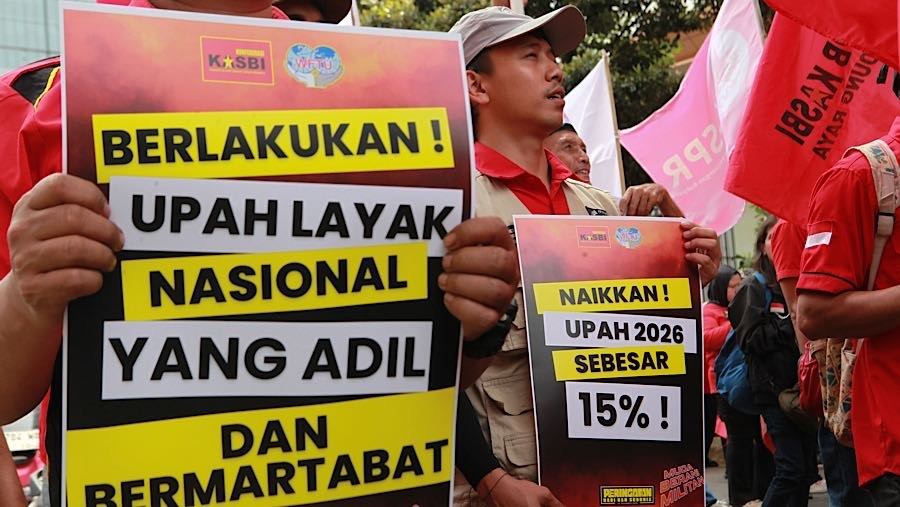
The Constitutional Court’s decision at the end of 2024, which declared the wage-setting mechanism unconstitutional, was initially seen as a significant momentum for worker struggle. It even became a symbol of victory proclaimed during May Day commemorations, as if reopening space for more equitable wage negotiations. However, up to the determination of wages for 2026, the policies in use still rely on the same macro-indicator-based formulation. This situation shows that legal change does not automatically shift policy practice. In this context, May Day is not only a celebration of symbolic achievements, but also a reminder that the struggle over wages is far from complete—especially when mechanisms that constrain worker bargaining space are maintained in only slightly modified forms.
The decision is often read as a victory for the worker movement, but such an interpretation needs to be treated with caution. Indeed, it reopens formal space for worker involvement in wage determination and corrects certain procedural aspects that previously limited participation. Yet beneath this, little has changed in the underlying logic of wage governance. The technocratic rationality that constrains negotiation remains intact, merely reformulated within a framework that is more legally acceptable. Under these conditions, what appears as an opening of space is in fact a reconfiguration—not a transformation—of the same control mechanism. In other words, the ruling does not disrupt the political foundation of wage-setting, which prioritizes worker cost stability, while worker bargaining power remains confined within predetermined limits.
May Day in the aftermath of the Constitutional Court ruling serves as a reminder that not all forms of worker protection emerge from the technocratic logic of the state. Some are the result of long-term collective struggle. The Religious Holiday Allowance (THR), for instance, is not merely an annual bonus, but a product of class compromise unique to Indonesia, fought for since the colonial period and later consolidated after independence through cross-sectoral worker pressure. In this sense, THR could only emerge in a context where worker political power was sufficiently organized to compel the state and employers to grant concessions. However, such achievements have become increasingly difficult to reproduce within a fragmented configuration of worker politics. A similar dynamic can be seen in the social security system such as BPJS, which is often presented as progress in social protection. Although inseparable from worker struggle, Indonesia’s form of social security differs from universal models in Nordic countries, where protection is broadly provided and not dependent on formal employment status. In Indonesia, amid worker flexibilization and expanding informality, BPJS coverage remains limited—many worker, especially those in non-permanent or informal arrangements, remain outside the system. Thus, both THR and BPJS reveal two sides of the same dynamic: tangible outcomes of worker struggle, yet also the limits of class compromise produced within an economic and political structure that continues to constrain them. Therefore, the main challenge for the worker movement after the Constitutional Court ruling is not merely to respond to regulatory changes, but to ensure that the reopening of space is not once again reduced to formal procedures without substantive impact. Previous experience shows that every opening for participation is often followed by efforts to reconfigure it in ways that preserve worker cost stability as the primary priority. For this reason, the more fundamental task lies in the ability of worker to push for wage-setting mechanisms that genuinely open space for negotiation, rather than consultation constrained by technocratic parameters. This challenge becomes even more complex under persistent fragmentation, where worker power is unevenly distributed and difficult to consolidate into a unified agenda. Without addressing these conditions, the space opened by the Constitutional Court ruling risks producing only limited forms of compromise—sufficient to diffuse pressure, but insufficient to fundamentally shift power relations in wage politics.
Anindya Dessi Wulansari is a lecturer at the Department of Public Administration, Faculty of Social and Political Sciences, Universitas Tidar, Magelang. Her research focuses on labour regimes, politic of minimum wages, political economy, and governance. She is the author of “Indonesia’s Cheap Wages Regime: The Political Economy of Minimum Wages Policy under Jokowi Presidency” (Fudan Journal of the Humanities and Social Sciences, 2021) and “Practising Being Precarious Workers: State, Policy and the Labour Regime in Indonesian Academic Internships” (Work, Organisation, Labour & Globalisation, 2025).
This article was previously published in Indonesian in the Critical Policy section published by the Policy Research Center (Porec).
Disclaimer: This story is auto-aggregated by a computer program and has not been created or edited by budgetbuddy.
Publisher: Source link
Publisher: Source link