What did economic and political power look like in the eighteenth century Cape Colony—and who held it? In our study of the Stellenbosch–Drakenstein district between 1720 and 1810, we trace the rise of an affluent settler gentry and show how their economic power was bound to local political authority. Drawing on newly digitised annual tax censuses (the opgaafrolle) and annual lists of heemraden (the settlers appointed to district judicial and administrative boards), we examine the economic and political landscape that underpinned the resilience of the Dutch East India Company (VOC) rule at the Cape.
Introduction
Every December at the Castle of Good Hope, a ritual played out. The Governor and his Council of Policy would appoint four men to serve as heemraden in the Stellenbosch–Drakenstein district – the local officials who administered justice, settled disputes, and enforced the rules of rural life. In theory, these were simply the district’s most capable settlers. In practice, at least half came from the richest ten per cent of households.
This is the central finding of our new study of colonial elites at the Cape, recently published in the Revista de Historia Industrial (Walters, Fourie and Ross 2026). Using newly digitised annual tax censuses – the opgaafrolle (Fourie et al. 2024) – and lists of heemraden extracted from the Resolutions of the Council of Policy (Liebenberg 2013), we trace the relationship between economic rank and political authority in the wine-producing heartland of Stellenbosch and Drakenstein between 1720 and 1810. The picture that emerges is one of tight alignment between wealth and office – and of a colonial state that depended on that alignment to function.
A remarkably unequal society
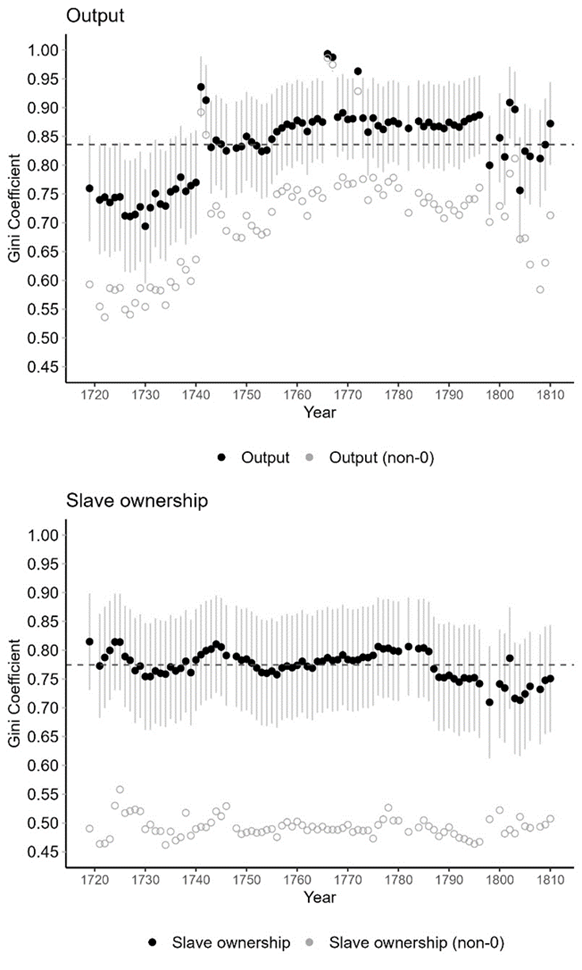
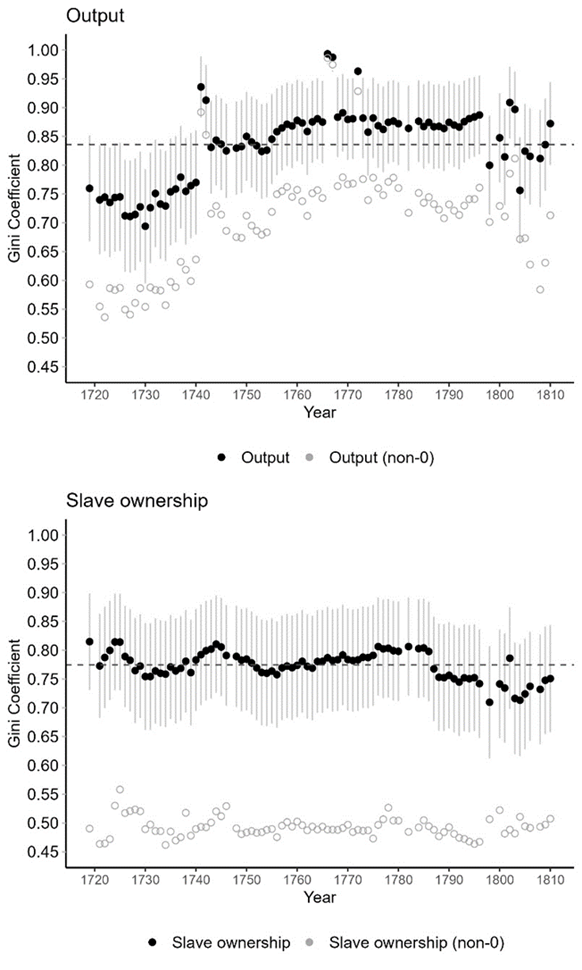
The Cape Colony was, on average, a prosperous place. Probate inventories suggest that its settlers enjoyed living standards higher than those in contemporary England or the Netherlands (Fourie 2013). But averages can deceive. The Gini coefficient for agricultural output among settler households averaged 0.84 over the period – a level of inequality comparable to the most stratified societies in colonial Latin America, and well above the American colonies.
To put it into perspective: a small cluster of wheat and wine farmers at the top were producing the vast majority of the district’s recorded output, while most households scraped by on modest herds or reported nothing at all. Nearly half of all household-year observations in our dataset of 83,745 records showed zero farm output. Out of this skewed distribution emerged what the historian Robert Ross labelled the ‘Cape gentry’ (Ross 1983) – a rural elite whose power rested on land, enslaved labour, and crop production for the maritime trade. Ships arriving in Table Bay needed food and wine. The families who could supply it grew rich.
Figure 1. Gini index – output and slave ownership
Following the money
One question that interested us was how this elite’s economic base changed over the century. We used the Theil index to decompose inequality by agricultural type – wheat, wine, cattle, or sheep. In the early decades, what a household grew mattered less than how much it grew: inequality existed within each sector. But from mid-century onward, the gap between sectors widened. Livestock became an increasingly important source of wealth as the frontier pushed outward and pastoral farming expanded. By the late 1700s, whether you were a wine farmer or a cattle farmer said a great deal about where you sat in the economic hierarchy. The picture looks different when we decompose by enslaved-labour holdings. Elite households appeared within every category of slave ownership – among those with mostly male slaves, those with mostly female slaves, and those with none. The Cape gentry were layered and heterogeneous, and their composition shifted with changes in policies and markets.
Wealth buys a seat at the table
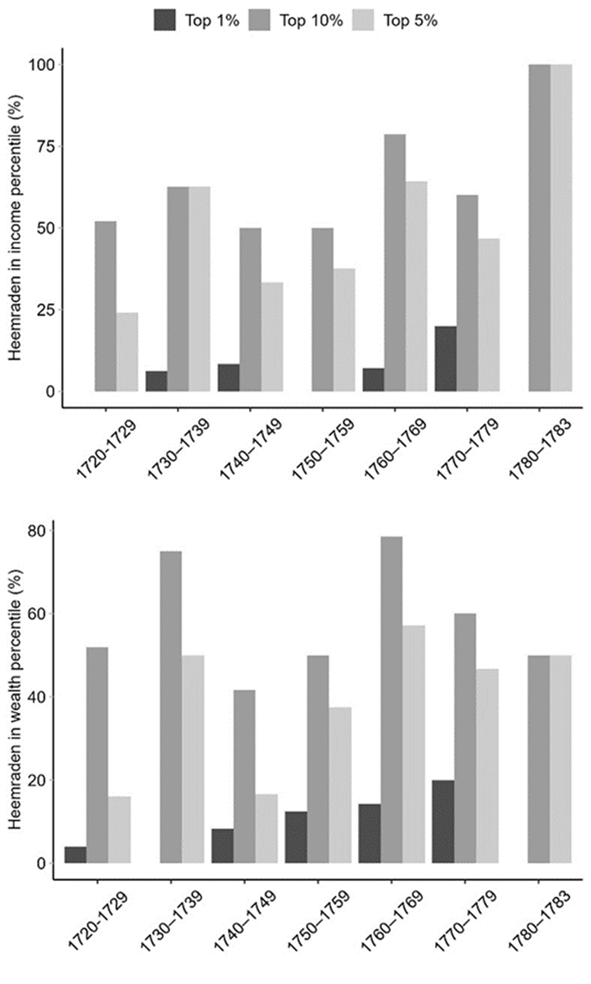
The heemraden were more than ceremonial figures. They sat on the district board, adjudicated disputes, inspected farms, and enforced ordinances governing the treatment of enslaved people, Khoesan labourers, and servants. In a colony where the nearest Company official might be days away on horseback, these men wielded real authority. We matched 92 heemraden to their household records in the tax censuses, using fuzzy name-matching across 83,745 household-year observations. The results are striking. On every margin – agricultural output, slave ownership, livestock, family size – heemraden households were substantially better off than the rest. Their median output was more than eighty times that of non-heemraden households.
Between 1730 and 1779, at least a quarter of newly appointed heemraden ranked in the top five per cent of the income distribution. Some sat in the top one per cent. A regression analysis confirms the pattern: both higher output and greater slave ownership significantly predict appointment. Being a crop farmer – specialising in wheat or wine rather than livestock – was also strongly associated with office-holding, consistent with the district’s economic structure for much of the century.
Figure 2. Heemraden economic position
Office likely conferred tangible advantages: access to information, sway in local disputes, favourable credit terms, and influence over regulatory decisions. In the framework of political economists like Acemoglu and Robinson, this is local state capacity being deployed by insiders to reinforce their economic position. Wealth opened the door to office. Office helped keep wealth in the family.
The colonial bargain
It is tempting to see all this as simple capture – rich men grabbing power. But the relationship between the VOC and the Cape gentry was more subtle and instructive. Colonial rule at the Cape rested on a reciprocal arrangement. The VOC needed the gentry to govern rural districts, organise agricultural production, and maintain hierarchy among what officials euphemistically called the ‘lower orders’. In return, the gentry received legal protections for their assets, access to markets, and a share of political authority. Both sides had reasons to keep the deal going.
The system worked – until it didn’t. By the late 1770s, affluent settlers began to chafe. A petition in 1779 demanded greater economic and political freedoms. In 1795, settlers in the frontier districts of Swellendam and Graaff-Reinet revolted outright. The bargain was being renegotiated, and the VOC – bankrupt and overextended – could no longer hold its end. Of course, our analysis has its limits. We measure inequality only within the settler population. Enslaved people and Khoesan labourers, who together outnumbered settlers by the 1790s, are excluded from the inequality calculation and counted, as the slave economy dictated, as part of the owners’ wealth stock. The true extent of inequality in Cape society was far greater than any within-settler Gini can capture. And our data covers a single district. But Stellenbosch–Drakenstein was the economic heartland of the colony, and the patterns we find are likely indicative of a broader logic.
The lesson?
Colonial states across Africa, Dutch, British, Portuguese, French, all faced the same structural problem: how to govern cheaply at a distance. TheBlog Posts answer, almost everywhere, involved co-opting local elites. What the Cape record shows is how tight the alignment between economic rank and political authority could become, and how that alignment sustained colonial rule for the better part of a century.
References
Fourie, Johan. 2013. ‘The remarkable wealth of the Dutch Cape Colony: measurements from eighteenth-century probate inventories’, The Economic History Review, 66 (2): 419–48.
Fourie, Johan, Erik Green, Christiaan Burger, Chris de Wit, Kate Ekama, Jan Greyling, Hans Heese, Jan-Hendrik Pretorius, Robert Ross, and Dieter von Fintel. 2024. ‘“Waar Is Beter Dorp in Zuid Africa Dan Stellenbos?”: What the Stellenbosch-Drakenstein Tax Censuses Reveal.’ South African Historical Journal 76 (4): 420–46.
Liebenberg, Helena. 2013. Introduction to the Resolutions of the Council of Policy of Cape of Good Hope. Cape Town: TANAP.
Ross, Robert. 1983. ‘The rise of the Cape gentry’, Journal of Southern African Studies, 9 (2): 193–217.
Walters, Leoné, Johan Fourie, and Robert Ross. 2025. ‘Colonial Elites in The Eighteenth-Century Cape Colony’. Revista de Historia Industrial–Industrial History Review. doi: https://doi.org/10.1344/rhiihr.48401.
Featured Image: Heemraad appointments, December 1740. Source: G.C. de Wet, Resolusies van die Politieke Raad Deel X: 1740-1743 (page 71).
Disclaimer: This story is auto-aggregated by a computer program and has not been created or edited by budgetbuddy.
Publisher: Source link
Publisher: Source link