
Who benefited from agricultural commercialization in colonial Africa? Using social tables for three African economies, we identify a small group of rural capitalists who captured disproportionate gains. We demonstrate how their strategies of accumulation varied across contexts and shaped divergent and often unequal development trajectories.
Commercialization and the Rise of Rural Capitalists
A long-standing view in the literature holds that commercialization in so-called peasant economies produced relatively egalitarian outcomes compared with settler colonies (Bowden et al., 2008). However, this perspective often overlooks the emergence of rural capitalists—African farmers who accumulated assets, expanded production, and earned incomes well above the rural average. In a recent study, we revisit the rural capitalist debate relying on evidence from social tables for Bechuanaland (Botswana), the Gold Coast (Ghana), and Tanganyika (Tanzania). We show that commercialization did not produce a single development trajectory, but rather divergent outcomes shaped by local conditions, colonial policies, and the strategies of better-earning farmers.
Identifying Rural Capitalists
Earlier literature on rural capitalists relied largely on qualitative case studies, from Polly Hill’s seminal work on cocoa farmers to later studies of agrarian differentiation (Berry, 1993; Hill, 1963). While rich in insight, these accounts rarely quantified the scale or economic significance of these groups. We address this gap by calculating population and income shares of different farmer groups, providing comparable evidence on their relative size and economic position.
Across all three cases, a group of better-earning farmers emerged alongside export agriculture. Large-scale cattle holders in Bechuanaland, cocoa farmers in the Gold Coast, and coffee growers in Tanganyika earned multiples of subsistence incomes. We define large-scale producers by their scale of production, in Bechuanaland they comprise cattleholders owning a minimum of 100 heads of cattle, in the Gold Coast, farmers producing 100 or more loads of cocoa, and in Tanganyika coffee growers with 1000 or more trees.
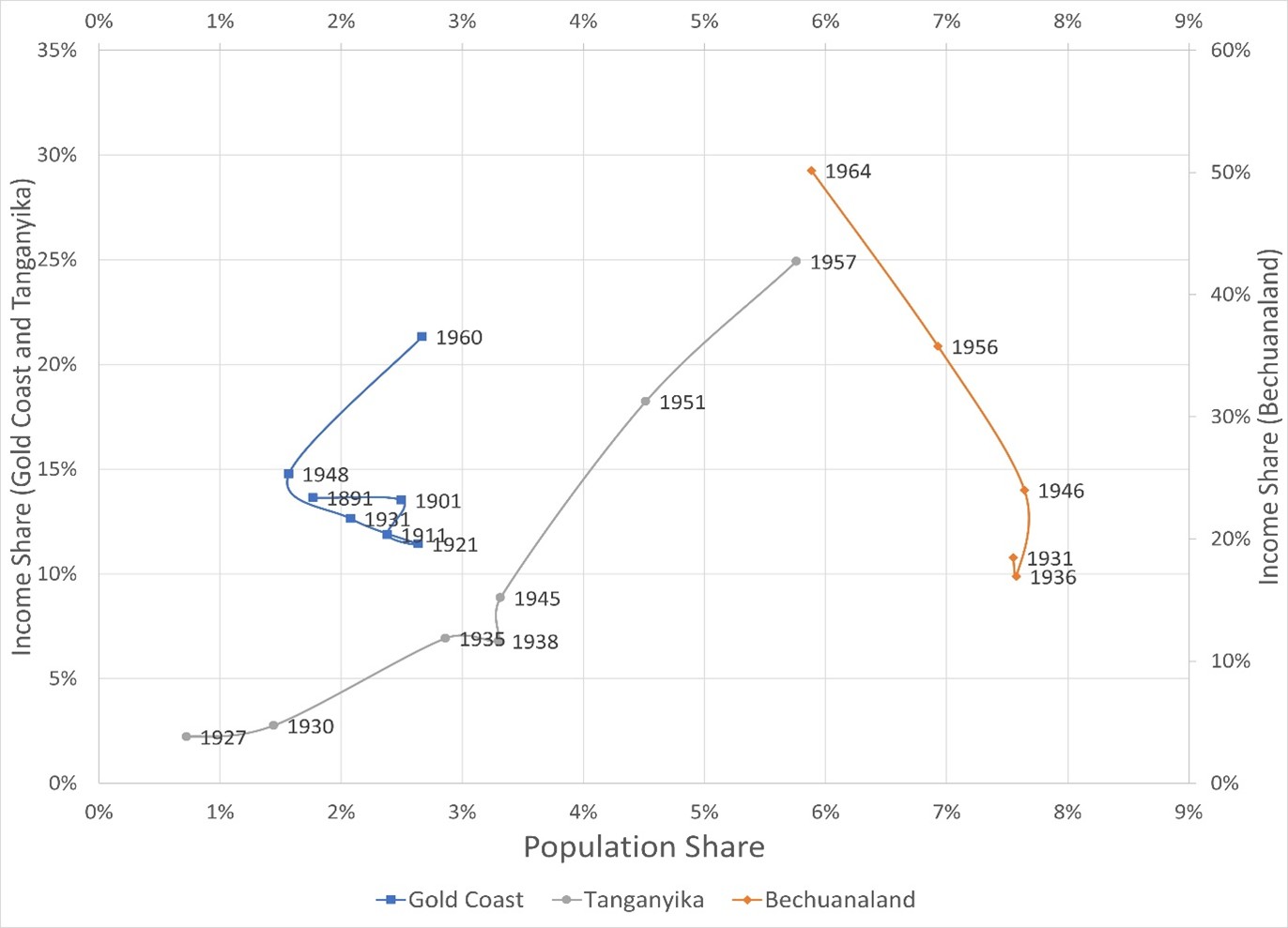
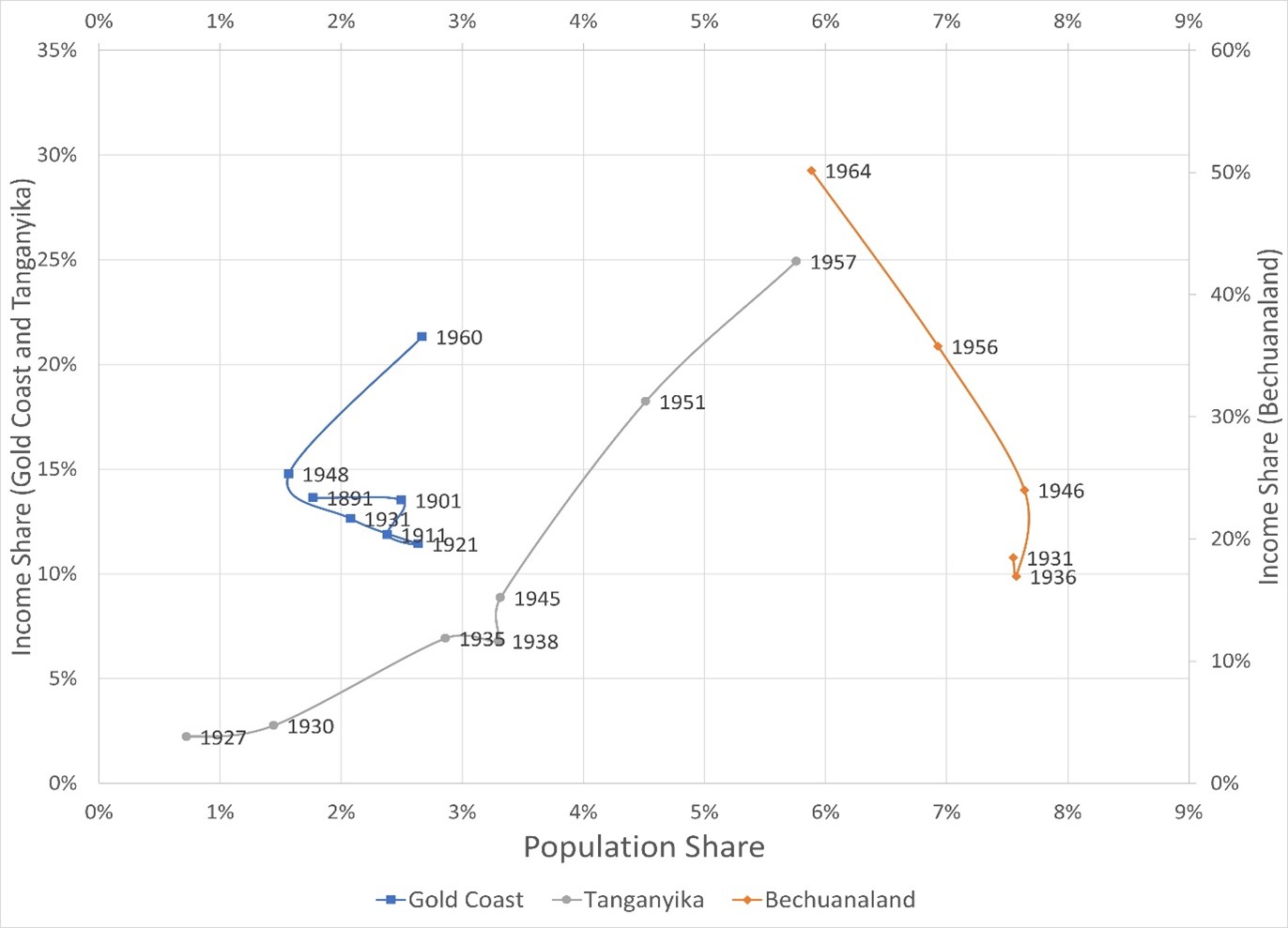
But higher incomes alone do not define rural capitalists. We distinguish outcomes from strategies by identifying key entrepreneurial attributes: profit-oriented market engagement, the ability to expand scale of production, long-sighted investment in assets such as trees or livestock, and pragmatic technological dynamism. These attributes enable us to conceptualize rural capitalists as active agents who shaped commercialization trajectories, rather than mere beneficiaries. The economic prominence of this group was highly concentrated, which is illustrated in Figure 1. It shows that large-scale producers constituted a small share of the population but captured a disproportionate share of income, with notable variation across cases.
Figure 1. Population and income shares of large-scale producers in Bechuanaland, the Gold Coast, and Tanganyika.
Not All Rural Capitalists Are the Same
We also find that rural capitalists were not a homogenous group. While they shared core attributes, their strategies varied with local conditions. In Bechuanaland, accumulation focused on livestock and control over water resources. Large-scale cattleholders invested in boreholes and wells to secure grazing access, enabling herd expansion. Long-sightedness took the form of investments in water infrastructure and livestock, while labour use remained limited given the low labour intensity of cattle production.
In the Gold Coast, cocoa farmers expanded by planting trees and acquiring land, reinvesting early gains into new farms. Long-sightedness was crucial given delayed returns, and scale expansion increasingly relied on hired labour. Technological adaptation remained selective, with farmers often favouring extensive expansion under conditions of abundant land.
In Tanganyika, coffee production allowed broader entry, as it could be combined with subsistence farming. Better-earning farmers expanded their scale but also benefited from cooperative institutions that facilitated access to processing, inputs, and markets. Here, long-sightedness and technological dynamism were often expressed through engagement with collective institutions. Across cases, shared attributes translated into divergent strategies of accumulation, labour use, and market engagement.
Inclusive or Exclusive Development?
Rural capitalists shaped development through investment, labour use, and the expansion or restriction of opportunities for others. In Bechuanaland, commercialization operated through concentrated accumulation. Investments in herds and water sources enabled expansion but raised barriers to entry. At the same time, cattle production generated limited wage labour, contributing to rising inequality and a growing cattleless population.
In the Gold Coast, the channels were broader. Cocoa farmers reinvested profits in farms, but also in trading, transport, moneylending, and infrastructure, linking agriculture to wider economic activity. Labour demand increased as farms matured, enabling broader participation early on. Over time, however, land constraints and consolidation shifted gains toward larger producers.
In Tanganyika, commercialization was more inclusive. Entry barriers were lower, and cooperatives helped diffuse technology and market access. This supported broader participation, even as better-off farmers retained advantages. Across cases, outcomes depended on how rural capitalists organized production, mobilized labour, and reinvested surpluses, determining who could participate and benefit.
Commercialization and Structural Transformation
Rural capitalists constituted only 1–8% of the agricultural population, even as export markets expanded. In classic accounts of structural transformation, agricultural growth is accompanied by productivity gains, labour reallocation, and income convergence across sectors (Timmer 2009). The colonial African cases followed a different path. Export agriculture generated income growth without consistent productivity improvements or labour absorption, instead reinforcing within-sector inequalities. The result was not a smooth transition out of agriculture, but accumulation concentrated among a small group alongside persistent rural differentiation. This contrast helps clarify why market expansion alone failed to deliver outcomes comparable to those observed in industrialized economies, and why agrarian distributional structures remain central to long-run development trajectories.
References
Berry, S. S. (1993). No condition is permanent: The social dynamics of agrarian change in sub-Saharan Africa. University of Wisconsin Press.
Bowden, S., Chiripanhura, B., & Mosley, P. (2008). Measuring and explaining poverty in six African countries: A long‐period approach. Journal of International Development, 20(8), 1049-1079.
Hill, P. (1963). The migrant cocoa-farmers of southern Ghana: A study in rural capitalism. Cambridge University Press.
Timmer, C. P. (2009). A World Without Agriculture: The Structural Transformation in Historical Perspective. AEI Press.
Feature image: Generated using ChatGPT.
Disclaimer: This story is auto-aggregated by a computer program and has not been created or edited by budgetbuddy.
Publisher: Source link
Publisher: Source link