

Is blog automation safe? Yes, but only if you use blog automation to improve your process, rather than dumping a high volume of low-quality content onto your site.
I see a lot of fear around this topic online, especially regarding Google penalties. Most of the fear comes from one bad assumption—people think Google hates AI. It doesn’t. Google hates low quality content.
The goal with using blog automation tools is to grow your organic traffic sustainably. I break my process down fully in this video:
Key Takeaways for Safe Blog Automation
- Blog automation doesn’t trigger penalties on its own, poor content quality does.
- Good automation removes repetitive work, but it doesn’t remove human judgment.
- Google rewards helpful, original, well-structured content with clear topical authority, boosting SEO rankings.
- Weak automation systems scale garbage, while strong systems scale topical authority.
- Use blog automations to repurpose videos, plan content, improve internal linking, and publish consistently.
If you want to try the free blog automation system I use on my own sites, create a free RightBlogger account.
Google Doesn’t Hate AI, It Hates Bad Content
The biggest mistake I see is people asking the wrong question. They ask whether AI content gets penalized, when the better question is this: does the content help anyone?
Google has said for a long time that it wants people-first content. That means content with a clear purpose, real usefulness, and something original behind it. In other words, the issue isn’t whether a machine helped with the draft.
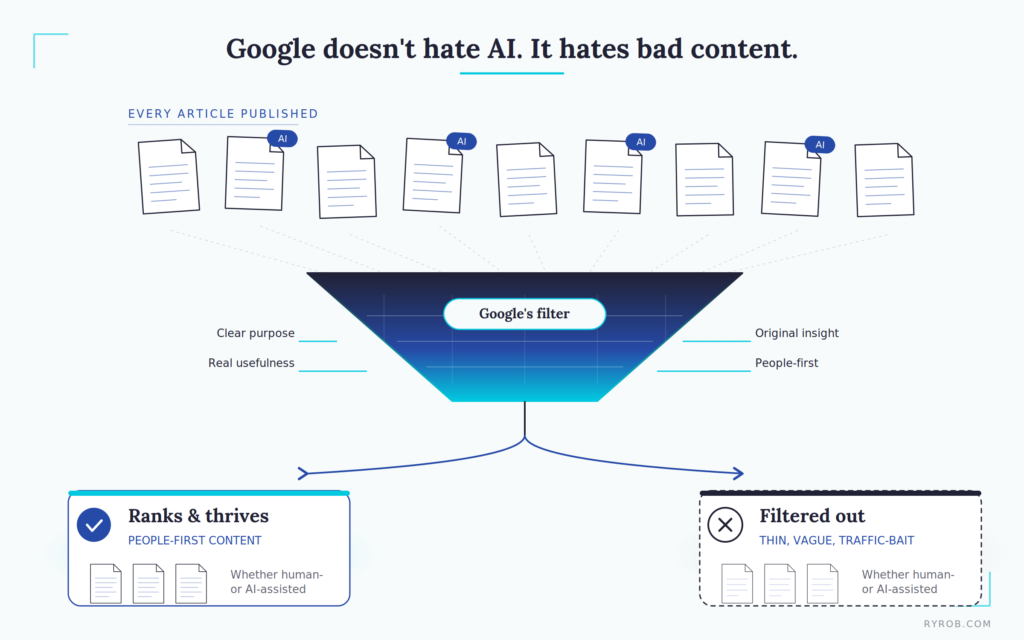
The issue is whether the finished page of content is thin, vague, or made only to grab search traffic.
That’s why I don’t think of automation as a writer. I think of it as a system. A good system helps me research topics, organize ideas, build structure, repurpose content, and keep publishing on schedule as part of my SEO strategy to produce unique content.
Then I step in where judgment matters most, editing, sharpening the angle, adding examples, and bringing in lived experience.
Google spells this out in its own helpful content update guidance. The pattern is simple. Search (and AI platforms alike) want useful pages. It doesn’t want mass-produced spam or filler like duplicate content, scraped content, or content spinning.
What tends to work best from an SEO perspective is pretty consistent:
- Original insight
- Clear structure
- Strong internal linking
- Topical authority
- Consistency over time
- Content that matches search intent
What tends to fail in Google search results is just as obvious. Thin articles, generic phrasing, no point of view, and pages that feel like they were published only because a tool could publish them.
If your blog automation system is weak, it scales garbage. If your system is strong, it scales authority.
That one line explains most of the debate on this topic. Try it for yourself and you’ll see. Speaking of which…
Bad Blog Automation vs Smart Blog Automation
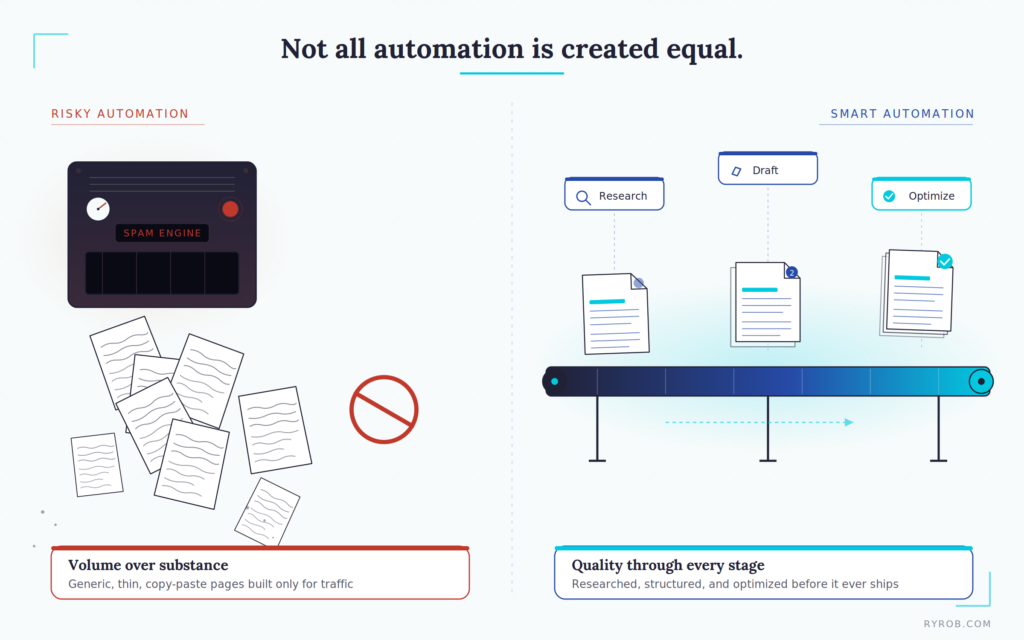
Bad blog automation is easy to spot. It’s the site using auto blogging platforms to push out bulk content like 100 AI posts a day with no editing, no topic plan, no internal links, no brand voice, and no quality control.
A risky blog automation setup doesn’t create efficiency. It creates a mess faster.
When I see people get burned by automation, it’s usually because they skipped the hard parts:
- They didn’t build a strong content engine first.
- They used AI like a magic button, then hoped traffic would show up.
That’s like building a house by speeding up the hammering, while ignoring the whole foundation.
Smart automation looks very different. I use AI automations to handle repeatable tasks that would otherwise eat up hours every week, including things like:
- Keyword research
- Content planning
- First drafts
- Repurposing videos into blog posts
- Formatting
- Internal linking logic
- Scheduling and promoting on social
Those are all useful jobs for automation because they save time without replacing the parts that still need human taste and experience.
Most importantly, healthy blog automation has oversight through manual review. I don’t hand the whole process to a machine and walk away. I use automation to create momentum, then I guide the result. That’s the difference between scaling output and scaling quality.
A strong automation setup also has a clear goal. Mine isn’t to publish the most pages possible. Mine is to publish better content more consistently, cover topic clusters faster, and make it easier for Google and AI tools like ChatGPT to understand what my sites are about.
That last part matters more than most people think. Search today isn’t only about ranking one post. It’s about teaching search engines and AI answer tools that your site is a trusted source on a topic. Random posts don’t do that. Systems do.
If you want a broader look at what’s working now, I’ve shared my picks for the best blog automation tools for SEO and AEO, because the tool matters less than the process it supports.
How I Use Blog Automation on My Own Sites
I don’t talk about this in theory. I use blog automation across almost all of my sites, and I use it because it’s helped me grow steadily over time.
1. Repurposing YouTube Videos into Blog Posts
One of my favorite uses for automation is turning videos from my YouTube channel into SEO-optimized blog posts that can drive even more traffic to my website.
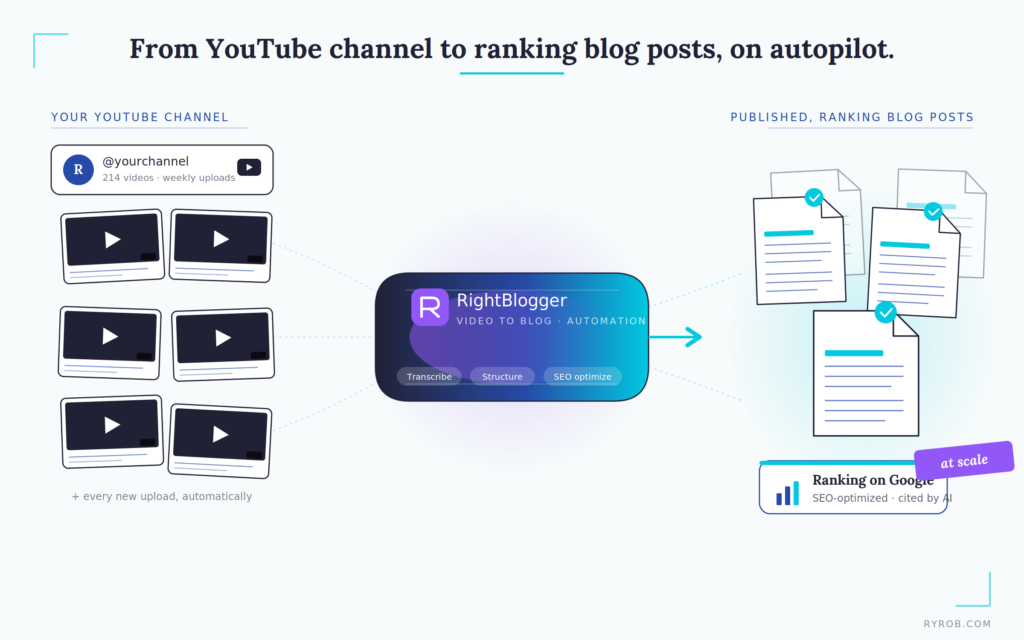
RightBlogger has an amazing tool for this, that I used to generate most of this blog post you’re reading right now.
If I’ve already recorded a useful YouTube video, I already have the raw material for a written article. So instead of leaving that value trapped in one format, I repurpose it into a text-based version designed for search and AI discovery.
That process saves time, but it also improves reach as part of my broader content marketing strategy. Some people want to watch. Others want to skim, search, copy, or reference key parts in writing. By publishing both formats, I serve both groups.
On RyRob, my automation scans my YouTube channel for new videos using the official API for seamless integration, pulls them in, turns them into blog drafts, and prepares them to publish. The resulting post has a strong headline, structured sections, clean formatting, helpful images, and the embedded video when it makes sense. Then I can review, adjust, and publish.
I’ve seen this automation work so well because it starts with something really useful. I’m not spinning empty content out of thin air. I’m taking ideas I’ve already explained, then shaping them into a form that fits written search better. That’s a huge difference.
The same thinking shows up in my broader AI blogging process for faster content. I use AI to move quicker, but I still fact-check, edit, add my own perspective, and make the article worth reading.
2. Consistent New Blog Posts from Keyword Research
I use the same automation system on my hiking blog, Hike With Ryan, where I publish daily content about U.S. national parks and topics related to my hiking adventures. This is a good example because the results have stacked up quickly.
I started automating content there around the first week of February. At first, nothing dramatic happened. Then, after a couple of weeks, organic traffic started to rise. Soon it was driving almost 10x the daily Google organic traffic I was used to seeing on that site. Social media automation can help distribute this content once published.
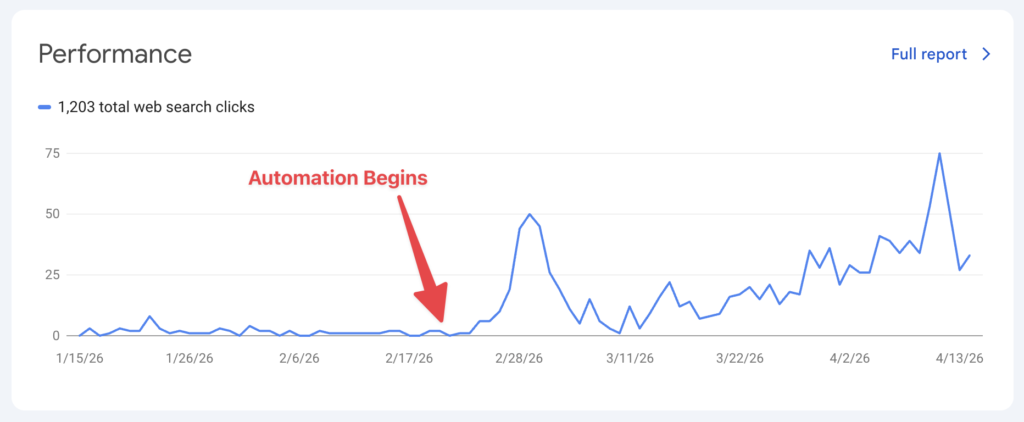
Why did that matter? Because the site wasn’t built on generic travel fluff. I’ve visited almost all of the national parks I write about. That means I can bring real experience to the content. Automation helps me publish with consistency, but experience gives the content weight.
That’s the part people miss when they ask whether blog automation is safe. Safety doesn’t come from avoiding tools. It comes from building a process that pairs scale with substance.
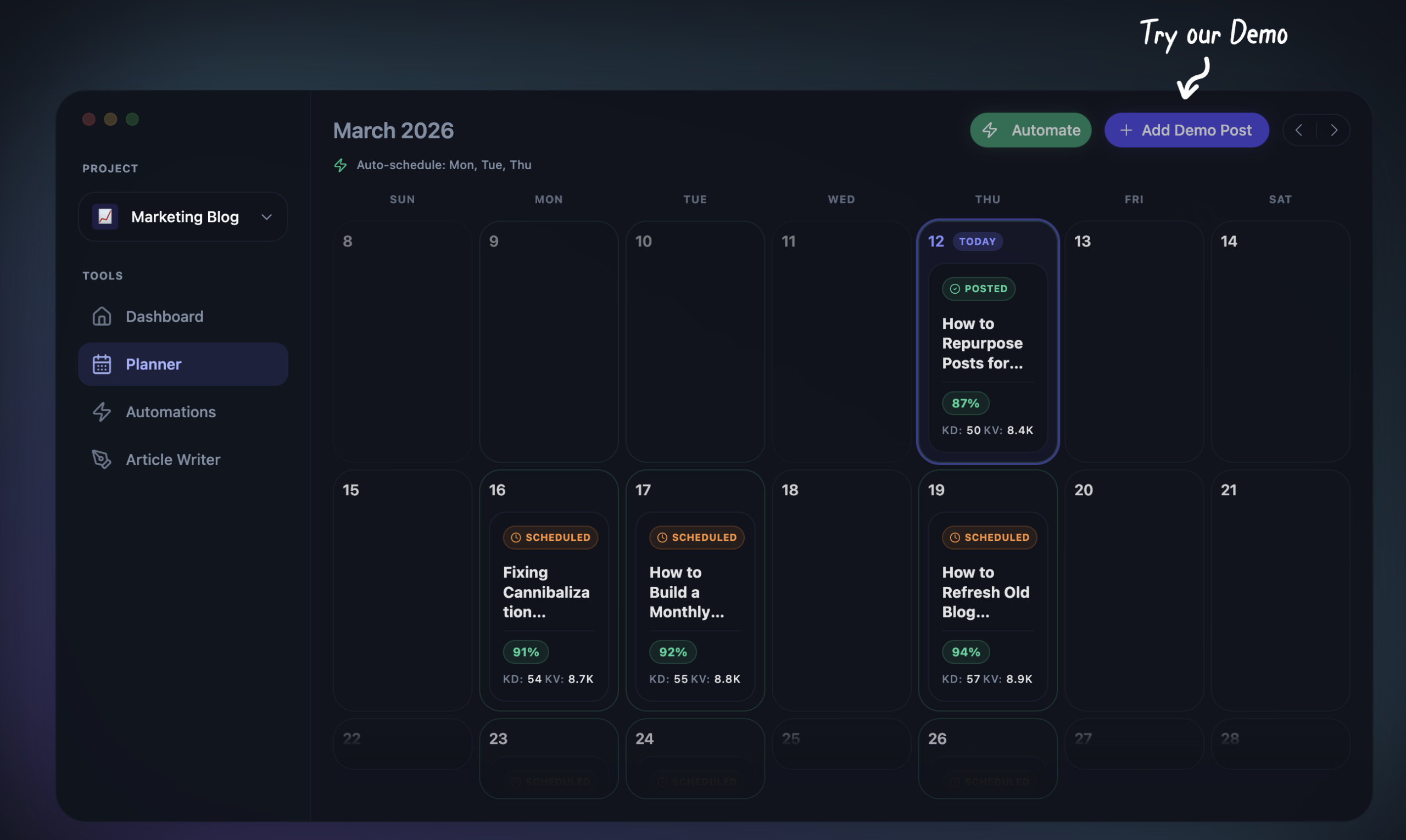
I use RightBlogger, which is the purpose-built system I created for full blog automation at quality & scale. It handles planning, drafting, optimization, internal linking, scheduling, publishing via a WordPress plugin, repurposing, and multi-site workflows.
More than 49,317 customers use it, and that has given me a lot of feedback about what works at scale—and what breaks down.
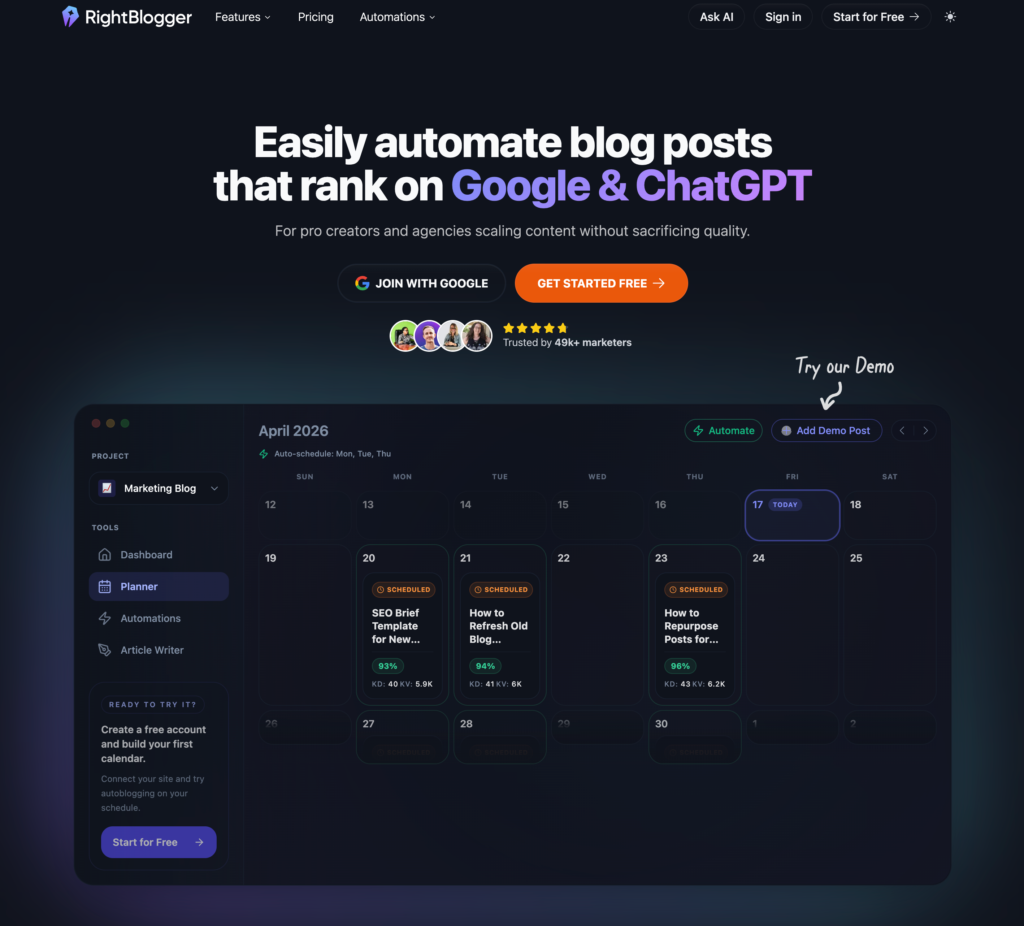
The big reason I built this system was simple. I wanted something that could automate the boring parts without turning my sites into content farms. I wanted a tool that could support quality, not replace it.
That said, you don’t need a dedicated platform to do this well. You can use ChatGPT, Claude, Gemini and other AI writing tools too. The trade-off is that it becomes more manual. You’ll spend more time prompting, guiding, organizing, and moving content between tools. That’s workable, especially at the start, but it’s not as efficient once you’re running multiple sites or publishing on a steady schedule.
If you’re comparing options, my guide to the best AI writing tools for bloggers and my walkthrough on using AI to boost SEO traffic will give you a better sense of the stack around this kind of workflow.
I also think it’s helpful to be honest about what tools can’t do…
- No tool understands your audience as well as you do.
- No tool knows which story from your own life will make a section click.
- No tool can fully replace editorial judgment.
- Content moderation remains your responsibility to ensure the AI output meets your standards.
That’s why I keep coming back to the same point: good automation supports the process, it doesn’t excuse you from owning the result.
Risky Blog Automation Mistakes to Avoid
This is where the real danger starts. Blog automation becomes risky when publishing speed outruns quality control, especially with bulk content or areas like automated link building where Google is particularly sensitive.
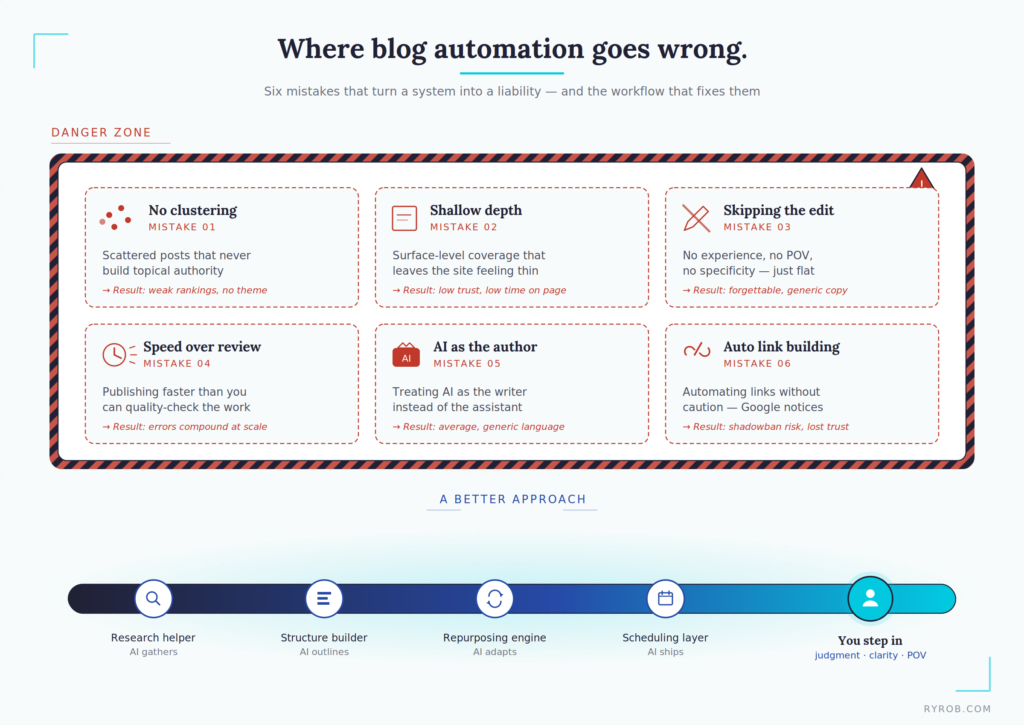
Here are some of the most common risky blog automation mistakes you can accidentally make:
- If you skip keyword clustering, you can end up with scattered posts that don’t build topical authority.
- If you don’t go deep enough on a topic, the site feels shallow.
- If you don’t edit for experience, point of view, and specificity, the post sounds flat.
- If you publish faster than you can review, mistakes pile up, and user-generated content slips through without proper content quality oversight.
Another common problem is treating AI like the author instead of the assistant, or automating link building without caution. That mindset leads to lazy publishing. It also leads to weak articles because the model fills gaps with average, generic language, and it can trigger a shadowban if Google flags it as spam.
A better approach is to use AI as a research helper, structure builder, repurposing engine, and scheduling layer. Then I step in with the parts AI can’t fake well: judgment, clarity, relevance, and lived experience.
This is also why I care so much about clusters instead of random posts. A system beats motivation every time. When my workflow helps me cover a full topic area, connect related articles, update older pieces, and keep the site consistent, I build topical authority faster and with less stress.
My 7-Step Framework for Safe Blog Automation
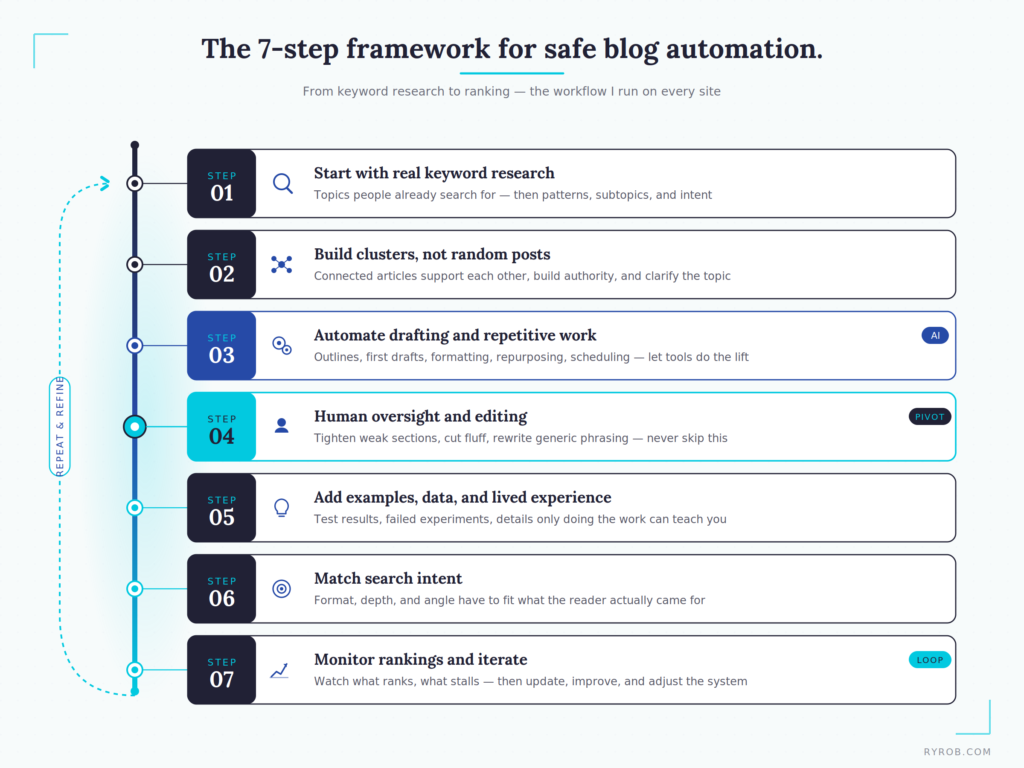
No matter which automation tool stack I use, this is the framework I always refer back to.
- Start with real keyword research: I don’t begin with a vague idea and hope it turns into traffic. I start with topics people are already searching for, then look for patterns, subtopics, and intent. That’s the only solid base for automation.
- Build clusters, not random posts: One good article can help, but a connected group of articles is much stronger. When I build around clusters, each post supports the next. That improves internal linking, topical depth, and clarity for search engines. Link building is more effective when the content is already high-quality.
- Automate the drafting and repetitive work: This is where automation shines. I let tools help with outlines, first drafts, formatting, repurposing, scheduling, and other repeatable tasks. That saves energy for the higher-value work later.
- Human oversight and editing: I always review the draft. I tighten weak sections, remove fluff, rewrite awkward phrasing, and correct anything that feels too generic. Publishing without this step is where most people get into trouble.
- Add examples, data, and lived experience: This is where the content becomes mine. I bring in what I’ve tested, seen, built, or learned. That could be results from one of my sites, a lesson from a failed experiment, or a detail that only comes from doing the work.
- Match search intent: If someone wants a practical answer and I give them a vague essay, I lose. So I make sure the format, depth, and angle fit what the reader is looking for. This matters as much as the topic itself.
- Monitor rankings and iterate: No automation tool is perfect out of the gate. I watch what ranks, what stalls, and what starts pulling traffic through manual review. Then I update, improve, and adjust the system. That’s how it gets better over time.
Here’s a snazzy graphic illustrating this blog automation framework, for my more visually inclined friends:
If you want a full walkthrough of this process, my guide to blogging with AI shows how I put the pieces together in practice.
FAQs About Blog Automation and Google
Here are some of the most common questions I get about whether blog automation is safe & how to stay in the good graces of search engines like Google (and AI platforms like ChatGPT, Perplexity, Gemini, and Claude).
Does Google Penalize AI-Generated Blog Content? Is Blog Automation Safe?
Not for being AI-generated. Google cares about whether the page is helpful, original enough, and worth surfacing in search. If the content is thin or spammy, that’s the problem.
Is Publishing Daily With Automation Safe?
It can be, if quality stays high. Daily publishing isn’t dangerous by itself. What’s dangerous is pushing content live faster than you can research, edit, and maintain it.
Is Publishing Daily With Automation Safe?
It can be, if quality stays high. Daily publishing isn’t dangerous by itself. What’s dangerous is pushing content live faster than you can research, edit, and maintain it.
Can I Use ChatGPT Instead of a Dedicated Automation Tool?
Yes, you can. I think it’s a solid option, especially when you’re starting out. The main downside is that it takes more manual back-and-forth, so it becomes harder to manage at scale.
What Makes Automated Content Feel Spammy?
Usually it’s generic language, weak structure, no firsthand experience, poor topic targeting, duplicate content, and no clear differentiation. Readers can feel that quickly, and search systems often can too.
How Long Does It Take to See Results From Blog Automation?
That depends on the site, the niche, and the quality of the system. On my hiking blog, I started seeing movement in search engine rankings within a couple of weeks. Still, consistency matters more than instant results.
Safe Blog Automation Needs a System (Not a Shortcut)
If you’re still wondering, is blog automation safe, my answer is simple: it’s safe when the system behind it is built for quality.
The sites that get into trouble usually aren’t using too much automation. They’re using bad automation. They’re scaling shortcuts. Meanwhile, the sites pulling ahead are building systems that help them publish useful content with consistency.
The best automated blogging tools empower users rather than replacing them entirely. If you want to go deeper, you can explore my guides on the best blog automation tools for SEO and AEO.
The edge today isn’t one lucky post. It’s a system that keeps getting better.
Disclaimer: This story is auto-aggregated by a computer program and has not been created or edited by budgetbuddy.
Publisher: Source link
Publisher: Source link